 Bellingham Exterior
 Why "It Depends" Is the Honest Answer
Every homeowner in Whatcom County asking about siding replacement costs wants a number, and every honest contractor's first answer is "it depends." That's not a dodge — it's the truth. Two houses of the same square footage on the same Bellingham street can land tens of thousands of dollars apart once you account for wall condition, product choice, trim complexity, and access. This page won't hand you a fake per-square-foot figure and pretend it applies to your house. Instead, it walks through the actual variables that move the number, so when you get quotes, you know what you're looking at and why they differ.
Siding replacement is one of the largest single investments most homeowners make in their house's exterior, and it's also one of the easiest projects to underprice on paper and overpay for in the long run. Understanding the cost drivers up front protects you from both a lowball bid that skips prep work and a bloated bid padded with things you don't need.
The Big Cost Drivers, One at a Time
1. What's Under the Old Siding
Nobody knows the true condition of your sheathing, framing, and weather barrier until the old siding comes off. Bellingham's climate — salt-laden air off the bay, driving rain that hits west and south walls hardest, and a moss season that runs most of the wet half of the year — is unforgiving of any gap in a home's water management. Houses that were under-flashed at windows or never had proper rainscreen ventilation often show rot at the sill lines, corners, and anywhere trim meets the wall. If a crew finds soft sheathing or damaged framing, that repair gets added to the job. This is the single biggest source of "why did my quote change" conversations, and it's also the reason a contractor who won't commit to a firm number before tear-off isn't being cagey — they're being accurate.
2. Material Choice
Siding material is the most visible cost lever, and homeowners are usually comparing vinyl, engineered wood (LP SmartSide), fiber cement (Hardie, Cemplank, Allura), and in some remodels, primed spruce or cedar. Material cost per square foot varies, but material is rarely the whole story — installation labor, fastening requirements, and finish work differ by product too, and those differences show up in the final bid as much as the raw board cost does.
3. Square Footage and Wall Complexity
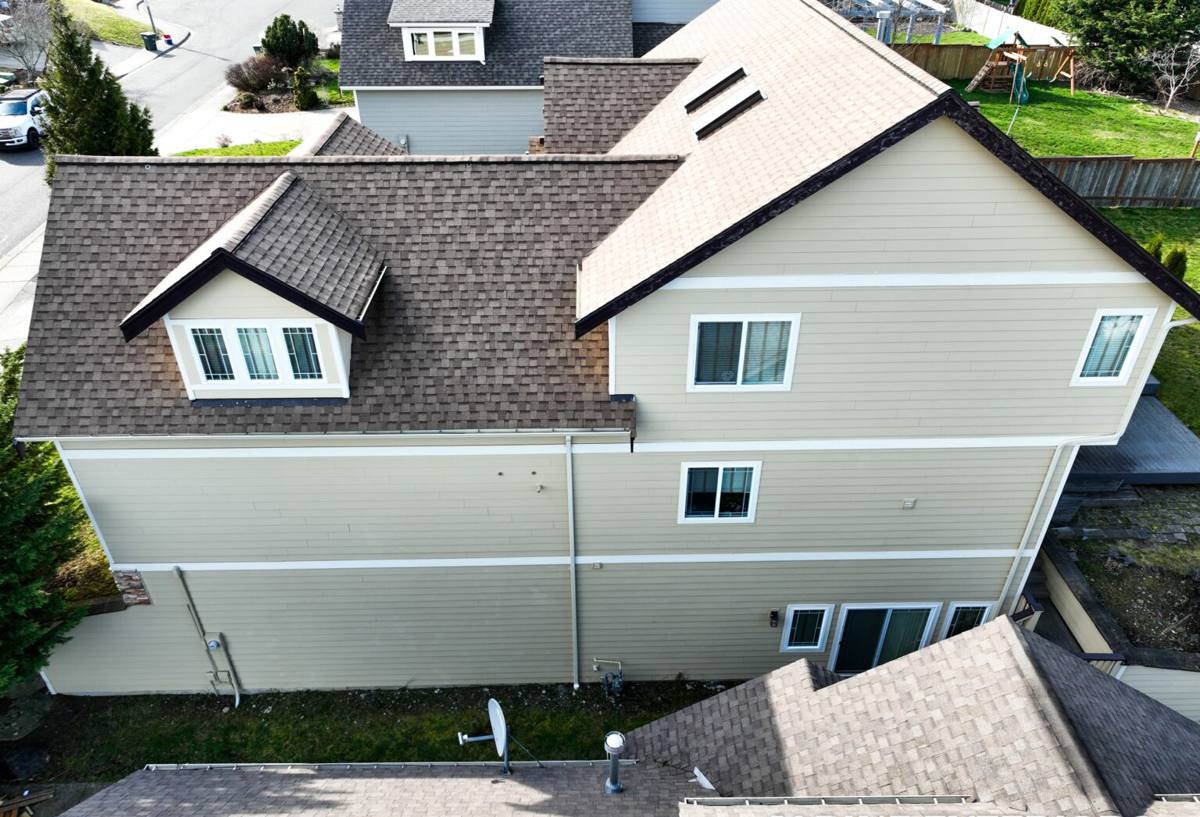
A simple rectangular ranch with few corners costs less per square foot to side than a house with dormers, bump-outs, multiple roof pitches meeting walls, and a lot of trim detail. Complexity multiplies both material waste (more cuts, more scrap) and labor hours (more precise flashing and fitting at every transition).
4. Access and Site Conditions
A single-story house with a flat, open yard is faster and cheaper to side than a three-story home wedged on a sloped Bellingham hillside lot with limited staging space. Scaffolding, lift rental, and protecting landscaping all add to labor time.
5. Tear-Off vs. Overclad
In rare cases, new siding can be installed over sound existing siding with proper furring. In most re-sides, especially anything driven by moisture damage, full tear-off to the sheathing is the right call — it's the only way to actually inspect and fix what's underneath, and it's usually non-negotiable when switching material types.
6. Paint, Trim, and Accessory Work
Full re-sides are the natural time to replace trim boards, fascia, and sometimes windows or doors while the wall is open. Skipping this to save money now often means paying to open the wall again later.
Comparing the Main Siding Options Homeowners Consider
This table is a general orientation, not a quote. Every line item below has real trade-offs worth understanding before you decide — several are covered in depth on our other pages.
| Material | Typical Upfront Cost | Maintenance Burden | How It Handles PNW Moisture |
|---|---|---|---|
| Vinyl | Lowest | Low, but fades and can crack in cold snaps | Doesn't rot itself, but traps moisture behind it if house wrap and flashing aren't perfect |
| LP SmartSide (engineered wood) | Low-mid | Moderate — edges and cut ends need diligent sealing | Wood-based core is moisture-sensitive at any breach in the finish |
| Primed spruce / cedar | Mid, often more with quality clear cedar | High — repainting cycle, checking, and moisture vigilance | Natural wood movement and moisture uptake are constant maintenance items in wet climates |
| Fiber cement (Cemplank, Allura, generic) | Mid | Low-moderate, finish quality varies by brand and paint system | Non-combustible, dimensionally stable, but field-applied finishes vary in how they hold up |
| James Hardie fiber cement (ColorPlus) | Mid-high | Low — factory-baked finish, engineered for the region | HZ5 product line is climate-engineered for Pacific Northwest moisture, plus a strong transferable warranty |
We install James Hardie exclusively, and this table is part of why. It's not that the other products are junk — vinyl and engineered wood have legitimate roles at different price points. It's that once you factor in maintenance over a 20-30 year horizon in a climate like Bellingham's, the math and the risk profile change, and we'd rather stand behind one system we trust completely than install several we have reservations about.
Why We Standardized on James Hardie
After years of re-siding homes across Whatcom County, we stopped installing vinyl, LP SmartSide, primed spruce, and cedar — not because every job with those products fails, but because the failure modes we kept seeing traced back to moisture intrusion at seams, cut ends, and behind panels that looked fine from the curb. Fiber cement solves the core problem: it doesn't rot, it's non-combustible, and it doesn't feed mold the way wood-based products can when water gets behind them.
Within fiber cement, we chose James Hardie specifically for three reasons: the ColorPlus factory finish (baked-on, not field-applied, which removes a major point of failure), the HZ5 product line engineered for high-moisture climates like ours, and a transferable warranty structure that holds up when a house changes hands. We're not paid to say this — it's the reason our crews only carry one brand of siding on the truck.
Labor: The Part of the Bid That Isn't About Materials
Roughly half or more of a quality siding job's cost is labor, not material. That covers tear-off and disposal, house wrap and rainscreen installation, flashing at every window, door, and penetration, precise fastening to manufacturer spec (which for Hardie means specific nailing patterns and clearances), and finish caulking and trim work. A cheap bid usually cuts corners here first — skipping rainscreen furring, reusing old flashing, or rushing fastener placement — because labor shortcuts are much harder for a homeowner to spot than material downgrades.
What Drives Cost Up (and What Doesn't Have To)
- Hidden rot repair — the biggest wildcard; a pre-project moisture inspection reduces the surprise factor
- Multiple stories and steep or hillside lots — common around Bellingham's terrain, adds equipment and labor time
- Extensive trim, corner boards, and architectural detail — more cuts, more precision, more hours
- Window and door replacement bundled into the same project — efficient timing, but adds its own line items
- Color and finish choice — factory ColorPlus finishes cost more upfront than field-painted options but remove a recurring repaint expense
- Full tear-off vs. overclad — tear-off costs more short-term but is almost always the right call when moisture is a concern
- Rushed timelines or off-season scheduling — rarely a major cost factor, but can affect scheduling flexibility more than price
The Bellingham Climate Factor
Whatcom County's exterior surfaces deal with a specific combination: salt air drifting off Bellingham Bay that accelerates corrosion on unprotected fasteners and hardware, driving rain that hammers exposed wall faces for months at a stretch, and a moss season that keeps north-facing and shaded walls damp far longer than they'd stay damp in a drier climate. None of this makes siding replacement more expensive by itself, but it does raise the cost of doing the job wrong. Skipped rainscreen gaps, under-flashed penetrations, or a finish that wasn't built for sustained moisture exposure all show their weaknesses here faster than they would in a drier region. Budgeting for correct water management details — not just the siding panels themselves — is a Bellingham-specific line item worth protecting, not cutting.
How to Read a Siding Quote
When you get bids, look past the bottom-line number and check what's actually included:
- Is tear-off and disposal of the old siding included, or billed separately?
- Does the quote specify house wrap and rainscreen/furring, or just "siding installation"?
- Is flashing at windows, doors, and penetrations called out, or assumed?
- What happens if rot is found once the walls are open — is there a per-square-foot repair rate agreed in advance?
- Is the finish factory-applied (like ColorPlus) or field-painted, and what does that mean for future maintenance?
- What's the warranty, and is it transferable if you sell the house?
A bid that's missing answers to most of these questions isn't necessarily dishonest, but it is incomplete, and incomplete bids are where cost surprises come from later.
Getting a Number for Your House
The only way to get a real number is a walk-through of your specific house — its square footage, wall complexity, current siding condition, and access. If you'd like an honest look at what your project would actually involve, including any moisture concerns visible from the outside, we offer a free, no-pressure estimate. There's no obligation, and you'll leave the conversation with a clearer picture of what drives your specific cost, not just a generic average.