 Bellingham Exterior
 Bellingham Siding Has to Work Harder Than Siding Almost Anywhere Else
Whatcom County sits in an unusual overlap: salt air rolling off Bellingham Bay and the Salish Sea, well over 100 days of measurable rain most years, and a maritime climate mild enough that moss, algae, and mildew never really go dormant. That combination is rough on a building envelope. Salt air accelerates corrosion of fasteners and finishes. Driving rain off the water finds every gap in flashing and caulk. And the shade, moisture, and mild winters that make this region beautiful also make it one of the better environments in the country for moss and algae to colonize a north-facing wall.
Most siding products are engineered for a national average climate, not this one. That's the practical reason we standardized on James Hardie fiber cement siding as the only product we install. This page explains what that decision is based on — not marketing claims, but material behavior, installation requirements, and what we've found actually holds up here.
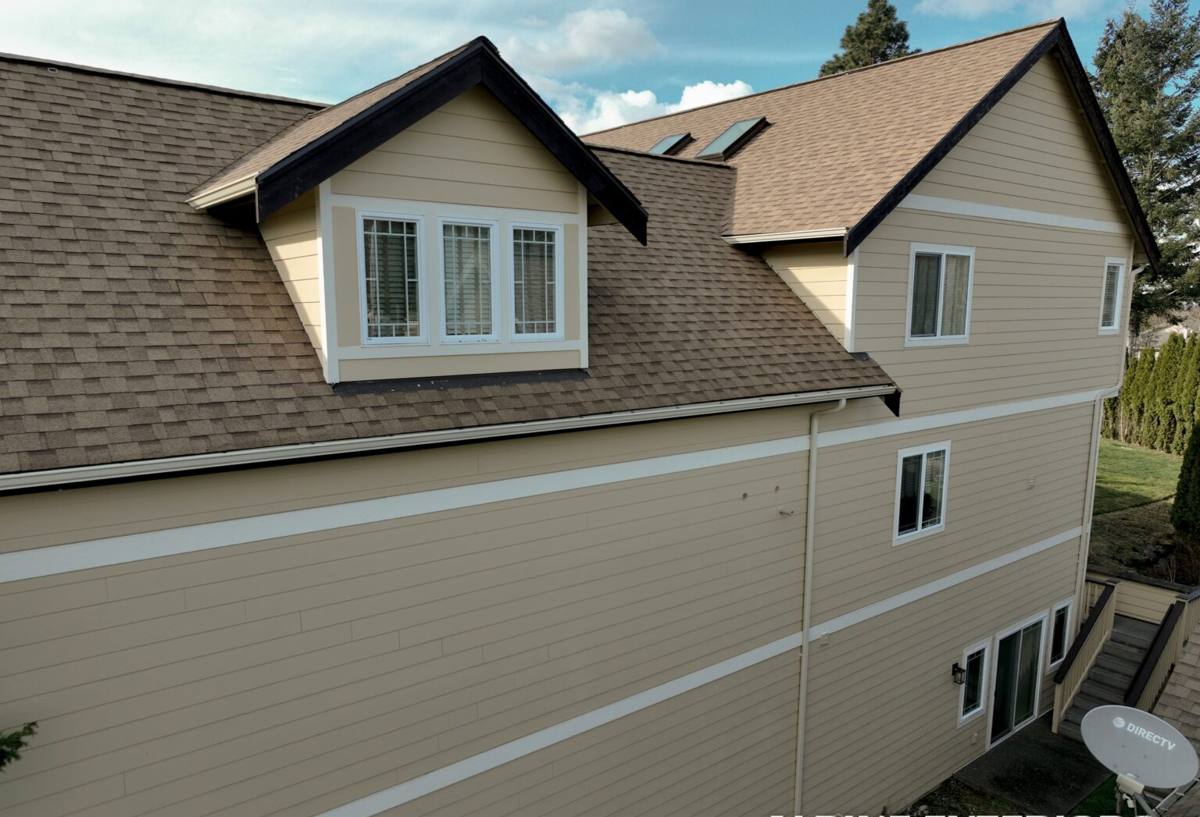
What James Hardie Fiber Cement Actually Is
James Hardie siding is fiber cement: a mix of Portland cement, sand, and cellulose fiber, cured under pressure and heat. It is not plastic (like vinyl), not wood-based composite (like LP SmartSide or primed spruce), and not a generic fiber cement blend (like Cemplank or Allura). The distinction matters because fiber cement as a category behaves very differently depending on the manufacturer's formulation, and Hardie's specific mix and manufacturing process is what we're standing behind — not "fiber cement" as a generic term.
Why the Material Matters in This Climate
Because it's cement-based rather than wood-based or plastic-based, it doesn't absorb water the way an OSB or wood-fiber product can, it doesn't expand and contract with temperature swings the way vinyl does, and it's non-combustible. In a region where siding spends half the year damp, the fact that the substrate itself isn't feeding on moisture is the single biggest factor in long-term performance.
HZ5 Engineering: Built for This Specific Climate
James Hardie doesn't sell one universal product. Its HardieZone system engineers different formulations for different climate zones — HZ10 for hot, humid regions and HZ5 for climates that see freeze-thaw cycles, sustained damp conditions, and moisture exposure like the Pacific Northwest. Bellingham falls squarely in HZ5 territory. The HZ5 formulation is designed around resistance to moisture-related deterioration and is backed by a warranty specific to that engineering.
This is a real, documented product distinction, not just packaging. It's part of why we don't treat "fiber cement" as an interchangeable category — a fiber cement board engineered for a dry climate doesn't perform the same way here as one engineered for ours.
ColorPlus Technology: Why We Care About the Finish, Not Just the Board
The board itself is only half the equation. How the color is applied matters just as much in a climate that gets this much sun exposure, rain, and salt air. James Hardie's ColorPlus finish is baked on at the factory in multiple coats under controlled conditions, rather than field-applied with a brush or sprayer on site. That gives a more consistent, UV- and moisture-resistant finish than standard field-applied paint, and it's backed by its own separate finish warranty.
Field-painted siding — whether it's primed spruce, cedar, or a job-site-painted fiber cement product — depends heavily on weather conditions during application and the skill of whoever's holding the sprayer that day. In a climate where you often don't get more than a few consecutive dry days, that's a real installation risk we'd rather not build a home around.
Why We Don't Install the Alternatives
We get asked regularly why we won't quote vinyl, LP SmartSide, cedar, primed spruce, or other fiber cement brands like Cemplank or Allura. Each of these is a legitimate, widely used product elsewhere, and each has honest strengths. Our decision isn't that they're bad products — it's that after years of installing and repairing siding in this specific climate, we found the trade-offs weren't ones we wanted to keep explaining to homeowners after the fact.
Vinyl Siding
Vinyl is inexpensive and low-maintenance in dry climates, but it's a petroleum-based plastic that expands and contracts significantly with temperature swings, can warp or buckle over time, and is not rated for the kind of direct-flame exposure protection that non-combustible materials offer. In driving coastal rain, vinyl's lap-and-gap installation style also relies heavily on perfect execution to keep water from working behind the panels.
LP SmartSide
LP SmartSide is an engineered wood/OSB-based product with a resin-saturated strand outer layer. It performs well in many climates and is more affordable than fiber cement. But it is still a wood-fiber substrate at its core, and wood-fiber products are more sensitive to sustained moisture exposure — cut edges, fastener penetrations, and any breach in the factory coating are places moisture can get a foothold. In a region where siding rarely gets a long stretch to fully dry out, that sensitivity concerned us enough to move away from it.
Cedar and Primed Spruce
Natural wood siding is beautiful, and Bellingham has plenty of it on older homes. But it requires ongoing maintenance — refinishing, caulking, and monitoring for rot — that most homeowners underestimate when they choose it. In a moss-prone, high-humidity climate, wood siding also needs more frequent cleaning and inspection to keep organic growth from taking hold in board seams.
Cemplank and Allura
These are other fiber cement manufacturers, and fiber cement as a category is sound. Our reason for standardizing on Hardie specifically rather than these alternatives comes down to the HZ5 climate-specific engineering, the ColorPlus factory finish system, and the manufacturer's warranty structure and installer network — not a claim that competing fiber cement boards are defective.
Comparing the Options
| Material | Substrate | Moisture Behavior | Finish | Typical Maintenance |
|---|---|---|---|---|
| James Hardie (HZ5) | Fiber cement | Does not absorb/swell like wood-based products | Factory ColorPlus or field paint | Occasional wash; repaint only if using primed option |
| Vinyl | PVC plastic | Doesn't rot, but can warp/buckle with heat | Integral color, fades over time | Periodic cleaning; panels can crack in impacts |
| LP SmartSide | Engineered wood/OSB | Sensitive at cut edges and fastener points | Factory-applied coating | Inspect edges/seams; recaulk over time |
| Cedar / Primed Spruce | Solid or engineered wood | Absorbs moisture; prone to rot if not maintained | Field-applied paint or stain | Refinish every few years; watch for moss/rot |
| Other fiber cement (Cemplank, Allura) | Fiber cement | Generally sound, formulation varies by maker | Varies — factory or field | Similar to Hardie, depends on formulation |
The Product Lines We Install
James Hardie makes several distinct product lines, and matching the right one to the home matters as much as the brand decision itself.
- HardiePlank lap siding — the most common choice, available in several textures and exposures, mimics traditional lap siding profiles seen throughout Bellingham neighborhoods.
- HardiePanel vertical siding — used for board-and-batten looks or as an accent alongside lap siding.
- HardieShingle siding — a shingle profile for homes going for a coastal or craftsman look without real wood shingle maintenance.
- HardieTrim boards — matching trim so window surrounds, corners, and fascia hold up to the same conditions as the field siding instead of becoming the weak point.
Color selection through the ColorPlus palette runs from traditional whites and grays to deeper tones that read well against the Pacific Northwest's evergreen backdrop, and primed boards are available for homeowners who want a custom field-painted color instead.
Warranty: What It Actually Covers
James Hardie backs its siding with a transferable limited warranty on the substrate — typically 30 years on the fiber cement product itself — plus a separate finish warranty on ColorPlus factory-applied color, which covers different failure modes (like finish peeling or fading) than a substrate warranty does. The two-part structure matters because it recognizes that the board and the finish can fail independently, and it holds the manufacturer accountable for both. Transferability also matters for resale — a documented, manufacturer-backed warranty that survives a change in ownership is worth more to a future buyer than a verbal assurance about a wood repaint job.
Warranty coverage is also conditioned on installation following Hardie's published specifications, which is why the installer matters as much as the product.
What Correct Installation Actually Involves
Fiber cement siding is only as good as the installation behind it. A Hardie board installed with the wrong fastener pattern, insufficient clearance, or poor flashing will fail the same way any other siding would — the material isn't magic. Correct installation in a climate like ours means:
- Proper water-resistive barrier and rainscreen or drainage plane behind the siding, not siding fastened directly to sheathing
- Correct fastener type, spacing, and penetration depth per Hardie's installation specifications
- Adequate clearance between siding and grade, roofing, decks, and other transitions where water collects
- Properly lapped and sealed flashing at every window, door, and penetration
- Factory-cut edges used wherever possible, with field cuts sealed per manufacturer guidance
- Correct joint treatment and caulking at butt joints and trim intersections
This is also where James Hardie's installer network matters — working with a contractor familiar with the specification, rather than a crew installing it the way they'd install any other lap siding, is what keeps the warranty valid and the wall assembly dry.
What This Means for Your Home
None of this is about a brand name for its own sake. It's about a specific set of decisions — cement-based substrate, HZ5 climate engineering, factory-applied finish, and a warranty structure that holds up over decades — that we've found actually perform in Bellingham's salt air, rain, and moss. That's why it's the only siding system we put our name behind.
If you're planning a siding replacement or want a second opinion on a bid you've already received, we're happy to walk your home, look at what's there now, and put together a free, no-pressure estimate.