 Bellingham Exterior
 Homeowners ask us fairly often why we don't have vinyl siding on our list of options. It's a fair question — vinyl is the most common siding material sold in the country, it's inexpensive, and plenty of it is hanging on homes all over Whatcom County right now. We're not going to tell you vinyl is junk, because that's not true. We're going to explain, honestly, why after years of doing siding and exterior work in Bellingham's climate, we made the call to install only James Hardie fiber cement and nothing else.
What Vinyl Siding Gets Right
Vinyl earned its market share honestly. It's affordable, it goes up fast, it never needs painting, and for a lot of climates and budgets it's a reasonable choice. Manufacturing has improved over the decades — better locking systems, thicker panel gauges in the premium lines, and more color options than the beige-and-almond era most people remember. If cost is the only factor on the table, vinyl will win that comparison every time.
The trade-offs show up over time, and they show up faster in a marine climate like ours than they do in a dry inland one. That's the part we want homeowners to understand before they sign a contract, not after.
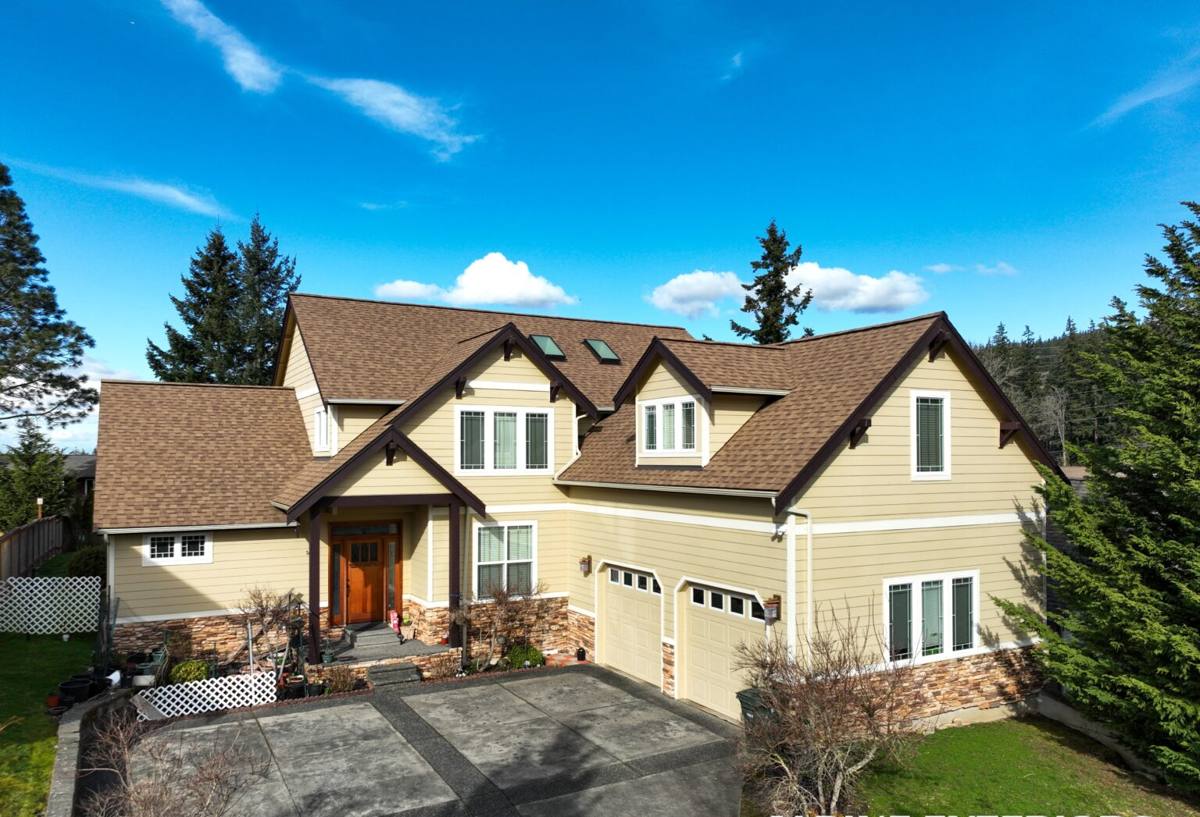
Why We Don't Install It Here
It's a Cladding, Not a Water Barrier — and Bellingham Gets a Lot of Water
Vinyl siding is designed as a rain screen, not a sealed envelope. Panels overlap and hang loosely on a nailing hem specifically so they can expand and contract with temperature. That works fine in moderate weather, but it also means wind-driven rain can get behind the panels during Whatcom County's fall and winter storm systems, when rain regularly comes in sideways off the Sound. Everything then depends on the house wrap and flashing behind the vinyl doing all the real waterproofing work. If that layer is imperfect — and after decades of exterior work, we can tell you it usually is somewhere — moisture gets trapped behind panels that don't breathe or dry the way a properly installed fiber cement system does.
Moss, Mildew, and a Long Wet Season
Bellingham doesn't get a short rainy season, it gets a long one, and the shaded, north-facing walls common on wooded Whatcom County lots stay damp for months at a stretch. Vinyl's plastic surface doesn't feed mold and moss any more than other siding does, but its seams, laps, and the slightly uneven surface texture give organic growth plenty of places to take hold, and the panels themselves can't be pressure washed aggressively without risking damage to the locking strips. Once moss and mildew establish themselves on a north wall, they're a maintenance problem for the life of the siding.
Heat Distortion and Cold Brittleness
Vinyl is a temperature-sensitive material. Dark colors absorb heat and can warp or buckle on sun-exposed walls, especially near reflective surfaces like windows or dark-painted trim. At the other end, our winter cold snaps make vinyl brittle — panels that flex fine in September can crack on impact in January. Neither extreme is common here, but both happen every year, and vinyl has no real margin for either one.
Wind and Impact Performance
Whatcom County sees genuine windstorms off the Strait and the Sound, plus the occasional wind-driven debris from fir and cedar trees that dominate a lot of local lots. Standard vinyl panels are rated for wind but they're also thin — even the heavier gauges are a fraction of the thickness of fiber cement — and a branch strike, a ladder bump, or a piece of storm debris can crack or puncture a panel in a way that's very hard to color-match when you replace just one section years later, since vinyl color availability shifts and fades.
Salt Air Exposure
Vinyl doesn't rust, but it does chalk and fade under UV exposure, and homes closer to Bellingham Bay and the water see that fading accelerate. The fasteners behind the panels, along with any exposed trim hardware, are more exposed to salt-laden air than most homeowners expect, and once fading sets in unevenly across a wall's sun and shade lines, there's no repainting your way out of it — vinyl isn't meant to be painted, and doing so voids most manufacturer warranties.
Thin Warranty Coverage That Follows the Panel, Not the House
Vinyl warranties read well until you look closely. Most are prorated after the first several years, meaning the payout for a failed panel shrinks steadily over time and rarely covers labor for tear-off and reinstall. Color and fade warranties are typically separate, shorter, and full of exclusions for anything within a certain distance of salt water — which describes a meaningful share of Whatcom County.
Vinyl vs. James Hardie: A Straight Comparison
| Factor | Standard Vinyl Siding | James Hardie Fiber Cement |
|---|---|---|
| Material | PVC plastic panel | Cement, sand, and cellulose fiber |
| Combustibility | Melts/burns, contributes fuel in a fire | Non-combustible |
| Wind-driven rain behind panel | Common failure point; relies entirely on house wrap | Still requires good flashing, but panel itself resists moisture damage |
| Impact resistance | Thin, cracks/punctures under impact | Rigid, resists dents and impact damage |
| Heat/cold behavior | Warps in heat, brittle in cold | Dimensionally stable across our temperature range |
| Finish | Color molded through plastic; not paintable without voiding warranty | Factory-baked ColorPlus finish, repaintable if ever needed |
| Typical warranty | Prorated after early years, excludes labor | Long, non-prorated coverage on the product |
| Upfront cost | Lowest | Higher, but lower lifetime maintenance cost |
Why We Standardized on James Hardie
We didn't arrive at "Hardie only" as a marketing position — it's a maintenance and callback position. Fiber cement is dimensionally stable, so it doesn't warp in a July heat wave or go brittle in a January freeze. It's non-combustible, which matters more every year as wildfire smoke seasons stretch further west and homeowners think harder about fire-conscious building materials even outside the highest-risk zones. Hardie's HZ5 product line is engineered specifically for climates with the kind of moisture exposure and freeze-thaw cycling we get here, not a generic national product stretched to cover every region.
The ColorPlus factory finish is baked on and backed by its own finish warranty, so it holds color and resists the chalking and fading we see accelerate on vinyl near the water. And because it's a rigid, mineral-based panel, it holds paint if a homeowner ever wants to change color decades down the line — something you simply can't do with vinyl. Combined with Hardie's transferable warranty structure, it's a product we can install once and stand behind, rather than one we know we'll be back to patch or replace piecemeal.
What Correct Installation Looks Like Here
Material choice only solves half the problem — installation is the other half, and it matters just as much in a climate like ours. A few things we hold to on every fiber cement job in Whatcom County:
- Proper rain screen gap and drainage plane behind the siding, not just a house wrap stapled flat
- Correct flashing at every window, door, and roof intersection, since that's where wind-driven rain actually gets in
- Manufacturer-specified fastener spacing and type — under- or over-driven nails are one of the most common fiber cement failure points we see on other contractors' work
- Proper clearance between siding and grade, decks, and roof lines to avoid wicking moisture and moss buildup
- Factory-primed or ColorPlus-finished cut edges sealed per spec, not left raw
Questions Worth Asking Before You Choose a Siding Material
Whether you go with us or another contractor, these are worth asking before you commit:
- Is the warranty prorated, and does it cover labor or just material?
- What happens to the color/fade warranty if the home is within a certain distance of salt water?
- Can the material be repainted later if I want to change the color?
- Is the product rated for our specific wind and moisture exposure, or a national average?
- What's the manufacturer's fastening and flashing spec, and will the crew actually follow it?
Our Bottom Line
Vinyl siding isn't a scam and it isn't automatically the wrong choice everywhere. But we've spent enough time replacing failed siding jobs — including vinyl — on Bellingham and Whatcom County homes to know which material holds up to salt air, driving rain, and months of shaded, damp walls without turning into a maintenance project. That's James Hardie fiber cement, installed correctly, and it's the only siding system we put our name behind.
If you're weighing siding options for a home in Bellingham or elsewhere in Whatcom County, we're happy to walk your property, look at your sun and weather exposure, and give you a straight, no-pressure estimate for a Hardie install — no upsell, no pressure, just what we'd actually recommend for your house.