 Bellingham Exterior
 Why This Decision Is Harder Here Than It Looks
Every siding contractor gets some version of the same question: is this a patch job or does the whole wall need to come off? In a lot of the country, that's a simple call based on square footage of visible damage. In Bellingham, it's not that simple, because our climate hides problems that a dry-climate inspector would never think to look for.
Salt-laden air off Bellingham Bay, driving rain that comes in sideways during a Pacific storm, and a moss season that can run eight or nine months a year all work on siding differently than heat and dryness do. A wall that looks fine from the driveway can be quietly failing behind the surface. That's the real reason "repair or replace" deserves more thought here than a quick visual estimate can give it.
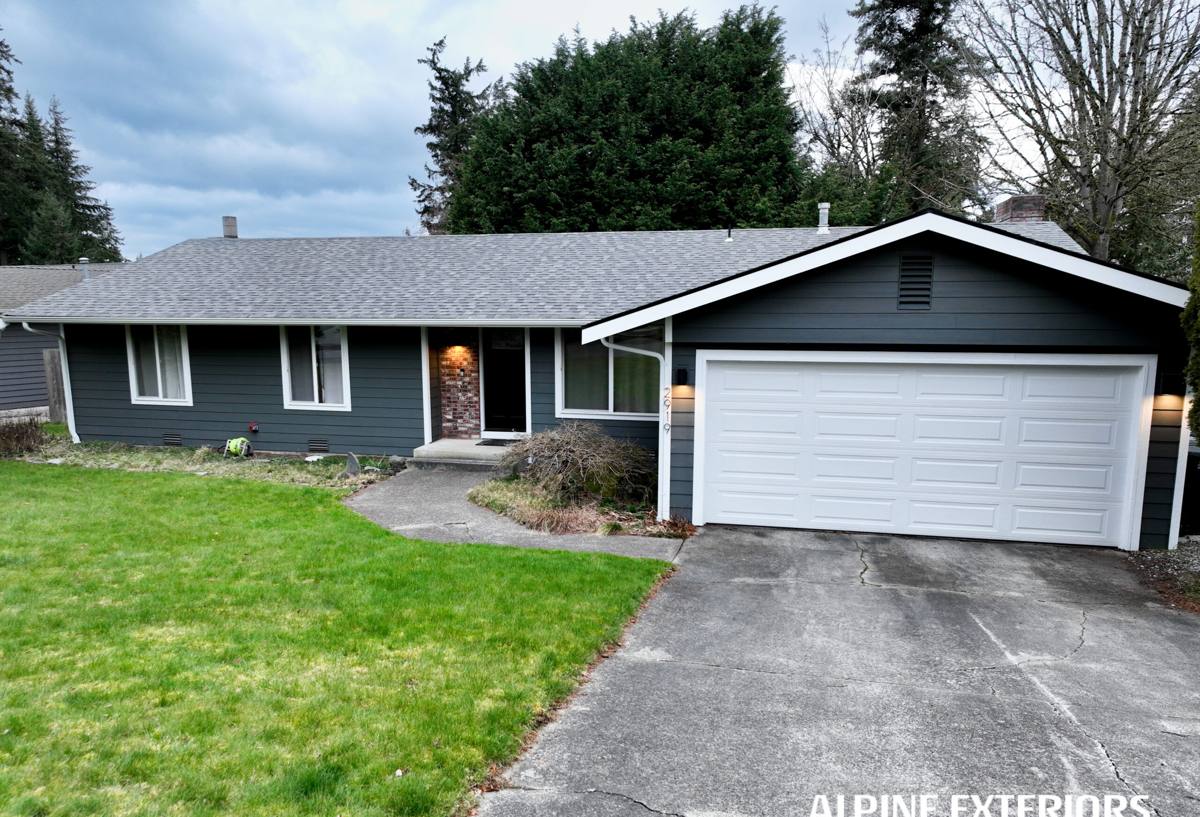
When Repair Is the Honest Answer
Not every siding problem justifies a full re-side, and a contractor who tells you otherwise on every single call isn't being straight with you. Repair usually makes sense when the damage is localized, recent, and the material underneath and around it is still sound.
- A single cracked or split board from an impact (a ladder, a falling branch, a stray baseball)
- Isolated woodpecker or pest damage caught early, with no rot spreading into the sheathing
- A few panels damaged by a specific event, like wind-driven debris, while the rest of the wall is dry and intact
- Caulking and trim failures around windows or corners where the siding field itself is still good
- Color or finish issues on a small area that don't reflect a systemic coating failure across the whole elevation
If a moisture check on the surrounding boards comes back dry and the sheathing behind the damaged section is solid, patching that section is the responsible, cost-effective move. There's no reason to tear off a whole wall to fix one bad board.
When Replacement Is the Honest Answer
The harder conversation is when a homeowner wants a "quick fix" for a problem that's actually systemic. Some signs that repair is just delaying an inevitable, more expensive job:
- Soft, spongy, or crumbling siding in multiple, unrelated locations on the same wall
- Paint or finish failure across an entire elevation, not just one weathered corner
- Visible buckling, warping, or separation at seams over a wide area
- Moisture readings that come back elevated even in spots with no visible damage
- Rot found at the bottom courses along more than one wall, which usually points to a drainage or flashing problem, not a one-time event
- Siding that's original to a home built more than 25-30 years ago and was never a climate-rated product to begin with
When damage shows up in more than one place with no shared cause, that's usually the material or the original installation failing generally, not a series of unrelated accidents. Patching a system-wide problem just means having the same conversation again in a year or two, on a different wall.
The Real Question Isn't the Siding — It's What's Behind It
The visible siding is often not the actual problem. Housewrap, flashing, and sheathing condition matter more than the surface material when deciding whether a repair will hold. In Whatcom County's wet-winter, wet-spring climate, water that gets behind siding and can't get back out does damage that's invisible until a board is pulled off.
This is why a competent repair estimate involves opening up the damaged area, not just looking at it from a ladder. If the sheathing underneath is wet, delaminating, or soft, no amount of new siding on top fixes the underlying problem — it just covers it back up until it reappears, usually worse.
What We Check Before Quoting Either Option
- Moisture meter readings at the damaged area and at several points beyond its visible edge
- Condition of the housewrap and flashing where accessible
- Whether the damage pattern is isolated or repeats at similar heights/locations around the home
- Age and material of the existing siding
- Whether prior repairs are visible, which often signals a recurring drainage issue rather than a one-time event
Repair Potential by Siding Material
How repairable a siding system is depends heavily on what it's made of. This is one of the practical reasons material choice matters long after installation day.
| Material | Typical Repairability | Common Long-Term Issue in Bellingham's Climate |
|---|---|---|
| Cedar / primed wood | Board-by-board repair possible, but matching weathered color is difficult | Rot at butt joints and lower courses; ongoing repainting |
| Vinyl | Individual panels can sometimes be swapped, but exact color match fades with age | Cracking in cold snaps, warping from heat/reflected sun, moisture trapped behind panels |
| Engineered wood (LP-type products) | Repairable if caught early, but edge-swelling failures often affect wide sections at once | Moisture wicking at cut edges and seams in prolonged wet weather |
| Fiber cement (James Hardie) | Board-level repair or replacement is straightforward; factory finish means color match is consistent | Minimal when installed to spec; failures usually trace back to installation gaps, not the material |
Notice the pattern: materials that absorb or wick moisture tend to fail in a way that spreads, which pushes more repairs toward "just replace the wall." Fiber cement doesn't absorb water the way wood-based products do, which is a big part of why board-level repairs on Hardie siding tend to stay board-level repairs.
Weighing the Cost Factors Honestly
A patch repair is almost always cheaper up front than a full re-side — that's not in question. The real cost comparison has to include what happens over the next several years, not just this invoice.
| Factor | Repair | Full Replacement |
|---|---|---|
| Upfront cost | Lower — often a few hundred dollars for a small section | Higher — a full elevation or whole-home re-side is a much larger investment |
| Color/finish match | Can be difficult once original siding has weathered or faded | Uniform, no patchwork appearance |
| Risk of recurring cost | Higher if underlying moisture issue wasn't addressed | Lower — new housewrap, flashing, and siding installed together |
| Warranty | Typically limited to the repaired section | Full manufacturer and labor warranty on the whole job |
| Disruption | Minimal — usually a day or less | Multiple days to a couple of weeks depending on home size |
The number that matters most is the "risk of recurring cost" row. If a home has had two or three "small" repairs in five years on different walls, the math has already tipped toward replacement — it just hasn't been added up yet.
What Bellingham's Moss Season Adds to the Equation
Whatcom County's long, damp shoulder seasons keep moss and algae growth active on north-facing and shaded walls for much of the year. Moss itself doesn't rot siding, but it holds moisture against the surface far longer than open air would, and it's often a sign that a wall gets less sun and airflow than the rest of the house — exactly the conditions where hidden moisture problems develop first.
If moss or heavy algae staining keeps returning to the same wall no matter how often it's cleaned, that's worth treating as a flag to inspect more closely, not just a cosmetic nuisance to pressure-wash away.
A Practical Checklist Before You Call Anyone
- Note which walls have visible damage and whether it's clustered or scattered
- Check whether the same spots have been "fixed" before
- Look for soft spots by pressing gently with a hand, not just visually scanning
- Note the age of the siding and, if known, what material it is
- Check gutters and downspouts near the damaged area — overflow is a common hidden cause of localized rot
- Get more than one opinion if a contractor recommends full replacement for what looks like isolated damage
Why We Rebuild with James Hardie When Replacement Is the Right Call
When a home genuinely needs a full re-side rather than a repair, the material decision matters more than most homeowners realize, because it determines whether their next contractor conversation happens in 5 years or in 25. We install James Hardie fiber cement exclusively for that reason. It doesn't absorb water the way wood-based and engineered-wood products can, it carries a factory-applied ColorPlus finish instead of field paint that has to be maintained, and Hardie's HZ product lines are engineered specifically for climates like ours — heavy moisture, salt air, and long wet seasons. That combination means fewer callbacks, a stronger transferable warranty, and siding that holds up to Whatcom County weather instead of just surviving it.
If you're not sure whether your siding needs a patch or a full re-side, we're glad to take a look and give you a straight answer either way. Reach out for a free, no-pressure estimate — there's a form right below to get started.