 Bellingham Exterior
 Why Decks in Sudden Valley Wear Out the Way They Do
Sudden Valley sits in the trees along Lake Whatcom, and that setting is exactly what makes deck maintenance harder here than in a lot of Bellingham neighborhoods. The tree canopy that gives the community its character also means many decks sit in partial shade for large stretches of the day. Combine that with Whatcom County's long, wet fall and winter, and you get boards and framing that simply don't dry out between rain events the way a deck in full sun would. Moss and algae get a head start on shaded, north-facing decks and on any deck tucked under overhanging branches, and once that green film takes hold it holds moisture against the wood and turns the surface slick and slippery underfoot.
Add in the region's driving rain and the salt-tinged marine air that moves through greater Bellingham off the Sound, and metal hardware — nails, screws, joist hangers, railing brackets — corrodes faster than homeowners expect. A deck built to a builder-grade spec twenty or twenty-five years ago was rarely designed with this combination of shade, moisture, and coastal air in mind. By the time boards are visibly cupping or graying unevenly, the framing underneath has usually been absorbing water for years.
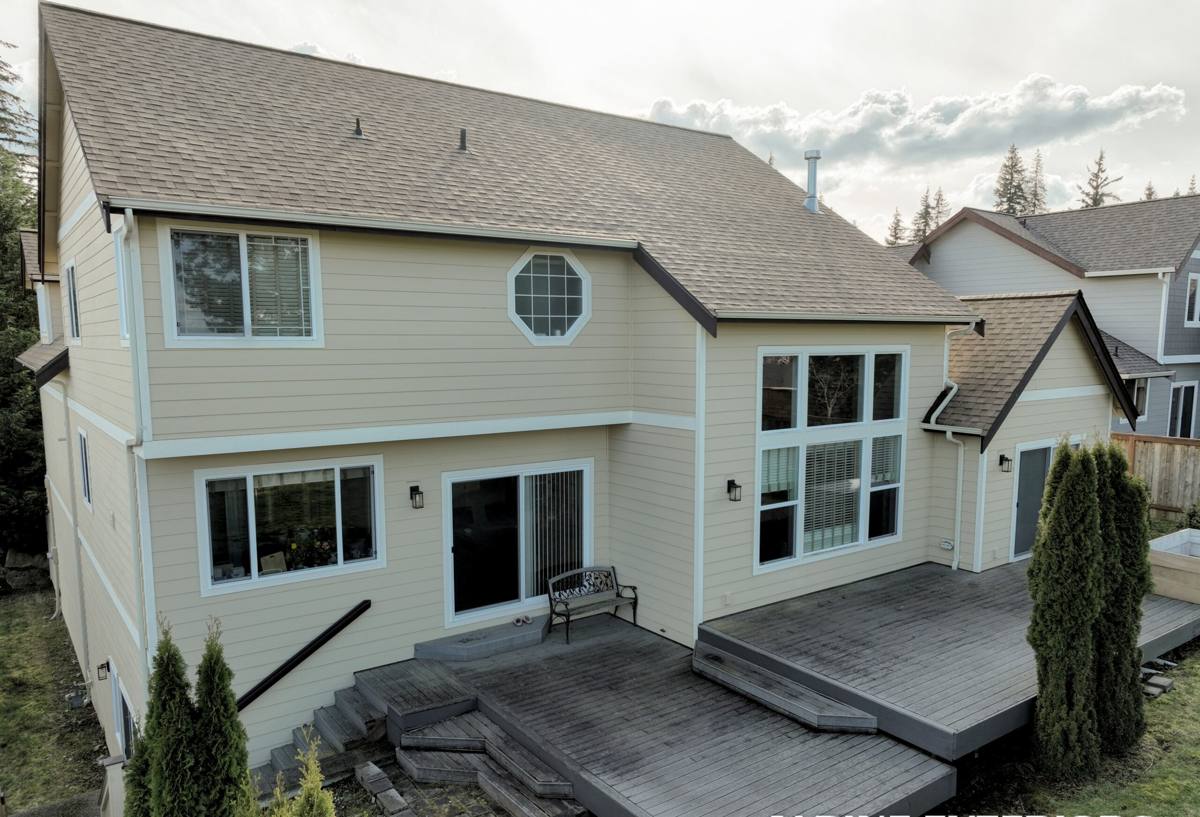
Repair or Replace? Signs to Look For
Not every deck in Sudden Valley needs full replacement, but a lot of the ones we get called out for have gone past the point where patching boards makes sense. Here's what tends to separate a repair job from a replacement job:
- Soft or spongy spots when you walk across the deck, especially near the house or at board ends
- Ledger board (where the deck attaches to the house) showing water staining, gaps, or rot
- Posts or support beams with visible splitting, checking, or soft wood at ground contact points
- Persistent moss or algae that returns within weeks of cleaning, even after pressure washing
- Railings that flex or wobble under normal pressure — a structural and safety issue, not cosmetic
- Fasteners that are rusted, backed out, or leaving dark streaks down the boards
- A deck more than 20-25 years old that has never had the framing inspected or upgraded
If what you're seeing is limited to a handful of surface boards with no soft spots and solid framing underneath, a repair or partial re-decking may be the honest answer. We'll tell you that directly rather than pushing a full tear-out you don't need.
Why the Framing Matters More Than the Surface
Homeowners naturally focus on the decking boards because that's what they see and walk on. But in our experience, the framing — joists, beams, posts, and especially the ledger board connection to the house — is where deck failures actually start in this climate. A deck can have brand-new composite boards on top of joists that are quietly rotting from the inside because the original builder skipped flashing at the ledger, or used untreated lumber where treated lumber was needed, or never installed joist tape to keep fasteners from wicking moisture into the wood grain. A proper replacement addresses what's underneath, not just what shows.
What a Proper Deck Replacement Involves
A full deck replacement isn't just pulling up old boards and screwing down new ones. Done right, it includes:
- Removing the old decking, railings, and stairs down to the framing
- Inspecting posts, beams, and joists for rot, checking, and structural soundness
- Verifying and, where needed, upgrading footings to meet current frost depth and load requirements
- Properly flashing the ledger board where the deck meets the house — this is the single most common failure point we find on older decks
- Installing joist tape or a comparable moisture barrier on top of framing before decking goes down
- Using corrosion-resistant, code-rated fasteners and structural connectors throughout
- Framing to current spacing and span requirements for the decking material chosen
- Installing decking, railings, and stairs to code, with attention to drainage and airflow underneath
Skipping any of these steps is how a "new" deck ends up with the same rot problems in eight or ten years instead of twenty-five or more.
Decking Material Options for a Shaded, Wet Lot
Material choice matters more in a shaded Sudden Valley lot than it does on an open, sun-exposed deck elsewhere in Bellingham. Here's how the common options compare for this specific setting:
| Material | Moisture & Moss Behavior | Maintenance | Typical Lifespan |
|---|---|---|---|
| Pressure-treated wood | Absorbs moisture readily; moss and algae take hold quickly in shade | Annual cleaning, periodic staining/sealing | 10-15 years before major issues in shaded settings |
| Cedar | Naturally rot-resistant but still needs to dry out between rains; shade slows that | Regular sealing to maintain resistance and appearance | 15-20 years with upkeep |
| Composite (capped) | Doesn't absorb water into the board core; surface can still host moss film that needs washing off | Occasional washing, no staining or sealing | 25-30+ years, backed by manufacturer warranties |
| PVC decking | Fully synthetic, most resistant to moisture-driven damage | Lowest maintenance of the group | 25-30+ years, backed by manufacturer warranties |
We don't push one material on every homeowner. Pressure-treated wood is still a reasonable, budget-conscious choice if you're willing to stay on top of cleaning and sealing. But for a shaded lot near the lake where a deck rarely gets a full day of direct sun to dry out, capped composite or PVC decking tends to hold up with a lot less fighting against moss and graying over the years. The tradeoff is upfront cost — composite and PVC materials cost more per square foot than treated lumber, though the difference narrows once you account for years of staining and sealing a wood deck would otherwise need.
A Note on Product Selection
We install materials based on what performs well in this specific climate, not on what's cheapest to buy or easiest to install. Some lower-tier composite products on the market are more sensitive to installation error — improper spacing or fastening can lead to buckling or moisture intrusion at cut edges — so we're selective about what we put our name behind, and we're happy to walk through the specific product lines we work with and why during your estimate.
Our Process for Sudden Valley Deck Replacements
Because we already work regularly in Sudden Valley, we know the access considerations for the community's wooded lots and sloped driveways, and we plan the job accordingly rather than figuring it out on day one. Our general process:
- On-site assessment of the existing deck, framing, and ground conditions, with honest feedback on repair vs. replacement
- Written estimate covering material options, scope, and timeline
- Permit filing where required, based on deck size, height, and attachment to the structure
- Demolition and disposal of the old deck
- Framing inspection and reconstruction, including footings, ledger flashing, and structural connections
- Installation of decking, railings, and stairs
- Final walkthrough and cleanup
We schedule around Whatcom County's weather patterns where we can, but a well-run crew can work through the region's typical rain — what we won't do is rush framing work or skip flashing steps to hit a deadline.
Permits and Whatcom County Considerations
Most deck replacements that involve structural changes — new footings, a raised deck, or a deck attached to the house — require a building permit, whether the project falls under City of Bellingham jurisdiction or unincorporated Whatcom County, which covers Sudden Valley. Permit requirements depend on deck height, size, and attachment method. We handle the permit filing as part of the job so you're not left navigating that process solo, and we build to current code rather than just matching what was there before, since code requirements around footings, guardrails, and stair geometry have changed over the years.
If your property is part of a planned community with its own design or exterior guidelines, it's worth checking those before finalizing material and color choices — we're glad to work within whatever those requirements are once you know them.
Why Local Experience in Sudden Valley Matters
A crew that mostly works flat, open lots in town will approach a Sudden Valley job the same way — and that's often where problems start. Wooded, sloped lots around Lake Whatcom mean different considerations for equipment access, footing placement on uneven grade, and material staging. Knowing which parts of a deck fail first in a shaded, lake-adjacent setting also changes what we look for during the initial inspection. We're not guessing at what this climate does to a deck over time; we've seen it in this specific neighborhood.
Keeping Your New Deck in Good Shape
Whatever material you choose, a little seasonal attention goes a long way in this climate:
- Sweep leaves and debris off the deck regularly in fall, especially in shaded areas prone to buildup
- Rinse or wash the surface a couple of times a year to keep moss and algae from establishing
- Check that gaps between boards stay clear so water can drain instead of pooling
- Inspect railings and stairs annually for looseness or movement
- For wood decks, plan on resealing on the schedule recommended for your specific product
- Trim back overhanging branches where practical to improve sun exposure and airflow
A deck built correctly for this climate, and maintained with basic seasonal care, should give you decades of use before you're back to thinking about replacement.
If your deck in Sudden Valley is showing soft spots, persistent moss, or just isn't holding up the way it should, we're happy to take a look and give you a straightforward assessment. Use the form below to request a free, no-pressure estimate.