 Bellingham Exterior
 Exteriors Built for Sunnyland's Climate
Sunnyland sits within the Bellingham exterior climate zone that gives Whatcom County homeowners a particular set of headaches: salt-tinged air drifting up from Bellingham Bay, driving rain that comes in sideways off the water more often than most homeowners expect, and a moss season that can stretch from October well into May. None of these things are dramatic on their own. What they do is compound, quietly, on the parts of a house that most people never look at closely — siding seams, roof valleys, window flashing, deck ledger boards. A house here doesn't usually fail all at once. It fails one overlooked detail at a time, over several winters.
We work exteriors across Bellingham and Whatcom County, and Sunnyland's mix of older homes and newer infill means we see both ends of the maintenance spectrum on the same block — a home with siding that's held up fine for decades next to one with rot behind the trim after ten years. The difference almost always comes down to material choice and how the original work was flashed and detailed, not bad luck.
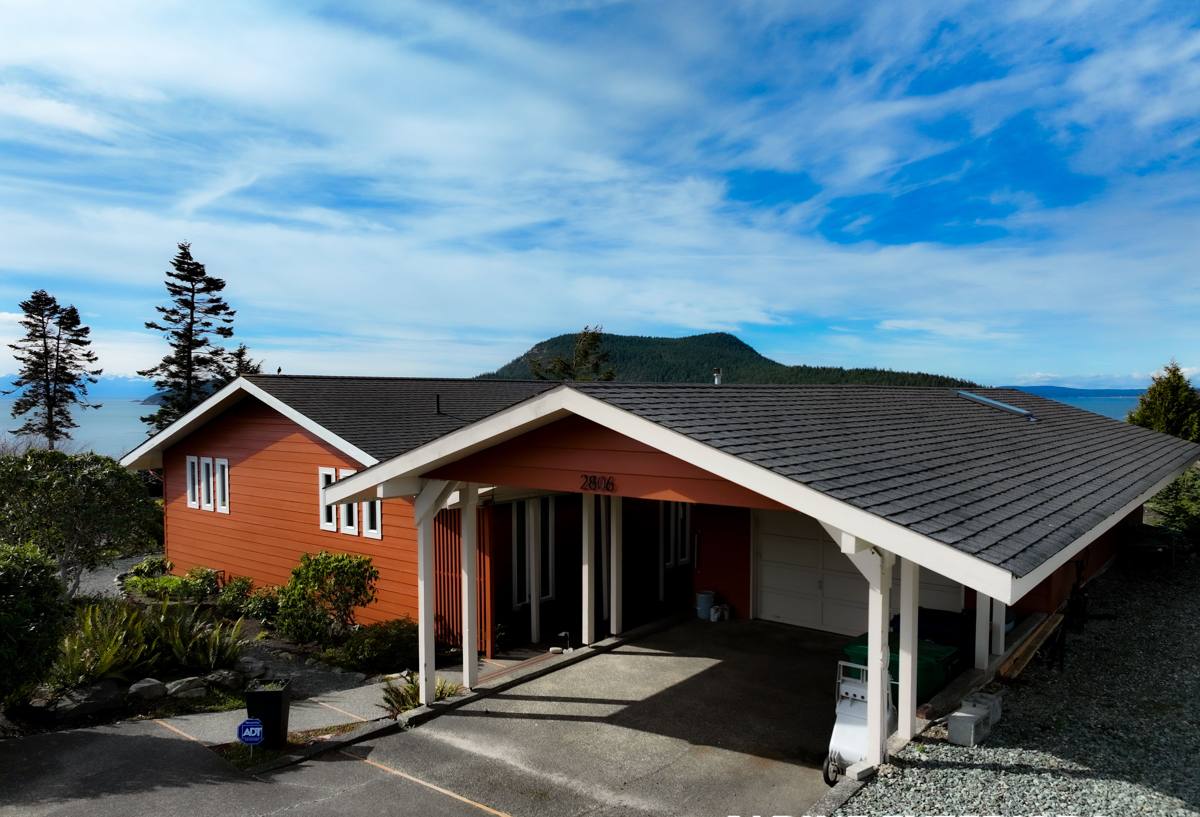
What Sunnyland Homes Actually Face
Salt Air and Moisture
Proximity to the bay means airborne salt and near-constant moisture in the air, even on days it isn't raining. Salt air accelerates corrosion on fasteners, flashing, and any metal exterior components, and it keeps painted or coated surfaces damp longer than they would stay in a drier inland climate. Materials that absorb moisture — or that rely on a surface coating to keep moisture out — are working harder here than they would almost anywhere else in the state.
Driving Rain
Bellingham's rain doesn't fall straight down as often as people assume. Wind off the water pushes it laterally into walls, especially on west- and southwest-facing elevations. That matters enormously for siding installation. A product and installation detail that performs fine under vertical rain can still let water track sideways behind the cladding if laps, joints, and flashing aren't done right. This is one of the reasons installation quality matters as much as the product itself.
Moss and Shade
Mature tree cover and a long damp season mean moss and algae growth on roofs, north-facing siding, and decks is close to unavoidable without some intervention. Moss holds moisture against a surface far longer than open air would, and on a roof it works its way under shingle edges over time. On siding, it stains and, on porous materials, it can hold enough moisture to encourage rot underneath.
Siding: Why We Only Install James Hardie
We install James Hardie fiber cement siding exclusively. We don't install vinyl, LP SmartSide, Cemplank, Allura, or primed wood species like spruce or cedar. That's not a marketing position — it's a standard we hold because of what we've seen these products do, and not do, in exactly this kind of climate.
The Core Problem With the Alternatives
Vinyl siding is inexpensive and low-maintenance in a general sense, but it's a petroleum-based product that expands and contracts significantly with temperature swings, and in driving rain it relies almost entirely on lap geometry — not a sealed surface — to keep water out. Wood-based composite siding (LP SmartSide and similar OSB-core products) uses an engineered wood substrate that, once its factory coating is breached at a cut edge, fastener hole, or impact point, can wick moisture and swell. In a climate with this much sustained dampness and salt air, that's a real long-term liability, not a hypothetical one. Primed cedar and spruce are honest, traditional materials, but they need active homeowner maintenance — recoating, caulking, monitoring — on a schedule most people don't keep up with once the excitement of a new exterior wears off.
What Hardie Does Differently
James Hardie fiber cement is a cement-and-cellulose composite, not a wood or vinyl product. It doesn't rot, it's not a food source for moss or insects, and it's non-combustible, which matters increasingly to insurers in this region. Hardie's ColorPlus finish is baked on at the factory under controlled conditions, which gives a more consistent, UV- and moisture-resistant finish than field-applied paint typically achieves, and it carries a meaningful factory finish warranty on top of the product warranty. Hardie also engineers regional product lines — its HZ5 formulation is built specifically for wetter, colder Pacific Northwest conditions, which is exactly the profile Bellingham and Whatcom County sit in.
Where Fiber Cement Still Needs Respect
Fiber cement isn't magic, and we're upfront about that. It's heavier than vinyl or wood composite, which means installation technique — proper fastening, correct gapping at joints, factory-mitered or properly sealed cuts, and flashing at every penetration — determines whether it performs the way it's supposed to for decades. A poorly installed Hardie job can still let water in behind the cladding. This is why we treat installation detail, not just the product spec sheet, as the actual deliverable on a siding job.
| Material | How It Handles Salt Air & Driving Rain | Long-Term Maintenance | Our Position |
|---|---|---|---|
| James Hardie fiber cement | Non-combustible, doesn't rot, engineered HZ5 line for wet climates | Repaint only when desired (15+ yrs typical on ColorPlus), no recoating required | What we install |
| Vinyl siding | Relies on lap geometry, not a seal; can warp under heat/UV cycling | Low, but limited repair options and can crack in cold snaps | Not installed |
| LP SmartSide / wood composite | Engineered wood core can wick moisture once coating is breached | Requires monitoring of cut edges, fastener sites, caulking | Not installed |
| Cemplank / Allura fiber cement | Similar base material to Hardie, but different finish system and warranty structure | Comparable maintenance profile to Hardie, but we standardize on one supported system | Not installed |
| Primed cedar / spruce | Absorbs moisture; salt air accelerates finish breakdown | High — recoating and caulk inspection needed every few years | Not installed |
Roofing in a Moss-Heavy, High-Rainfall Area
Roofing decisions in Sunnyland come down to two things: how well the roof sheds the volume of rain Bellingham gets, and how well it resists moss colonization under tree cover. Underlayment quality and proper valley, flashing, and vent detailing matter more here than in drier climates, because a roof doesn't just need to shed water once — it needs to keep shedding it correctly through months of saturation. We look closely at ridge and valley flashing, ice-and-water shield placement at vulnerable points, and ventilation, since poor attic ventilation combined with constant moisture is a common driver of premature roof aging and interior moisture issues we get called out for.
Moss control is part of a realistic roofing conversation here, not an afterthought. Zinc or copper strips near the ridge, periodic gentle cleaning, and keeping overhanging branches trimmed back all extend a roof's service life meaningfully in a neighborhood with this much tree cover.
Windows: Sealing Against Wind-Driven Rain
Window failures in this climate are rarely about the glass itself — they're about flashing and the seal between the window unit and the wall assembly. Wind-driven rain finds any gap in that seal, and once water gets behind a window frame it can travel and cause damage well away from the window itself, showing up as staining or soft trim on an interior wall months later. When we replace windows, proper flashing integration with the wall's water-resistive barrier and siding is treated as the critical step, not the window unit selection alone. We also talk with Sunnyland homeowners about condensation and thermal performance, since older single-pane or early dual-pane windows in a consistently damp, cool climate tend to show interior condensation that newer units handle far better.
Decks: Built for Shade, Rain, and Moss
Decks in shaded, tree-covered lots like much of Sunnyland deal with the same moss and moisture pressure as roofs, plus standing water risk if drainage and board spacing weren't planned correctly at build time. Ledger board attachment to the house is one of the most safety-critical and most commonly under-detailed parts of deck construction — it's also exactly the kind of connection point where our siding and structural work overlap, since a ledger board tied into poorly flashed siding is a moisture problem waiting to happen. We pay particular attention to proper flashing at the ledger, adequate joist spacing and drainage, and material selection that holds up to sustained shade and dampness rather than just looking good on installation day.
Why a Local Crew Matters Here
Exterior work in Bellingham and Whatcom County isn't generic exterior work. A crew that mostly works drier inland climates can install a technically correct product the wrong way for this environment — under-flashing a valley that needs extra protection here, or skipping a moisture barrier detail that's optional elsewhere but not optional on a shaded, rain-exposed elevation in Sunnyland. Local crews also know which elevations on a given lot take the worst of the wind-driven rain, how tree cover on a specific block affects moss pressure, and how salt air proximity varies even within a few blocks of the bay. That local pattern recognition is hard to replicate from a spec sheet.
A Seasonal Maintenance Checklist for Sunnyland Homes
- Inspect roof valleys and gutters for moss buildup and debris before the fall rains set in
- Check window flashing and caulking annually for gaps, especially on west- and southwest-facing units
- Look at siding for staining, soft spots, or gaps at joints — particularly on shaded, north-facing walls
- Clear gutters and downspouts at least twice a year given the amount of tree cover in the neighborhood
- Inspect deck ledger boards and joist connections for moisture staining or softness
- Trim back branches that keep roof and siding surfaces in constant shade and dampness
- Address any moss growth early — waiting a full season lets it work under shingles and siding edges
What Homeowners Should Ask Before Committing to an Exterior Job
A few questions separate a durable exterior job from one that looks fine for a couple of years and then starts causing problems. Ask what underlayment or moisture barrier is being used behind the siding or roofing, not just the visible product. Ask how flashing will be handled at every window, door, and roof penetration — this is where most failures actually originate, not in the field of the material itself. And ask about warranty structure: a manufacturer's product warranty and a contractor's installation warranty are two different things, and a strong product installed poorly is only as good as the weaker of the two.
| Question to Ask | Why It Matters in Bellingham's Climate |
|---|---|
| What underlayment or moisture barrier is used? | Determines how the assembly performs once, not if, water gets past the surface layer |
| How is flashing detailed at penetrations? | Wind-driven rain exploits gaps here more than anywhere else in the assembly |
| What's the manufacturer vs. installation warranty? | Product warranties often don't cover water damage from installation error |
| Is the crew familiar with this specific neighborhood? | Shade, wind exposure, and salt air vary block to block near the bay |
Getting Started
If you're weighing a siding, roofing, window, or deck project on a Sunnyland home, we're glad to take a look and talk through what your specific lot and exposure actually need — no pressure, no generic sales pitch. Use the form below to request a free estimate.