 Bellingham Exterior
 Sunnyland sits close enough to Bellingham Bay that homes here deal with a specific combination of weather most inland neighborhoods don't: salt-laden air drifting off the water, long stretches of driving rain through fall and winter, and a moss season that seems to start earlier and last longer every year. A roof in this neighborhood earns its keep. Metal roofing has become one of the most requested upgrades we install here, and for good reason — when it's specified and installed correctly for this exact climate, it holds up to all three of those stressors better than most alternatives. This page walks through what that actually means in practice, not in marketing language.
Why Sunnyland's Climate Puts Real Demands on a Roof
Whatcom County weather isn't dramatic, but it's relentless. Bellingham gets a steady volume of rain across many months of the year rather than short, intense downpours, which means roofing materials here spend more cumulative hours wet than in drier parts of Washington. Add in proximity to the bay, and you get airborne salt that accelerates corrosion on unprotected metal fasteners, flashing, and any exposed steel. Then there's shade and moisture together — the two conditions moss needs to establish itself on roofing surfaces and stay there through the wet months.
None of these factors alone would be a big deal. Together, over years, they're what separates a roof that looks tired at year ten from one that still looks tight at year thirty. A metal roofing system that's rated, fastened, and flashed for this specific combination of salt exposure and sustained moisture is doing a fundamentally different job than the same product installed in a drier, inland climate.
What This Means for Existing Roofs in the Neighborhood
If you've owned a home in Sunnyland for more than a few years, you've probably already noticed some combination of: dark streaking or green growth on north-facing slopes, granule loss around valleys and low-slope sections, or rust bleed at older metal flashing and fasteners. These aren't cosmetic issues in isolation — they're early signs of a roofing system losing its ability to shed water cleanly, which is the one job a roof actually has.
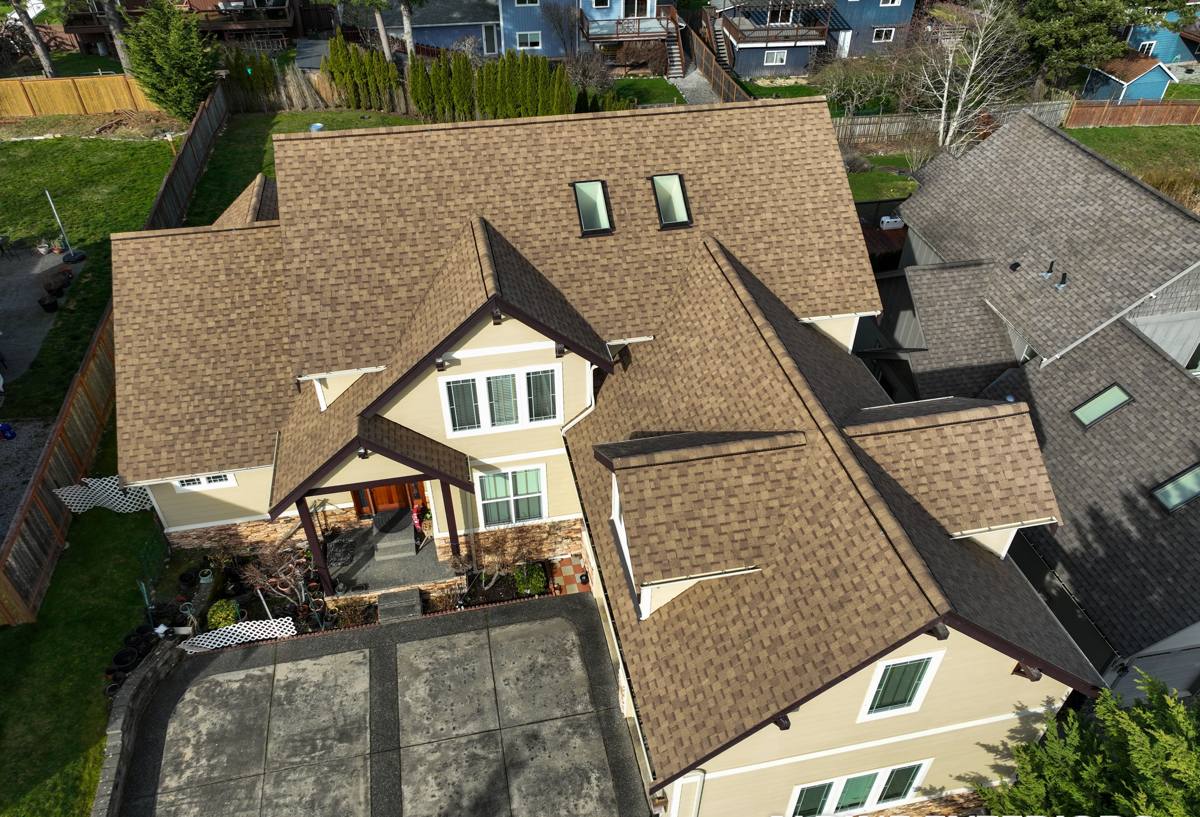
Why Metal Roofing Fits This Environment
Metal roofing isn't automatically the right answer for every home or budget, but it addresses the three problems above directly:
- Moss resistance: Metal doesn't give moss and moss-related algae the organic surface texture they need to take hold the way composition shingles can, especially on shaded, north-facing sections common in this neighborhood's tree cover.
- Water shedding: A steep-slope metal panel system, particularly standing seam, sheds sustained rain faster and with fewer horizontal seams than shingle systems, which matters during the long wet stretches Whatcom County sees each year.
- Corrosion management: Quality metal roofing for this area uses coated steel or aluminum with fastener and flashing systems rated for coastal exposure, so the salt air off the bay isn't working against the material from day one.
That last point is where a lot of metal roofing installs go wrong if they weren't specified for a coastal-influenced climate to begin with. The panel finish matters, but so does every fastener, closure strip, and piece of flashing that goes with it.
What a Correct Metal Roofing Job Actually Involves
A metal roof is only as good as what's underneath and around it. We treat the following as non-negotiable on every metal roofing install in this neighborhood:
Deck and Underlayment
Before any panel goes down, the roof deck has to be sound — no soft spots, no hidden rot from years of slow leaks. Over that deck, we install a high-temperature, self-adhering underlayment rated for metal roofing, not a generic felt product. Metal roofs run hotter in direct sun and colder at night than shingle roofs, and a standard underlayment can degrade faster under those temperature swings. This layer is also the last line of defense if wind-driven rain ever gets past a seam, which is exactly the scenario Bellingham's weather can produce.
Panel Selection and Fastening
Standing-seam systems, where panels are joined with raised, mechanically-seamed ribs and no exposed fasteners on the field of the roof, are generally the strongest choice for this climate because there are far fewer penetration points where water or salt air can work into the assembly over time. Exposed-fastener panel systems can still be appropriate for some structures and budgets, but they require a maintenance conversation up front, since every fastener is a potential future weak point that will eventually need attention.
Flashing, Valleys, and Penetrations
Most roof failures we get called out to inspect — metal or otherwise — trace back to flashing, not the field material itself. Valleys, chimney and vent penetrations, wall transitions, and eave details all need flashing that's compatible with the panel metal to avoid galvanic corrosion, and sealed with methods built for decades of service, not just a bead of caulk. This is where experience with metal specifically, rather than general roofing experience, shows up in the finished product.
Ventilation
Metal roofs perform best with a properly vented attic or roof assembly underneath. Good ventilation controls condensation on the underside of the panels and helps the whole system regulate temperature, which matters for both the roof's longevity and the comfort of the rooms below it.
Comparing Roofing Options for Sunnyland Homes
There's no single correct roofing material for every house — budget, roof pitch, home style, and how long you plan to stay in the home all factor in. Here's an honest comparison for this specific climate:
| Factor | Standing-Seam Metal | Composition Shingle |
|---|---|---|
| Moss resistance | High | Moderate — needs regular treatment/cleaning |
| Typical service life (this climate) | 40-60+ years with proper install | 20-30 years with proper maintenance |
| Coastal/salt-air durability | High, with correct fastener and flashing spec | Moderate — granule and edge wear over time |
| Upfront cost | Higher | Lower |
| Maintenance needs | Low — periodic inspection | Moderate — moss treatment, granule loss monitoring |
| Noise in heavy rain | Minimal with proper deck/underlayment/insulation | Minimal |
The higher upfront cost of metal is real, and we won't pretend otherwise. The case for it in Sunnyland is a long-term one: fewer moss treatments, fewer reroof cycles over the life of the home, and a system built specifically to handle the bay's salt air and the region's wet season rather than just tolerate it.
Our Process, Start to Finish
- On-site inspection: We walk the roof and attic, check deck condition, existing ventilation, flashing points, and any signs of moss, rot, or past leaks.
- Honest recommendation: We'll tell you plainly whether metal is the right fit for your roof's pitch, structure, and your budget — and what the trade-offs are against other materials if it isn't.
- Detailed proposal: Panel type, gauge, finish, underlayment, flashing plan, and ventilation approach, specified for Bellingham's coastal-influenced climate.
- Tear-off and deck prep: Old roofing removed, deck inspected and repaired as needed before anything new goes down.
- Underlayment and flashing installation: The part of the job that determines whether the roof performs in year one and still performs in year twenty.
- Panel installation: Precise seaming and fastening to spec, with attention to valleys, ridges, and every penetration.
- Final walkthrough: We review the finished roof with you and explain any simple maintenance steps specific to your property.
What Ongoing Maintenance Looks Like
One of the real advantages of metal roofing in this climate is how little it asks of you afterward, but "little" isn't "none." A short, practical maintenance checklist for a metal roof in Sunnyland:
- Clear debris from valleys and gutters each fall before the heavy rain sets in, so water has a clean path off the roof.
- Do a visual check after major windstorms for any lifted flashing or debris impact.
- Keep overhanging branches trimmed back where practical — less shade and leaf litter means less moss pressure even on a moss-resistant surface.
- Have flashing and sealant points inspected every few years, especially around chimneys and vents, since these are the areas most likely to need attention over time.
- Watch for any early rust bleed at cut edges or fasteners, which is easier and cheaper to address early than after it spreads.
Why Local Experience in Sunnyland Matters
Metal roofing done wrong for this climate doesn't fail dramatically — it fails slowly, through a fastener that wasn't rated for salt exposure, a flashing detail that was fine in a drier region but not here, or underlayment that wasn't built for the temperature swings metal roofs create. That's the risk of hiring a crew whose experience comes from a different climate zone.
We work throughout Bellingham and Whatcom County, and Sunnyland's mix of mature tree cover, older housing stock, and proximity to the bay is a combination we see regularly. That familiarity shapes real decisions on your project — how we detail a valley that collects extra runoff, which fastener coating we spec given how close a property sits to the water, or where extra ventilation will pay off given a particular roof's shade pattern. It's the difference between a roof that's technically installed correctly and one that's installed correctly for where it actually sits.
Signs It Might Be Time to Consider Metal
You don't need to wait for a leak to start this conversation. Common signals we hear from Sunnyland homeowners include recurring moss growth despite regular cleaning, a current shingle roof approaching the end of its expected service life, visible granule loss or curling shingles, rust staining from old metal flashing, or simply wanting to stop the cycle of moss treatment and periodic reroofing every couple of decades. Any of these is a reasonable starting point for an inspection and honest conversation about whether metal makes sense for your specific roof.
If you're weighing a new roof for a home in Sunnyland, or just want a straight answer on whether metal roofing is worth the investment for your property, we're glad to take a look. Use the form below to request a free, no-pressure estimate — we'll walk the roof, answer your questions, and give you a clear picture of your options before you decide anything.