 Bellingham Exterior
 Windows for a Different Kind of Weather
Birch Bay sits right on the water, and that changes what a window has to survive day to day. Homes a few blocks inland in Bellingham deal with plenty of rain, but a Birch Bay property also takes on salt spray carried in off the water, near-constant wind exposure, and the kind of driving, sideways rain that finds every weak seam in a window assembly. Add in a long stretch of gray, damp months where moss and mildew get a head start on anything with a foothold, and you've got a climate that's genuinely harder on windows than most inland Whatcom County neighborhoods.
That doesn't mean Birch Bay homes need exotic materials or a completely different product line. It means the installation has to be done with the coast in mind — correct flashing, the right frame material, sealants that actually hold up to salt exposure, and glass packages chosen for wind and moisture, not just looks. Get those details right and a custom window install here will perform for decades. Skip them, and you'll be dealing with fogged glass, soft frames, or water stains inside of a few years.
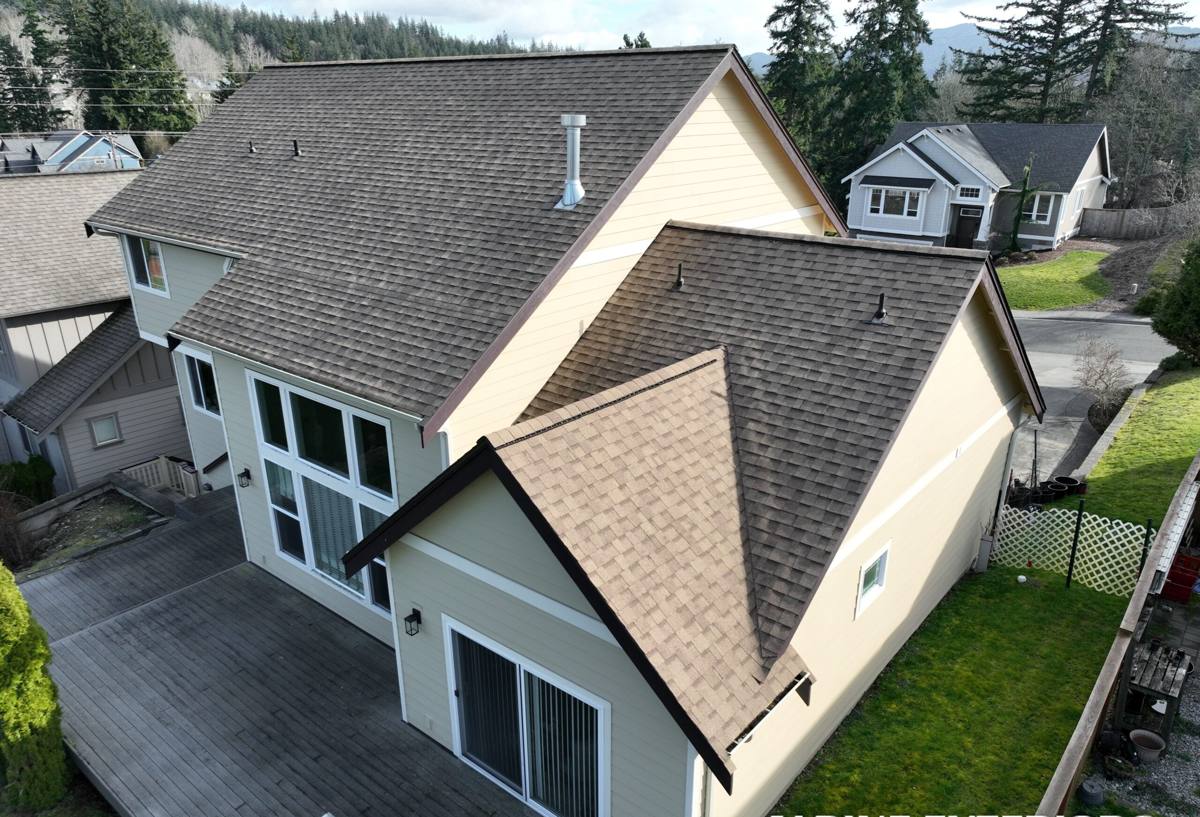
What Salt Air, Rain, and Moss Actually Do to a Window
Salt Air and Corrosion
Salt in the air settles on hardware, tracks, and any exposed metal components. Over time it accelerates corrosion on cheaper hinges, cranks, and locking mechanisms, and it can pit lower-grade aluminum frames. This is slow damage — it doesn't show up in year one — which is exactly why it gets ignored until a window won't latch properly or the hardware seizes up.
Wind-Driven Rain
Standard rain falls straight down. Driving rain off the water hits window assemblies at an angle, under pressure, and pushes at every joint. A window that would be perfectly watertight in a sheltered inland yard can leak in a Birch Bay wind event if the flashing, sill pan, or sealant bead wasn't installed with that pressure in mind.
Moss and Mildew
Northwest Washington's damp season gives moss and mildew a long runway. On windows, that shows up as dark streaking on sills and frames, degraded caulking, and — on wood components that aren't properly sealed — slow rot starting at the corners and bottom rail. It's cosmetic at first, but it's also an early warning sign that moisture is getting past the surface.
What a Correct Custom Window Job Involves
"Custom" doesn't just mean a non-standard size, though that's part of it — a lot of Birch Bay homes have older or nonstandard rough openings that off-the-shelf windows don't fit cleanly. A correct job covers several things at once:
- Accurate measurement and a frame built (or ordered) to fit the actual opening, not a close-enough stock size
- Removal of the old window down to the rough opening, with a check for hidden rot or water damage before anything new goes in
- A properly sloped sill pan and correct flashing sequence so water sheds outward, not into the wall cavity
- Sealant and backer rod rated for exterior, coastal exposure — not a generic caulk that will chalk and crack in a season or two
- Hardware and frame material matched to the home's exposure — a west- or water-facing wall gets more scrutiny than a sheltered side
- A final check of operation, seal, and drainage before we call the job done
Any one of these steps done poorly can undo the benefit of an otherwise good window. This is why window failures in coastal areas are so often an installation problem, not a product problem.
Choosing the Right Frame Material
Frame material matters more here than in a sheltered inland location. Below is how the common options generally hold up under Birch Bay's conditions.
| Material | Coastal/Salt Air Performance | Maintenance | Notes |
|---|---|---|---|
| Vinyl | Good — won't corrode or rot | Low | Solid value option; quality varies a lot between manufacturers |
| Fiberglass | Very good — stable and corrosion-resistant | Low | Handles temperature swings and coastal exposure well; higher upfront cost |
| Wood-clad | Fair to good, depends on the cladding | Moderate | Attractive interior wood look; the exterior clad layer and seams need to be done right or moisture gets in |
| Aluminum | Fair — prone to corrosion without a quality coating | Moderate | We're selective about where we use bare aluminum this close to salt air |
There's no single "correct" material for every home — a lot depends on your home's style, budget, and how exposed the specific wall is. We'll walk through the honest trade-offs for your house rather than push one product line.
Glass and Performance Options Worth Considering
Frame material gets most of the attention, but the glass package matters just as much for comfort and durability:
- Double-pane with Low-E coating is the standard baseline for most Birch Bay homes — good insulation and UV control at a reasonable cost.
- Triple-pane adds extra insulation and sound dampening, worth considering on a windy, water-facing wall where wind noise and heat loss are both bigger issues.
- Tempered or laminated glass is required in certain locations by code (near doors, low to the floor, in wet areas) — we'll flag anywhere that applies on your project.
- Argon or krypton gas fill between panes improves insulation value and is common on quality double- and triple-pane units.
We size the glass package to the wall's actual exposure rather than defaulting to the same spec on every elevation of the house.
How We Handle a Birch Bay Custom Window Project
The process is straightforward, and we keep it that way on purpose:
- On-site assessment. We look at your current windows, the rough openings, and the specific exposure of each wall — a water-facing side gets different treatment than a sheltered one.
- Straightforward estimate. You get a written scope covering materials, frame choice, and what the install involves — no vague allowances.
- Ordering and scheduling. Custom units take lead time to manufacture; we'll give you a realistic timeline up front rather than a guess.
- Removal and inspection. Old windows come out carefully, and we check the opening for hidden rot or prior water damage before installing anything new.
- Installation. Correct flashing, sill pan, insulation, and sealant — the details that actually determine whether the window performs in coastal weather.
- Final walkthrough. We check operation, seal, and finish work with you before we consider the job complete.
Depending on scope — a handful of windows versus a full-house replacement — a Birch Bay project typically runs from a modest investment for a few units up to a considerably larger one for a whole-house upgrade with premium glass. We'll give you real numbers for your home rather than a generic figure that doesn't mean much.
Signs Your Current Windows Are Already Struggling
Coastal wear is gradual, so it helps to know what to watch for:
- Fogging or moisture trapped between panes — a sign the seal has failed
- Hardware that's stiff, corroded, or won't latch fully
- Drafts you can feel around the frame on a windy day
- Soft or discolored wood at the sill or bottom corners
- Dark streaking or persistent moss/mildew on the frame or sill
- Visible daylight or gaps between the frame and the siding
- Noticeably higher heating costs with no other explanation
Any one of these on its own isn't necessarily an emergency, but a few together usually mean the windows are past the point where caulking and weatherstripping will fix things.
Why Local Experience in Birch Bay Matters
A contractor who mostly works sheltered, inland jobs will often use the same approach everywhere — and in a place like Birch Bay, that approach doesn't hold up. We work throughout Whatcom County, including the coastal exposure that Birch Bay properties deal with, so we're used to accounting for wind-driven rain, salt exposure, and moss growth as standard parts of the plan, not surprises. That shows up in small decisions — which sealant we use, how we detail the sill pan, which frame material we recommend for a water-facing wall — that a generalist crew might not think twice about.
It also means we're realistic about timelines and weather windows. Coastal jobs sometimes need a dry stretch to do the flashing and sealant work properly, and we plan around that instead of rushing a critical step to hit a schedule.
Protecting Your Investment After Installation
New windows are close to maintenance-free, but a little upkeep goes a long way in this climate:
- Rinse salt residue off frames and hardware a couple times a year, especially after storms
- Keep weep holes and drainage tracks clear of debris and moss
- Check and refresh exterior caulking every few years — it's the first thing to wear in salt air
- Operate hardware periodically through the winter so cranks and locks don't seize
None of this is complicated, but it's the difference between a window system that looks and performs well for 20-plus years and one that starts showing coastal wear well before it should.
If your current windows are drafty, fogged, or just not holding up to the weather anymore, we're happy to take a look and give you a straightforward, no-pressure estimate for your Birch Bay home. Use the form below to get started.