 Bellingham Exterior
 Why Decks Fail Faster in Blaine Than Inland
Blaine sits right on the water, close to the Canadian border, and that location comes with a climate profile that's tougher on exterior wood and fasteners than most of Whatcom County. Salt-laden air moves off the water and settles on everything — railings, ledger boards, hardware, the undersides of joists that never quite dry out. Add Bellingham's long wet season and the shade that mature Pacific Northwest trees throw over a lot of Blaine yards, and you get a near-constant moss and mildew cycle on deck surfaces from fall through spring.
None of that means a deck in Blaine is doomed. It means the deck has to be built with that environment in mind from the ledger board down to the footings, not patched together with whatever framing lumber and fasteners work fine forty miles inland. A lot of the deck failures we see here aren't the fault of bad carpentry — they're the fault of a deck built to a generic spec instead of a coastal one.
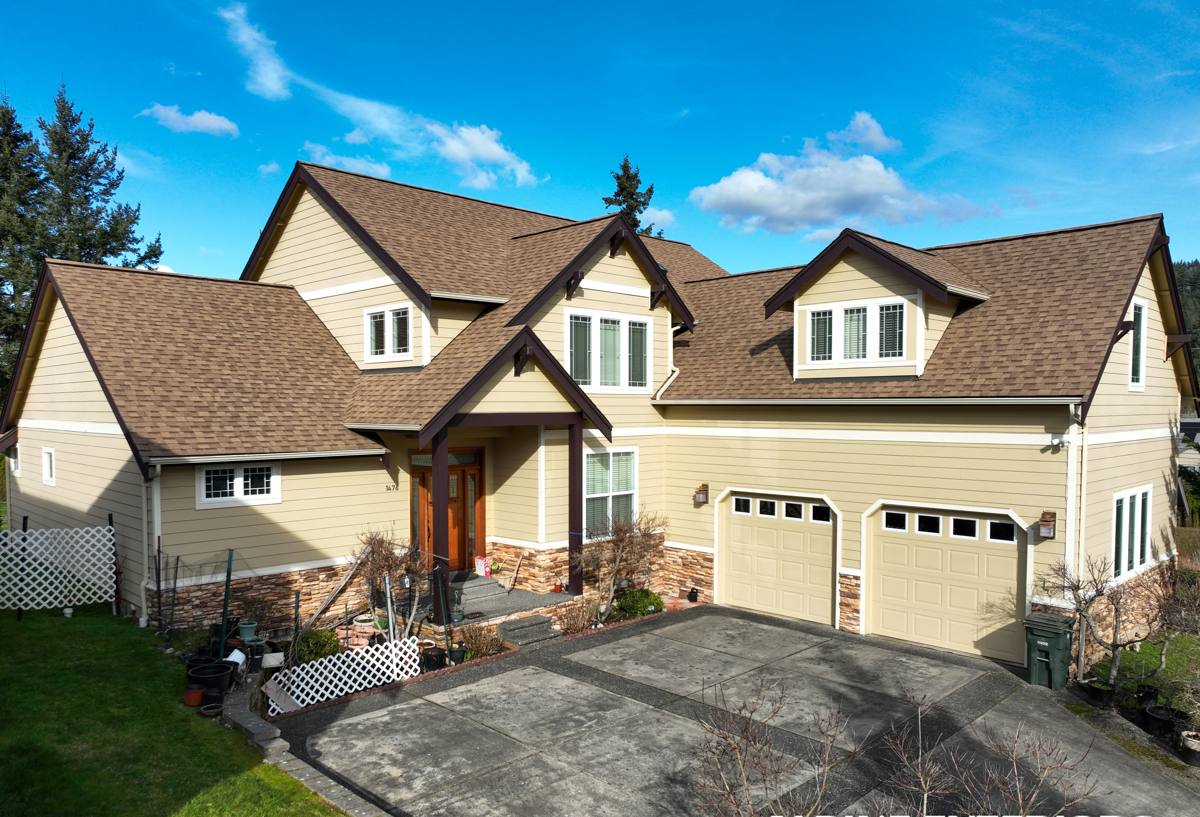
Signs a Blaine Deck Needs Replacement, Not Another Repair
Homeowners often ask us to "fix a few boards" when the real problem is underneath. Here's how we tell the difference on site:
- Soft or spongy spots when you walk the deck, especially near the house or around post bases — usually rot in the framing, not just the surface boards.
- Rust streaks bleeding out around fasteners — a sign the hardware is corroding from salt exposure, which weakens the connection even if the wood around it still looks fine.
- A ledger board that's separating from the house rim joist, or flashing that's missing or failing at that connection — this is a structural safety issue, not cosmetic.
- Persistent moss or black-green staining that comes back within weeks of cleaning, no matter how often it's washed — that's a drainage and airflow problem, not a cleaning problem.
- Posts or footings that feel loose or have visibly shifted — often from years of saturated ground freezing and thawing.
If it's isolated to a handful of surface boards and the framing underneath is sound, repair makes sense. If the framing, ledger connection, or footings are compromised, replacement is the honest answer — patching those problems just delays a bigger failure and adds cost on top of cost.
What a Correct Deck Replacement Actually Involves
Structure First
Everything visible on a deck depends on what's underneath it. A proper replacement starts with the ledger board attachment to the house — correctly flashed, correctly fastened, and sized for the actual load the deck will carry. From there it's footings rated for our soil and frost conditions, joists spaced and sized to the span, and beam sizing that doesn't rely on the decking material to add strength it isn't designed to provide.
Fasteners and Hardware
In a salt-air environment, fastener choice matters as much as lumber choice. Standard galvanized hardware corrodes faster near the water than it does a few miles inland. We spec stainless or high-grade coated fasteners and connectors rated for coastal exposure, because a deck is only as strong as its weakest joint, and a rusted-through joist hanger doesn't announce itself until it fails.
Drainage and Airflow
Moss and rot both need standing moisture to take hold. Correct board spacing, a slight slope away from the house, and clear airflow underneath the deck all matter more in Bellingham's climate than they would somewhere dry. A deck built flush to the ground with no ventilation underneath will grow moss and hold moisture no matter what decking material sits on top.
Choosing the Right Decking Material for This Climate
There's no single "best" decking material — there's a best fit for your budget, maintenance tolerance, and how close your lot sits to the water. Here's how the common options actually perform in a Blaine setting:
| Material | Salt Air / Moisture Behavior | Maintenance | Typical Lifespan Here |
|---|---|---|---|
| Pressure-treated wood | Performs fine if sealed and re-sealed on schedule; untreated ends and cuts are the weak point | Annual cleaning, re-staining or sealing every 1-2 years | 10-15 years with upkeep |
| Cedar | Naturally rot-resistant but still needs sealing near the coast; grays and softens without maintenance | Sealing every 1-2 years, regular cleaning to slow moss | 15-20 years with upkeep |
| Composite decking | Doesn't rot or absorb moisture the way wood does; some early-generation boards trapped moisture at fastener points | Periodic washing to keep moss from gripping the surface texture | 25+ years, varies by product line and installation |
| PVC/capped polymer | Fully sealed surface, best resistance to salt air and standing moisture | Lowest maintenance of the common options | 25-30+ years |
We install a range of these depending on what a homeowner wants to spend and how hands-on they want ongoing care to be. Our standard is to walk you through the honest trade-offs — upfront cost versus long-term maintenance, appearance versus moisture performance — rather than push one product because it's easier to install or carries a better margin. Wood decks aren't a wrong choice near the water; they just require a homeowner who's willing to keep up the sealing schedule.
Our Deck Replacement Process
- On-site assessment — we inspect the existing structure from the ledger connection down to the footings, not just the surface, so you know exactly what's failing and why.
- Honest scope and estimate — a clear breakdown of what needs full replacement versus what could reasonably be reused, with material options priced separately so you're deciding, not us.
- Demo and disposal — full removal of the old deck, including hardware and any compromised framing, hauled off the site.
- Framing and structural work — ledger, footings, posts, beams, and joists built to current code and sized for the deck's actual use, not the minimum.
- Decking, railing, and finish work — installed to manufacturer spec with coastal-rated fasteners throughout.
- Final walkthrough — we go over the finished deck with you, including what maintenance it needs and on what schedule.
Why a Bellingham-Based Crew That Already Works Blaine Matters
Blaine is a small enough community that its building department, its typical lot conditions, and its climate quirks are well known to a crew that works the area regularly — versus a contractor who mostly builds inland and treats a Blaine job as one-off. That familiarity shows up in practical ways: knowing which fastener grade actually holds up here instead of learning it the hard way on a callback, knowing how local soil drains during the wet months when setting footings, and knowing what inspectors in Whatcom County actually want to see at a ledger connection.
Being based in Bellingham also means we're not driving a crew in from out of the region for a single project and disappearing after. If a question comes up two years after installation, we're still local and still reachable.
Permitting and Code in Whatcom County
Most deck replacements — especially anything involving new footings, a raised structure, or a ledger reattachment — require a building permit and inspection in Whatcom County. This isn't paperwork for its own sake: the inspection process is what catches an undersized footing or a missing flashing detail before it becomes a safety problem years down the road. We handle the permit process as part of the job so you're not left tracking down inspections yourself, and we build to the current code rather than to whatever the old deck happened to meet when it went up.
Keeping a New Deck Ahead of the Climate
A well-built deck still needs some seasonal attention in this climate. A short, honest maintenance routine goes a long way toward getting the full lifespan out of the materials:
- Sweep leaves and debris off the deck surface regularly in fall — trapped wet leaves are one of the fastest ways to stain or degrade decking.
- Rinse or lightly wash the surface a couple of times a year to slow moss buildup before it takes hold in grooves and seams.
- Check railings and stair connections annually for looseness — hardware is the first thing to show wear in salt air.
- Re-seal or re-stain wood decking on the schedule appropriate to the product — don't wait until it's visibly gray and dry.
- Keep gutters and downspouts near the deck clear so runoff isn't dumping extra water onto or under the structure.
Get a Straight Answer About Your Deck
If you're not sure whether your Blaine deck needs a repair or a full replacement, we're happy to take a look and tell you honestly which one it is — no pressure, no upsell. Use the form below to request a free estimate, and we'll walk the property, explain what we find, and give you real numbers to work from.