 Bellingham Exterior
 Cordata's Climate Puts Real Demands on Exterior Siding
Cordata sits in north Bellingham, a neighborhood that sees the same weather pattern as the rest of Whatcom County: damp winters, a long stretch of low gray skies, and enough salt-laden air drifting in off the Salish Sea to matter for anything nailed to the outside of a house. Add driving rain that comes in sideways during winter storms and a moss season that can run from October well into spring, and you have a climate that is genuinely tough on siding, regardless of what it's made from.
Board and batten is a popular look in this part of Bellingham because it reads as clean, modern, and a little more architectural than standard lap siding — but the style only holds up if the material underneath is built for this climate and the installation accounts for how water actually moves on a vertical-panel wall. That's the part homeowners often don't see until something goes wrong.
Why Board & Batten Fits Cordata Homes
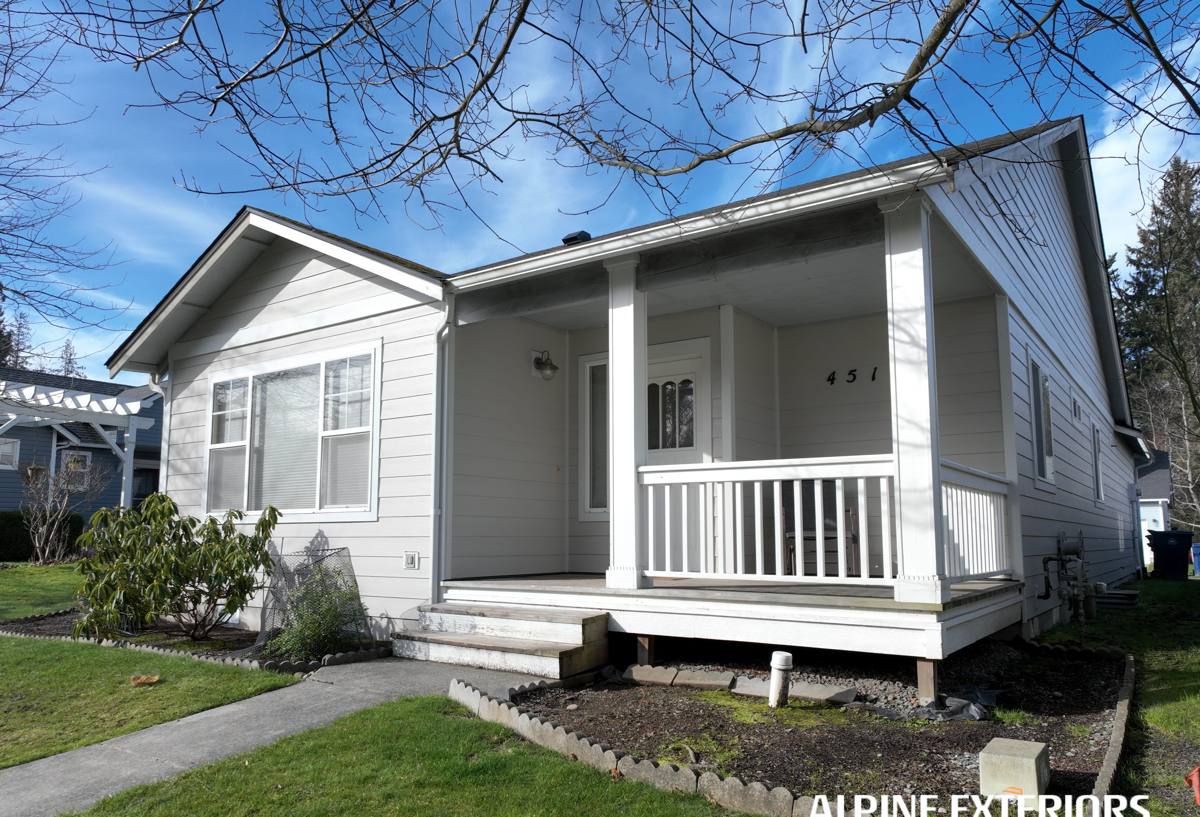
Cordata's mix of newer construction and established single-family homes gives board and batten a lot of room to work. The vertical lines pair well with contemporary rooflines and gable accents, and it's commonly used as a contrast material — paired with a horizontal lap field on the same elevation to break up a large wall or highlight an entry, a garage face, or a second-story dormer.
The style also does something practical: the raised battens create shadow lines that make a flat elevation look more dimensional, which matters on homes with simpler massing. But that same vertical profile means every batten strip is a potential water-collection point if it isn't detailed correctly — which is why the installation details below matter more for board and batten than they do for a standard lap job.
What a Correct James Hardie Board & Batten Installation Involves
The Panel System
We install James Hardie fiber cement board and batten as an engineered panel system — a smooth or textured HardiePanel base with vertical batten strips fastened over the seams — not a stack of individual boards. Fiber cement doesn't absorb water the way wood-based products do, and it won't swell, cup, or delaminate the way engineered wood siding can when it takes on repeated moisture. That matters directly here: a product that handles wetting and drying cycles without dimensional change is the baseline requirement for anything installed in Whatcom County, and it's the main reason we don't offer wood-based or vinyl alternatives for this style.
Moisture Management Behind the Panel
The siding itself is only half the system. Behind every board and batten installation we do, there's a weather-resistive barrier, correctly lapped flashing at every horizontal transition, and rainscreen furring to create a drainage gap behind the panel. That gap gives any water that gets past the panel face — from wind-driven rain or condensation — a path to drain and dry out instead of sitting against the sheathing. Skipping the rainscreen gap is one of the most common corner-cuts in board and batten installs, and it's one of the most consequential, because trapped moisture behind a vertical panel wall doesn't show itself until there's already damage underneath.
Fastening and Joints
Battens and panels need to be fastened per the manufacturer's engineering — correct nail placement, spacing, and penetration into framing, not just into sheathing. Vertical and horizontal joints get factory-primed edges sealed and flashed rather than caulked-and-hoped, since caulk is a maintenance item, not a permanent moisture barrier. Every one of these details is where a code-minimum install and a correctly built one diverge.
| Factor | Board & Batten (Hardie fiber cement) | Standard Lap Siding |
|---|---|---|
| Visual style | Vertical, architectural, strong shadow lines | Traditional horizontal reveal |
| Water shedding | Depends entirely on flashing and rainscreen detail | Naturally sheds water via overlap |
| Best use on Cordata homes | Accent walls, entries, gables, modern facades | Full-elevation coverage, traditional facades |
| Installation sensitivity | Higher — more joints and battens to detail correctly | Lower — fewer vertical transitions |
| Long-term performance in wet climates | Excellent when rainscreen and flashing are done right | Excellent with standard practices |
Our Process for a Cordata Board & Batten Project
- Walkthrough and assessment — we look at existing siding, sheathing condition, trim, and any areas showing past moisture intrusion before quoting anything.
- Design and layout — we plan batten spacing and panel layout around windows, corners, and any full-lap-to-board-and-batten transitions on the elevation.
- Tear-off and sheathing check — old siding comes off, and we inspect and repair sheathing before anything new goes on. This step catches hidden rot before it's covered up again.
- Weather barrier and rainscreen installation — the drainage plane goes on first, correctly lapped and taped at every seam and penetration.
- Flashing at every transition — windows, doors, roof lines, and horizontal joints get flashed before panels go up, not caulked after.
- Panel and batten installation — fastened to manufacturer spec, joints detailed, and factory-cut edges sealed.
- Final inspection and cleanup — we walk the finished job with the homeowner before calling it done.
Cost Factors for Board & Batten Siding in Cordata
Every project is different, but the same handful of factors drive most of the cost variation we see on board and batten jobs in this area:
| Factor | Why it matters |
|---|---|
| Sheathing condition | Rot or moisture damage found during tear-off adds repair scope before new siding can go on |
| Extent of coverage | Full-elevation board and batten costs more than accent-wall or partial applications |
| Number of transitions | Corners, window returns, and lap-to-batten transitions each add labor and flashing detail |
| Access and site conditions | Steep lots, tight setbacks, or multi-story walls affect staging and labor time |
| Color and finish | ColorPlus factory-finished panels versus field-painted options affect material pricing |
We give a written, itemized estimate before any work starts, so homeowners know exactly what's driving the number.
Living With Board & Batten Through Whatcom County's Moss Season
Moss and algae growth on siding is common across this whole region, not a sign that something was installed wrong — but board and batten's vertical battens and shadow lines can hold moisture and debris a little differently than flat lap siding, especially on north-facing walls that stay shaded most of the day. A little routine attention keeps it looking right and keeps moisture from lingering where it doesn't need to:
- Rinse siding (garden-hose pressure, not a pressure washer) once or twice a year, focusing on shaded and north-facing elevations where moss takes hold first
- Keep gutters clear so overflow doesn't run down the wall and feed moss growth along batten lines
- Trim back shrubs and trees that keep a wall damp and shaded longer than the rest of the house
- Check caulking at trim and penetrations annually — not because it's the primary water barrier, but because failed caulk is an early warning sign worth catching
- Repaint or refresh field-applied finishes on the manufacturer's recommended cycle if you didn't choose a factory ColorPlus finish
ColorPlus factory-finished panels hold their color and resist this kind of buildup better than field-painted fiber cement, which is one more reason we recommend it for homes in a moss-heavy climate like this one.
Why Hiring a Crew That Already Works Cordata Matters
Board and batten's higher joint count and flashing complexity mean the gap between a correctly built wall and a code-minimum one is bigger than it is with standard lap siding. A crew that already works in and around Bellingham has seen how Whatcom County's rain patterns and moss growth actually play out on a finished wall over a few winters — not just in a spec sheet. That experience shows up in small decisions: where to add extra flashing on a north-facing gable, how much rainscreen gap to leave on a wall that stays shaded most of the day, or which batten spacing holds up best against driving rain off the water.
It also means straightforward accountability. A local crew is around to stand behind the work, not just the manufacturer's material warranty, and that's worth more on a style like board and batten where the installation detail matters as much as the product itself.
Get a Straight Answer for Your Cordata Home
If you're considering board and batten siding for a Cordata home, we're glad to walk the property, look at what's there now, and give you a clear, no-pressure estimate for doing it right — James Hardie fiber cement, correctly flashed and detailed for this climate. Use the form below to get started.