 Bellingham Exterior
 Why Cordata Roofs Wear Differently Than You'd Expect
Cordata sits in north Bellingham, close enough to Bellingham Bay and the Strait of Georgia that homes here deal with a specific combination of weather most inland Washington towns never see. Salt-tinged air off the water accelerates corrosion on exposed metal — flashing, fasteners, gutter hardware — faster than a spec sheet written for a drier climate would predict. Add Whatcom County's driving rain, which comes in sideways during winter storms instead of falling straight down, and water finds its way into laps and seams that would stay dry in a gentler rainfall pattern. Then there's moss. Between fall and late spring, shaded roof sections rarely get enough sun or airflow to dry out fully, and that's exactly the environment moss needs to take hold.
None of this means Cordata roofs fail faster than they should. It means they need repair work that accounts for all three factors at once, not a generic patch job. A repair that only addresses the visible leak but ignores the moss colony feeding moisture into the decking underneath it is a repair that gets redone in two years.
The Repair Issues We See Most in This Neighborhood
Moss and Organic Growth
Moss on a roof isn't just cosmetic. Its root structure lifts shingle edges and its mat holds water against the roofing surface long after the rest of the roof has dried. Over a full moss season — which in this part of Whatcom County can run eight months or more on shaded north-facing slopes — that trapped moisture works its way under shingle tabs, degrades the granule coating, and eventually reaches the decking. By the time a homeowner notices a stain on the ceiling, the moss has usually been doing damage for a year or two already.
Flashing and Fastener Corrosion
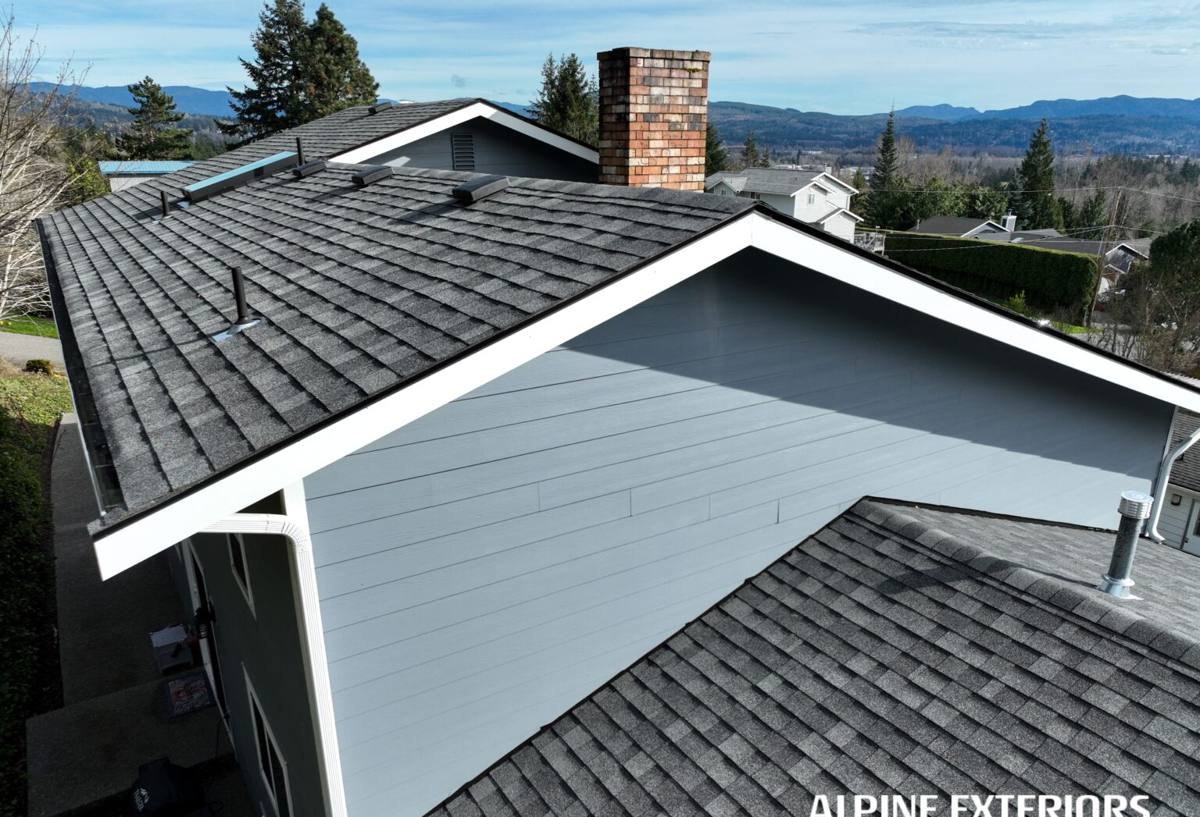
Flashing around chimneys, skylights, and roof-to-wall transitions is the first thing to fail when salt air and driving rain work together. Galvanized fasteners and thin flashing stock corrode from the inside of the seam outward, so the failure is often invisible until it's already leaking. This is one of the most common repair calls we get that started as "just a small drip" during a windstorm.
Valley and Ridge Wear
Valleys concentrate runoff from two roof planes into one channel, so they take the heaviest volume of water on the roof. Combined with wind-driven rain that can push water uphill under a shingle edge for a few inches, valleys and ridge caps are where we find the majority of active leaks we're called out for.
Gutter and Drainage Backups
A roof leak is sometimes not a roof problem at all — it's a drainage problem. Clogged or undersized gutters back water up under the roof edge, especially in a neighborhood with mature tree cover where needle and leaf debris builds up quickly. We check this every time, because fixing shingles while ignoring a backed-up gutter just buys you another service call.
What an Honest Roof Repair Actually Involves
A correct repair starts with finding the actual source of the problem, not just the point where water is showing up inside the house. Water travels — a stain on a bedroom ceiling can trace back to a flashing failure eight feet away. That means every repair call from us starts with a full inspection of the affected roof plane, not a spot patch on the first thing that looks wrong.
Once we've found the source, the repair itself needs to match how the roof was originally built. That means matching shingle exposure and nailing patterns, using flashing metal that won't corrode faster than the surrounding material, and making sure any underlayment we expose during the repair gets replaced rather than reused. Cutting corners on any one of these steps is how a "repaired" roof ends up leaking again in the same spot within a year or two.
Signs Your Roof Needs a Repair Call
- Dark streaking or green growth on shingles, especially on shaded or north-facing slopes
- Granules collecting in gutters or at the base of downspouts
- Curling, cracked, or missing shingle tabs after a windstorm
- Daylight visible through the attic roof deck or soffit venting
- Water stains on ceilings or upper walls that appear or worsen during heavy rain
- Soft or spongy spots underfoot when walking the roof for inspection
- Rust streaking below flashing points or metal roof valleys
- Sagging in the roofline between rafters
Our Repair Process
- Inspection. We walk the roof and the attic (when accessible) to trace the leak or damage back to its actual source, not just the symptom.
- Written scope. You get a plain-language explanation of what's failing, why, and what the repair involves — before any work starts.
- Removal of damaged material. We pull back shingles, flashing, or underlayment only as far as needed to reach sound material underneath.
- Deck check. If the plywood or sheathing underneath has taken on moisture damage, we address that before anything goes back on top of it — patching over soft decking is how repairs fail.
- Rebuild. New underlayment, correctly lapped flashing, and matched shingles or roofing material installed to the same standard as new construction.
- Cleanup and moss treatment. Debris removed, and if moss was part of the problem, we treat the affected areas and talk through prevention going forward.
- Walkthrough. We show you what was done and what to watch for, so there are no surprises later.
Repair or Replace? How We Help You Decide
Not every roof problem in Cordata needs a full replacement, and not every repair is worth doing on a roof that's near the end of its service life. The honest answer usually comes down to how much of the roof is affected, how old the existing roofing is, and whether the decking underneath is still sound.
| Factor | Leans Toward Repair | Leans Toward Replacement |
|---|---|---|
| Roof age | Under 15 years, shingles otherwise in good condition | Near or past manufacturer's expected lifespan |
| Extent of damage | Isolated to one flashing point, valley, or section | Widespread granule loss, curling, or moss across multiple slopes |
| Decking condition | Solid, no soft spots found during inspection | Soft, delaminated, or water-stained sheathing in multiple areas |
| Leak history | First occurrence or isolated storm damage | Recurring leaks in different spots over recent years |
| Underlayment | Still intact where exposed during inspection | Brittle, torn, or missing in multiple areas |
When a roof falls in the middle of this table, we'll tell you that too — sometimes the honest answer is "repair it now, budget for replacement in the next few years," and we'd rather give you that answer than sell you a job you don't need yet.
Materials and Product Choices for This Climate
In a neighborhood dealing with sustained moisture and moss pressure, product choice matters more than in drier climates. We favor algae- and moss-resistant shingle lines where a repair involves a full section replacement, since the copper- or zinc-infused granules in these products actively discourage regrowth rather than just resisting it passively. For flashing, we use corrosion-resistant metal rather than the thinnest gauge available, because the marginal cost difference is small compared to the cost of redoing a flashing repair in five years instead of fifteen.
We're selective about ventilation products and underlayment as well. Poor attic ventilation traps moisture against the underside of the roof deck, which undoes the benefit of even the best shingle on top. Any repair that touches a section with inadequate venting gets flagged, because fixing the leak without fixing the airflow just delays the next problem.
What We Steer Away From, and Why
We're cautious about the lowest-tier shingle products in this climate — not because they're incapable of shedding water, but because their granule adhesion and algae resistance tend to fall short faster under Bellingham's extended damp season, meaning a homeowner ends up back in repair mode sooner than the warranty term would suggest. That's a maintenance-burden and value judgment on our part, not a claim that any specific brand fails outright. We'd rather spec a product that holds up to eight months of shade and moisture a year than one rated for a national average that doesn't reflect Whatcom County weather.
Timing a Repair Around the Pacific Northwest Calendar
Roof repairs can be done in almost any season here, but timing affects both the work and the cost of waiting. Late spring through early fall gives the most stable working conditions and the best shingle sealing performance, since asphalt shingles bond best in warmer weather. That said, a leak found in November shouldn't wait for June — active moisture intrusion during the wettest months causes more decking damage the longer it's left, so urgent repairs get scheduled and completed regardless of season using techniques suited to wet-weather work. The bigger seasonal factor is moss: fall is the best time to treat and remove it, before winter rains wash spores into every crevice and start the cycle again for another year.
Why a Crew That Already Works in Cordata Matters
Roofing crews who split their time across very different climates tend to apply one standard everywhere, and that standard often doesn't account for how much moss pressure, salt air, and driving rain compound each other in a neighborhood like this one. Working roofs in and around Bellingham regularly means we're not guessing at how a repair will hold up through a Whatcom County winter — we've already seen how last year's repairs performed through this year's rain. That translates into practical decisions on your roof: which flashing detail to use at a given valley pitch, how much moss treatment is enough versus overkill, and when a "small" leak is actually a sign of a bigger problem building underneath.
It also means straightforward, local accountability. A repair crew based in the area isn't a phone number in another state — if something about the repair doesn't hold up the way it should, we're a short drive away, not a call center.
Get a Straight Answer About Your Roof
If you're dealing with a leak, moss buildup, or storm damage on a Cordata home, we're happy to take a look and give you a clear, no-pressure assessment of what's actually going on and what it would take to fix it right. Use the form below to request a free estimate.