 Bellingham Exterior
 Edgemoor's Waterfront Exposure Puts Real Demands on Siding
Edgemoor sits on the bluffs and shoreline above Bellingham Bay, and that location shapes everything about how siding performs there. Homes here get two things at once that most inland Whatcom County properties don't: direct exposure to marine air coming off the bay, and heavy tree canopy that keeps large sections of the exterior shaded and damp for much of the year. Wind-driven rain off the water, salt-laden air, and a long stretch of low sun and moss growth all load onto the siding at the same time. A product that holds up fine on a sunny, open lot a few miles inland can struggle on a shaded, water-facing lot in Edgemoor.
We've worked on homes throughout Bellingham and Whatcom County long enough to know that "siding for the Pacific Northwest" isn't one single answer. Edgemoor's specific combination of salt air, driving rain, and a long moss season calls for a product and an installation approach built for exactly that mix, not a generic regional recommendation.
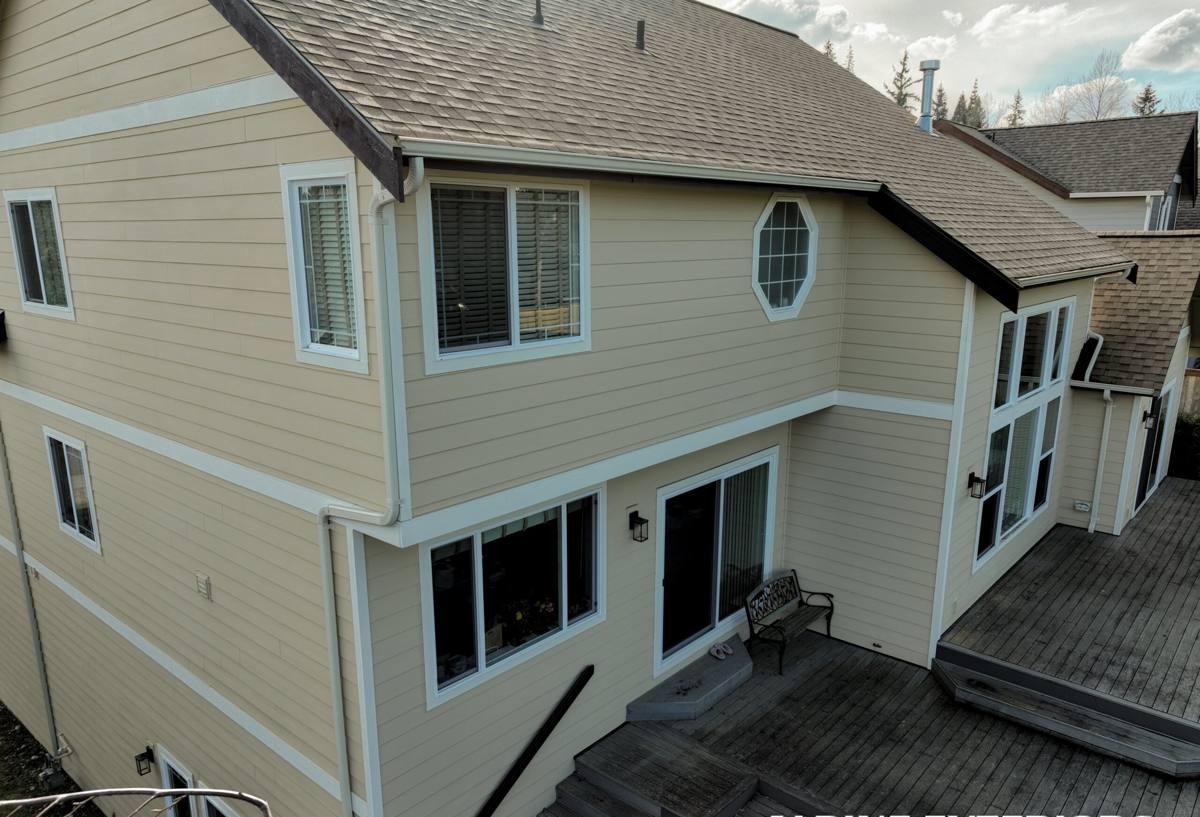
What Salt Air, Driving Rain, and Moss Season Actually Do to Siding
Salt Air
Airborne salt from the bay settles on exterior surfaces and accelerates corrosion of exposed metal — fasteners, flashing, trim edges — and it holds moisture against whatever it lands on. Materials that rely on a painted or coated surface film to keep water out are more vulnerable here, because salt residue breaks down finishes faster than it does a few miles from the water.
Driving Rain
Bellingham Bay generates wind that drives rain sideways into a wall rather than letting it fall straight down and run off. That means water gets pushed at seams, laps, window and door trim, and any gap in the weather barrier with more force than a calm-rain installation would ever see. Siding and flashing details that are "good enough" in a sheltered inland yard can leak on an exposed Edgemoor wall.
The Long Moss Season
Shade from mature trees plus consistent moisture is exactly what moss and algae need to take hold, and once established they hold water against the siding surface far longer than open air would. On wood-based products, that trapped moisture is where rot starts. On products with a painted wood-fiber surface, it's where the finish fails first. The growing season for moss in a shaded Edgemoor yard runs longer than it does on an open, sun-exposed lot elsewhere in Bellingham.
Why We Only Install James Hardie Fiber Cement in Edgemoor
Fiber cement is made from Portland cement, sand, and cellulose fibers, pressed and cured into a rigid, non-combustible board. It doesn't have a wood core that can absorb water and rot from the inside, and it doesn't rely on an organic surface layer that moss and algae can feed on the way some engineered-wood and untreated wood products do. That matters directly for an Edgemoor lot: a material that stays dimensionally stable when it's wet, doesn't swell or delaminate at cut edges, and won't feed the moss growth that shaded, damp yards produce is simply the right tool for this specific site condition.
We've made a deliberate choice not to install LP SmartSide, Cemplank, Allura, primed spruce, or cedar. Every one of those products has real strengths, and we're not going to pretend otherwise — engineered wood siding is lighter and easier to handle, cedar has a look a lot of homeowners love, and vinyl is inexpensive up front. But on a site with Edgemoor's exposure, the trade-offs stack up: wood-based products need more diligent maintenance and are more sensitive to the kind of sustained moisture this neighborhood sees, and vinyl can warp or fade under direct sun exposure on the more open lots and doesn't hold paint if a homeowner ever wants to change the color. James Hardie's fiber cement, finished with their factory-applied ColorPlus coating, gives us a product we're comfortable standing behind on a marine-exposed, tree-shaded lot without asking the homeowner to take on a maintenance schedule the site doesn't forgive.
Choosing the Right Hardie Product Line for an Edgemoor Home
Bellingham falls in James Hardie's HZ5 climate zone, which is engineered for regions that see sustained moisture, humidity, and freeze-thaw cycling — as opposed to their HZ10 line, built for hot, high-UV climates like the Gulf Coast. Every board we install here is HZ5-engineered specifically for this kind of weather, not a generic national product.
Beyond the climate engineering, the right choice also depends on the home's architecture. Edgemoor has a mix of older craftsman and cottage-style homes and newer builds, and the product line should match that.
| Product | Best suited for | Texture options |
|---|---|---|
| HardiePlank lap siding | Most homes; traditional horizontal lap look | Smooth, Select Cedarmill, Cedarmill |
| HardieShingle | Craftsman, cottage, and Cape Cod-style homes | Staggered-edge or straight-edge panels |
| HardiePanel | Vertical accents, gables, modern facades | Smooth, Stucco, Sierra 8 |
| HardieTrim | Corner boards, window and door trim, fascia | Smooth, Roughsawn |
On a shaded, water-facing lot, we also pay close attention to color. Darker ColorPlus finishes can show water spotting and mineral deposits from splashback differently than lighter finishes, and we'll walk through that trade-off with you rather than just handing over a color chart.
What a Correct Installation Actually Involves
Fiber cement performs exactly as well as it's installed — the product itself isn't the whole story. On a site like Edgemoor, where wind-driven rain is pushing water at every seam, the installation details are what actually keep water out of the wall assembly. A correct job includes:
- A drainable rainscreen gap behind the siding, so any water that does get past the surface has somewhere to go and can dry out instead of sitting against the sheathing
- Correct fastener type, spacing, and nailing pattern for the HZ5 zone — under-fastened or improperly placed nails are one of the most common causes of early failure
- Properly lapped and sealed weather-resistive barrier behind the siding, with all penetrations flashed before the siding goes on
- Kickout flashing at every roof-to-wall intersection, directing runoff away from the wall instead of behind it
- Correct clearance between the bottom of the siding and grade, decking, and roof lines, so splashback and standing water can't wick into the board
- Factory-primed or field-primed cut edges, sealed before installation, so moisture can't enter through an exposed cut
- Caulking only at the joints Hardie's install specs call for — over-caulking traps moisture just as surely as under-caulking lets it in
This is also where hiring a crew that already knows Edgemoor pays off. A generalist crew that mostly installs on open, inland lots may not default to the rainscreen detailing or kickout flashing this neighborhood actually needs, because they haven't had to solve for it as often.
Our Process, Start to Finish
- On-site inspection. We look at the existing siding, sheathing, and trim condition, check for any moisture or rot already present, and assess the specific exposure of your lot — how much direct rain and sun it gets, how much shade and moss pressure it carries.
- Tear-off and assessment. Removing the old siding lets us see the sheathing and framing underneath. Any water damage found at this stage gets repaired before anything new goes back on — we don't cover over a problem.
- Weather barrier and rainscreen installation. We install a new weather-resistive barrier and a drainable rainscreen gap, flashing all windows, doors, and penetrations as we go.
- Trim and flashing. Corner boards, window and door trim, and all flashing details go in before the field siding, set to the reveal and clearances the job calls for.
- Hardie siding installation. Boards, panels, or shingles go up to James Hardie's published installation instructions for the HZ5 zone, with correct fastening and joint treatment throughout.
- Caulk, touch-up, and final detailing. Cut edges are sealed, touch-up paint is applied where needed, and every joint is checked against spec.
- Final walkthrough. We go over the finished job with you before calling it done.
Cost Factors for an Edgemoor Fiber Cement Project
Every home is different, and we'll give you an exact number after we've actually looked at your house — but these are the variables that move the price up or down on a typical Edgemoor project:
| Factor | Why it matters |
|---|---|
| Square footage and home height | More surface area and multi-story walls mean more material and labor, plus more scaffolding or lift work |
| Tear-off scope | Removing and disposing of existing siding adds cost versus a bare-sheathing new build |
| Hidden moisture or rot repair | Damaged sheathing or framing found during tear-off has to be repaired before new siding goes on |
| Site access | Bluff lots, mature trees, and tight side yards common in Edgemoor can slow staging and material handling |
| Trim and detail complexity | Multiple gables, dormers, and accent panels take more time than a simple rectangular wall |
| Product line and texture | HardieShingle and custom trim profiles cost more than standard HardiePlank lap siding |
Why Local Experience in This Neighborhood Matters
A siding job that looks fine the day it's finished can still fail in three or four years if it wasn't detailed for the actual site conditions. Crews that regularly work in Edgemoor already know how much rain a bay-facing wall takes compared to a sheltered one two streets back, how long moss pressure lasts under mature tree cover, and how to sequence a project around Whatcom County's wetter months so the wall assembly isn't left open to weather longer than it has to be. That local pattern recognition is the difference between a crew that follows a generic checklist and one that adjusts the checklist to your actual lot.
Caring for Your Siding After Installation
Correctly installed James Hardie fiber cement is genuinely low-maintenance, but "low-maintenance" doesn't mean "no maintenance," especially on an Edgemoor lot. A few habits keep it performing the way it's designed to:
- Rinse siding surfaces once or twice a year to clear salt residue and organic buildup before moss gets a foothold
- Keep gutters and downspouts clear so runoff doesn't sheet down the wall face
- Trim back vegetation and tree limbs that hold siding in constant shade and slow drying time
- Have caulked joints inspected every few years and re-sealed if they've dried out or pulled away
- Touch up any nicks or scratches promptly with matching ColorPlus touch-up paint to keep the factory finish protecting the substrate
James Hardie backs its siding with a long, non-prorated, transferable product warranty, and we stand behind our own workmanship on top of that — which only holds up if the installation was done to spec in the first place.
If you're weighing siding options for a home in Edgemoor, we're happy to walk your property, look at your specific exposure, and give you a straightforward, no-pressure estimate — just fill out the form below to get started.