 Bellingham Exterior
 Why Ferndale Roofs Wear Differently Than Roofs Inland
Ferndale sits close enough to Puget Sound that salt-laden air is a regular part of the weather, not an occasional visitor. Combine that with Whatcom County's long wet season, driving rain that comes in sideways off the water, and tree cover that keeps roofs shaded and damp for weeks at a stretch, and you get a roofing environment that's tougher on materials than most manufacturers' warranty testing accounts for. Asphalt shingles are still the right choice for the vast majority of Ferndale homes — they're durable, affordable, and available in styles that hold up well here — but only when they're specified and installed with this specific climate in mind.
We've worked on roofs throughout the Bellingham area long enough to see the pattern repeat: a shingle roof installed with inland assumptions — minimal underlayment, standard ventilation, no real moss strategy — starts showing problems five to seven years earlier than one installed for what Whatcom County actually throws at it. That gap is almost entirely about installation choices, not the shingle brand.
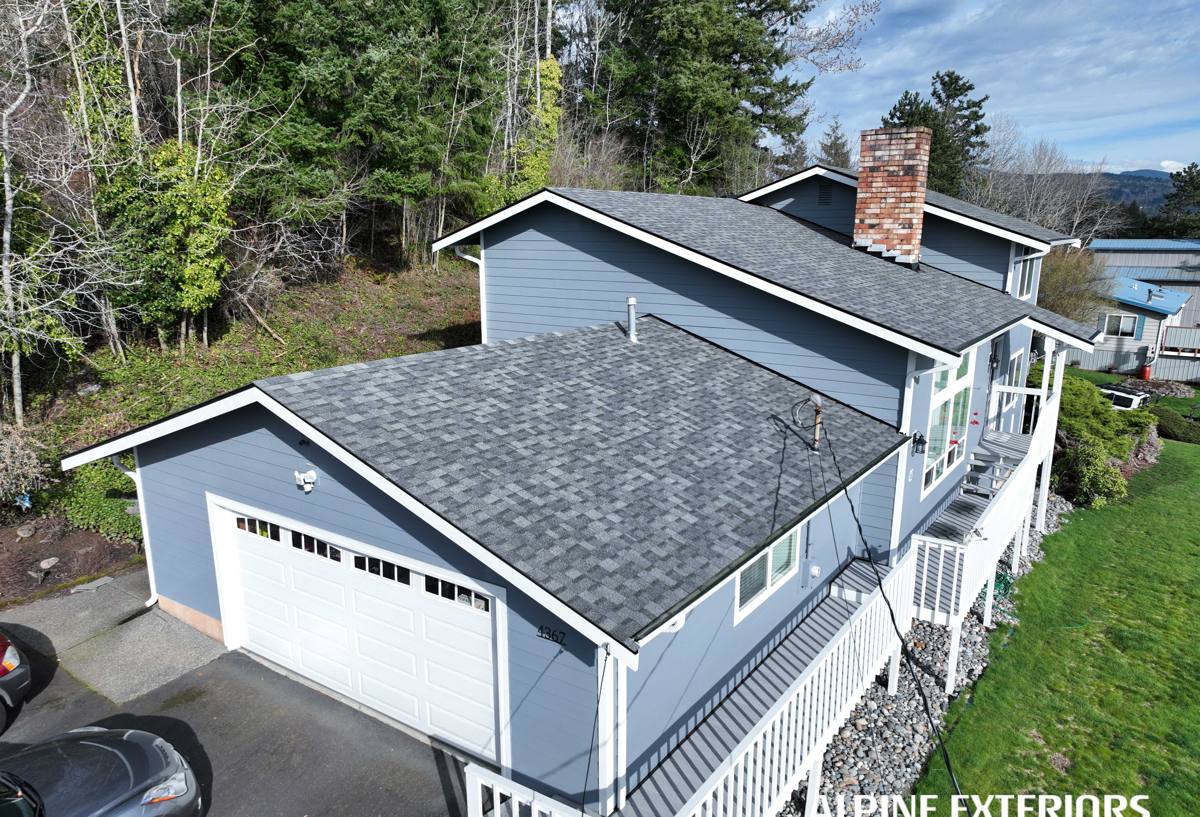
What Goes Into a Correctly Installed Asphalt Shingle Roof
A shingle roof is a system, not a single product. The shingle itself gets all the attention, but in a marine climate like Ferndale's, the layers underneath and around it usually determine whether the roof reaches its full service life.
Tear-Off and Deck Inspection
We don't install new shingles over old ones, and we don't recommend it here. A full tear-off lets us actually see the roof deck — the plywood or OSB sheathing underneath — and check it for soft spots, delamination, or rot before covering it back up for another 20-plus years. In a climate with this much sustained moisture, deck problems that get sealed over don't go away; they just get worse out of sight.
Underlayment and Moisture Protection
Standard felt underlayment is the minimum code requirement, not the right call for a coastal Whatcom County roof. We install a synthetic underlayment rated for high-moisture exposure across the full roof, and we add self-adhering ice-and-water membrane at the eaves, valleys, and any low-slope transitions — the spots where wind-driven rain is most likely to find a way under the shingle line. This is the layer that keeps a roof watertight even after a shingle gets lifted or damaged in a windstorm, which matters more here than in drier parts of the state.
Flashing Details That Actually Stop Leaks
Most roof leaks don't come from failed shingles — they come from flashing: the metal at chimneys, skylights, sidewalls, and roof-to-wall transitions. We use new step flashing and counter-flashing at every penetration and wall intersection rather than reusing old pieces or relying on caulk to bridge a gap. Caulk is a maintenance item, not a waterproofing strategy, and in a climate this wet it fails faster than homeowners expect.
Ventilation: The Part Homeowners Never See
Balanced intake and exhaust ventilation keeps the attic space close to outdoor temperature and humidity, which does two things in Ferndale specifically: it reduces condensation buildup on the underside of the deck during our long damp stretches, and it helps the shingles shed heat evenly so they age at the same rate across the whole roof. A roof that's under-ventilated often shows premature granule loss and curling years before it should, even with a good shingle installed correctly on top.
Choosing a Shingle for Whatcom County Weather
Not every asphalt shingle line performs the same way in a marine climate. The biggest practical differences show up in algae resistance, wind rating, and how forgiving the shingle is during installation in cool, damp conditions — which describes most of the roofing season here.
| Shingle Tier | Typical Wind Rating | Algae Resistance | Best Fit For |
|---|---|---|---|
| Standard 3-tab | Lower end of the range | Minimal or none | Budget-driven projects, secondary structures |
| Architectural / laminated | Mid-to-high range | Usually includes algae-resistant granules | Most Ferndale homes — the practical baseline |
| Premium designer laminate | High end of the range | Enhanced algae-resistant granules | Steeper rooflines, higher exposure to wind off the water |
For most Ferndale properties, we point homeowners toward a mid-to-upper architectural shingle with algae-resistant (copper-infused) granules built in. It costs more than 3-tab up front, but the algae resistance alone tends to pay for itself here — a roof without it can show visible streaking within a few damp seasons, and that discoloration doesn't wash off with a garden hose.
Moss, Algae, and Salt Air: Living With the Climate After Install
No shingle, no matter how good, makes a roof maintenance-free in this part of Whatcom County. Moss spores travel on wind and settle wherever shade and moisture linger, and Ferndale has plenty of both for much of the year. A correctly installed roof reduces the problem significantly but doesn't eliminate it.
We install zinc or copper strips near the ridge on roofs where moss has been a recurring issue — rainwater carrying trace metal ions down the roof face creates an environment moss doesn't like. We also make sure gutters and valleys are clear and properly pitched at handoff, since trapped organic debris in a gutter is one of the most common places moss and rot get started, and it's the easiest thing for a homeowner to stay on top of afterward.
Salt air mainly affects the metal components of a roofing system — flashing, fasteners, vents — faster than it affects the shingles themselves. We spec corrosion-resistant fasteners and flashing on every job this close to the water, which is a small cost difference at installation and a real difference in how the roof looks and performs a decade in.
Signs Your Ferndale Roof Needs Attention
Most roof failures don't happen suddenly — there's usually a window of warning signs first. Worth checking for, especially after a hard winter storm season:
- Granules collecting in gutters or at the base of downspouts
- Dark streaking or green-black patches, particularly on north-facing slopes
- Shingles that look curled, cupped, or lifted at the edges
- Moss visibly growing along the ridge, valleys, or shaded slopes
- Daylight visible through the attic roof deck
- Water stains on interior ceilings, especially near chimneys or skylights
- Missing or torn shingles after a windstorm
- Sagging areas anywhere on the roof plane
Any one of these on its own isn't necessarily an emergency, but they're worth a professional look rather than a wait-and-see approach — moisture intrusion in this climate rarely stays small.
How Our Process Works, Start to Finish
- On-site inspection and estimate. We walk the roof (or use a drone where a walk isn't safe), check the attic if accessible, and give you an honest read on condition — repair versus replacement, no upsell pressure either direction.
- Written scope and material selection. You get a clear, itemized proposal covering tear-off, decking, underlayment, flashing, ventilation, and the specific shingle line, so there's no ambiguity about what's included.
- Scheduling around the weather. We work with Whatcom County's rain patterns rather than against them, and we don't start a tear-off without a realistic window to get the roof dried in.
- Tear-off and deck repair. Old material comes off, the deck gets inspected, and any damaged sheathing is replaced before anything new goes down.
- Underlayment, flashing, and shingle installation. Installed in the sequence and detail described above — not shortcut to save a day of labor.
- Cleanup and magnetic sweep. Job site and surrounding yard are cleared of debris and swept for nails and staples before we consider the job done.
- Final walkthrough. We go over the finished roof with you, answer questions, and cover basic maintenance — gutter clearing, what to watch for — before we leave.
Why Hiring a Crew That Already Works in Ferndale Matters
A roofing crew based in the Bellingham area and already working in Ferndale brings a few practical advantages that an out-of-town or traveling crew usually can't match. We already know how local building department permitting and inspections typically run, so scheduling doesn't get held up by surprises. We know how exposed a given roofline is likely to be to wind coming off the water, which affects fastening patterns and shingle selection, not just aesthetics. And because we're local, a warranty callback or storm-damage check isn't a multi-hour drive for us — it's a normal part of the week.
That local presence also means accountability. We're not a crew that finishes a job and disappears to the next region over; we live and work in this area, and our reputation here depends on the roofs we've installed still performing years later.
What Drives the Cost of a Ferndale Roofing Job
Every roof is different, and we'd rather give you an accurate number from an actual inspection than a broad estimate that doesn't hold up. That said, a few factors consistently move the price on Ferndale jobs more than others:
| Factor | Why It Matters Here |
|---|---|
| Roof pitch and access | Steeper roofs and difficult access add labor and safety-equipment time |
| Deck condition | Moisture-related sheathing damage is more common in this climate and adds repair cost when found |
| Shingle tier selected | Algae-resistant architectural shingles cost more up front than 3-tab but reduce maintenance and staining |
| Flashing and penetration count | Chimneys, skylights, and multiple roof planes each add flashing labor and material |
| Ventilation upgrades | Adding or correcting intake/exhaust venting is often worth doing during a tear-off rather than later |
| Moss mitigation | Zinc/copper strip installation is a small add-on cost with a real payoff on shaded roofs |
Broadly, a straightforward asphalt shingle replacement on a typical single-family home in this area runs in the range most homeowners expect for quality architectural shingles with full underlayment and flashing work — the specifics depend on the roof itself, which is why we measure and inspect before quoting rather than pricing over the phone.
If your roof is due for a look, or you just want a straight answer about what shape it's in, we're happy to come out and take a look. The estimate is free, there's no pressure attached to it, and you can use the form below to get in touch.