 Bellingham Exterior
 Board & Batten Siding in Happy Valley
Happy Valley is one of Bellingham's older, tree-shaded residential neighborhoods, close enough to Bellingham Bay that salt air is part of daily life and hemmed in by mature tree canopy that keeps large sections of every roofline and wall in shade for much of the year. That combination — moisture off the water, shade that never fully dries out, and a housing stock that spans early-1900s craftsman-era homes to newer infill construction — makes board and batten one of the more popular siding profiles homeowners ask us about here. It reads as classic Pacific Northwest and it fits the mix of architectural styles in the neighborhood without looking out of place next to a 1920s bungalow or a 2015 build. But board and batten is also a profile that punishes bad installation faster than lap siding does, and Happy Valley's climate is exactly the kind of environment that finds those mistakes.
This page covers what board and batten siding needs to hold up in this specific neighborhood, what a correct installation actually involves, and why the crew doing the work matters as much as the material itself.
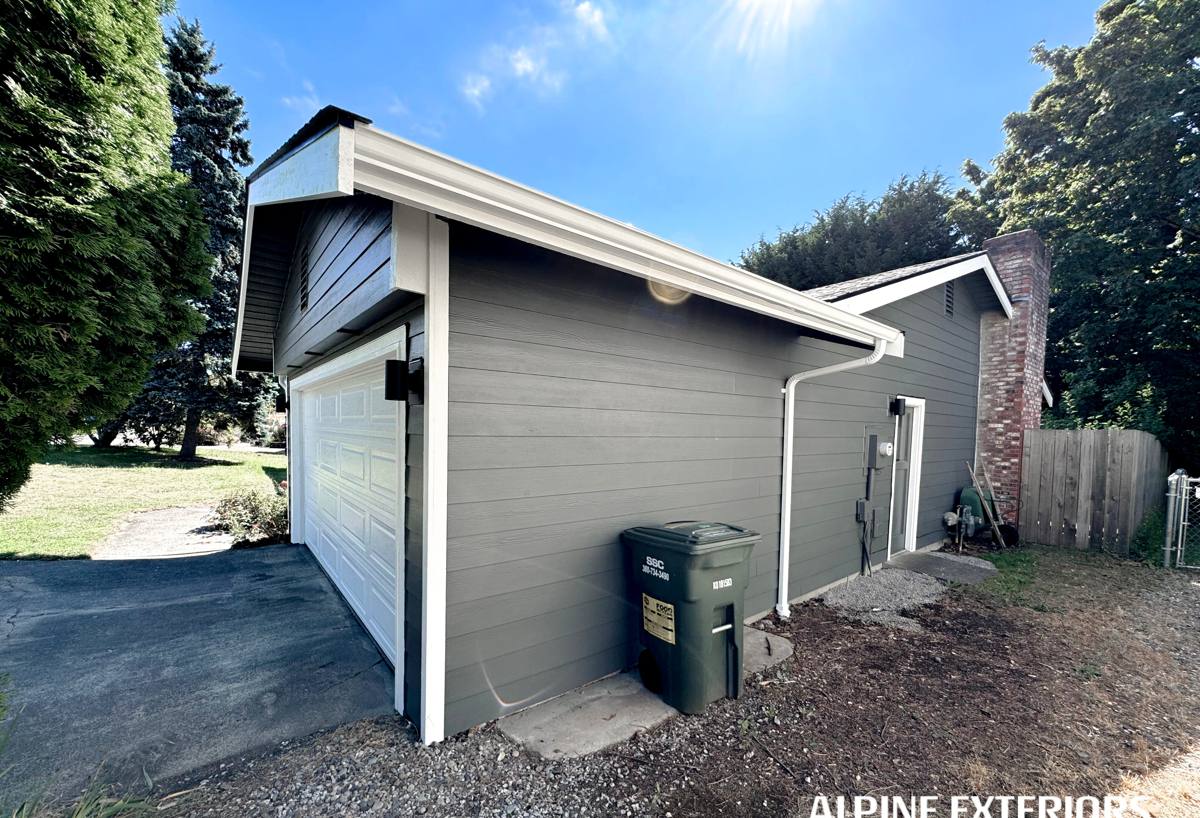
What Bellingham's Climate Does to Vertical Siding
Board and batten is a vertical profile with a batten strip covering every seam between boards. That design is part of why homeowners like the look, but it also means every batten is a potential water trap if it isn't installed with the right spacing, fasteners, and drainage behind it. In Whatcom County's climate, three factors matter more than most homeowners expect:
Salt Air
Proximity to Bellingham Bay means airborne salt is a constant, low-level presence on the west and north-facing walls of homes throughout Happy Valley. Salt accelerates corrosion on fasteners and metal trim, and it degrades cheap paint finishes faster than inland exposure would. Any board and batten system installed here needs corrosion-resistant fasteners and a factory finish rated to hold color and adhesion against that exposure — not a field-applied paint job that's doing all the work on its own.
Driving Rain
Bellingham doesn't just get rain — it gets wind-driven rain off the Strait and the Bay that hits walls sideways rather than falling straight down. Vertical siding profiles like board and batten are more exposed to this than horizontal lap siding because the battens create more vertical seams for wind-driven water to find. Correct flashing at every horizontal transition — windows, doors, water tables, roof lines — is what actually keeps that water out, not the siding material by itself.
Moss Season
The tree cover that gives Happy Valley its character also means long stretches of shade where surfaces stay damp well after a storm has passed. That's a long moss and algae season on siding, trim, and roofing. Fiber cement resists moisture absorption in a way that wood-based products don't, but no siding material is moss-proof if it's installed tight against foliage with no airflow, or if drainage behind the panel is blocked.
The James Hardie Board & Batten System We Install
We install James Hardie fiber cement exclusively, and for board and batten applications that means Hardie's vertical panel and batten system, factory-finished with ColorPlus Technology. A few things about that system matter specifically for this neighborhood:
- Non-combustible core — fiber cement doesn't feed a fire the way wood-based sidings can, which matters given how much dry vegetation surrounds homes here during summer months.
- Factory-baked finish — ColorPlus finish is cured onto the board before it ever reaches the job site, which holds up better against salt exposure and UV than field-applied paint, and it comes with its own finish warranty separate from the substrate warranty.
- HZ5 or HZ10 engineering — Hardie manufactures its siding in moisture and freeze-thaw formulations matched to specific climate zones. Western Washington falls into the HZ5 category, engineered for the wet, moderate climate we actually have rather than a generic national spec.
- Dimensional stability — fiber cement doesn't swell, cup, or split the way wood and some engineered wood products can when they take on repeated moisture cycles, which is a real advantage in a neighborhood that stays damp as long as Happy Valley does.
We don't install vinyl, LP SmartSide, cedar, primed spruce, or other fiber cement brands. That's a deliberate standard, not a sales pitch — we've made the call that Hardie's combination of factory finish, climate-specific engineering, and warranty structure is what we're willing to put our name behind, and it's the only system we warranty our installation work against.
What Correct Installation Actually Involves
Board and batten fails in this climate almost exclusively because of installation shortcuts, not material failure. The panel and battens are only as good as the water management system built behind them. A correct installation on a Happy Valley home includes:
- A drainable weather-resistive barrier installed continuously behind the siding, not just tucked in around openings
- Rainscreen furring strips or a drainage mat to create an air gap behind the panel, so bulk water and condensation can drain and dry instead of sitting against the substrate
- Correctly flashed window and door heads, sills, and jambs — the single most common failure point we find on older siding jobs in this neighborhood
- Batten fastening per Hardie's engineering specs, with corrosion-resistant fasteners sized and spaced for wind and moisture exposure
- Proper clearance at the base of the wall — siding held off grade, decks, and hardscape per manufacturer minimums so splash-back and standing moisture don't sit against the bottom course
- Caulking and sealant only where Hardie's install guide actually calls for it — over-caulking a board and batten system can trap moisture behind the panel instead of letting it drain
Any one of those steps skipped is invisible on installation day and shows up two to five years later as staining, soft trim, or premature paint failure — right around when driving rain and moss season have had a few cycles to find the gap.
Board & Batten vs. Other Common Siding Choices in Happy Valley
Homeowners in this neighborhood often ask how board and batten compares to the lap siding and shingle-style siding common on older homes nearby. Here's how the honest trade-offs shake out:
| Factor | Board & Batten (Hardie) | Horizontal Lap Siding | Cedar Shingle Siding |
|---|---|---|---|
| Water exposure risk | Higher seam count, needs correct drainage plane | Fewer vertical seams, sheds water more simply | High-maintenance, prone to moss and rot in shade |
| Look on older homes | Classic, works on craftsman and farmhouse-style homes | Traditional, very common in the neighborhood | Historic look, high upkeep |
| Maintenance | Low — factory finish, occasional wash | Low with fiber cement, higher with wood | High — regular treatment, moss removal |
| Salt air performance | Strong with ColorPlus finish and stainless/coated fasteners | Strong, same finish system | Weak — wood degrades faster near the Bay |
| Installation sensitivity | High — depends heavily on crew experience | Moderate | High, labor-intensive |
Board and batten isn't automatically the "better" choice — it's a look-driven decision that comes with a higher installation bar. On a home where it fits the architecture, it's an excellent choice as long as the crew installing it treats it that way.
Our Process From Estimate to Finished Job
For a board and batten project in Happy Valley, our process is the same whether it's a full re-side or a targeted section:
- On-site walkthrough — we look at existing siding, trim condition, moisture history around windows and the foundation line, and how much shade and tree cover the walls get.
- Water management plan — before we talk panel color, we plan the weather-resistive barrier, drainage gap, and flashing details specific to that house's exposure.
- Written estimate — scope, product line, finish color, and a clear breakdown of what's included, with no vague allowances.
- Tear-off and substrate check — we don't panel over rot or hidden water damage; anything we find gets flagged and addressed before new siding goes up.
- Installation to Hardie spec — drainage plane, battens, flashing, and fastening done to manufacturer engineering, not shortcuts.
- Final walkthrough — we go over the finished job with the homeowner before we call it done.
Why Hiring a Crew That Already Works Happy Valley Matters
Board and batten installation isn't neighborhood-specific in the sense of needing local permits knowledge only — it's specific in the sense that a crew who's worked on shaded, salt-exposed, older housing stock in this part of Bellingham has already seen how these homes fail when the wrong install method was used. That's not something a crew coming from a drier inland region, or one used to new-construction tract homes with simple wall assemblies, necessarily has calibrated. Whatcom County's combination of coastal exposure and heavy tree cover is a specific set of conditions, and a contractor who treats every job the same regardless of region is the most common source of the callbacks we get asked to fix.
Maintenance and What to Expect Year to Year
Correctly installed Hardie board and batten is low-maintenance, not no-maintenance. In this climate, plan on:
- An annual rinse-down, especially on shaded walls, to keep moss and algae from taking hold
- Periodic visual checks at flashing points — window heads, the water table, and where siding meets roof lines — after major storm seasons
- Keeping vegetation and mulch beds pulled back from the base of the wall so airflow and drainage aren't blocked
- Repainting is rarely needed with ColorPlus finish, but if a section is ever damaged, it should be repaired with matched materials rather than patched with a different product
None of this is heavy upkeep — it's the difference between a board and batten job that still looks sharp at fifteen years and one that's showing moss streaking and soft trim at year five.
Get a Free Estimate
If you're weighing board and batten for a home in Happy Valley, we're glad to come take a look, walk the exterior with you, and give you a straight answer on what the job actually needs — no pressure, no inflated scope. Use the form below to request a free estimate.