 Bellingham Exterior
 Siding Built for the Way Happy Valley Actually Weathers
Happy Valley sits close enough to the water and the hills around Bellingham that its homes take a specific kind of beating year-round. Salt-laden air moves in off Bellingham Bay, wind-driven rain hits siding sideways instead of straight down, and the shaded, tree-lined character of the neighborhood means moss and algae have a long growing season with plenty of moisture to work with. None of that is unusual for Whatcom County, but it adds up differently on a wall that faces the water than it does on a wall that doesn't. If you're planning a siding installation in Happy Valley, the product and the installation details matter more here than they would somewhere drier and more sheltered.
We install James Hardie fiber cement siding exclusively. That's not a marketing angle — it's a standard we hold because we've seen how different siding materials actually perform once they've spent a few winters absorbing coastal moisture and shrugging off (or not shrugging off) moss and mildew. This page walks through what a correct siding installation looks like for a Happy Valley home, why the climate here changes the calculus, and how our process is built around those conditions.
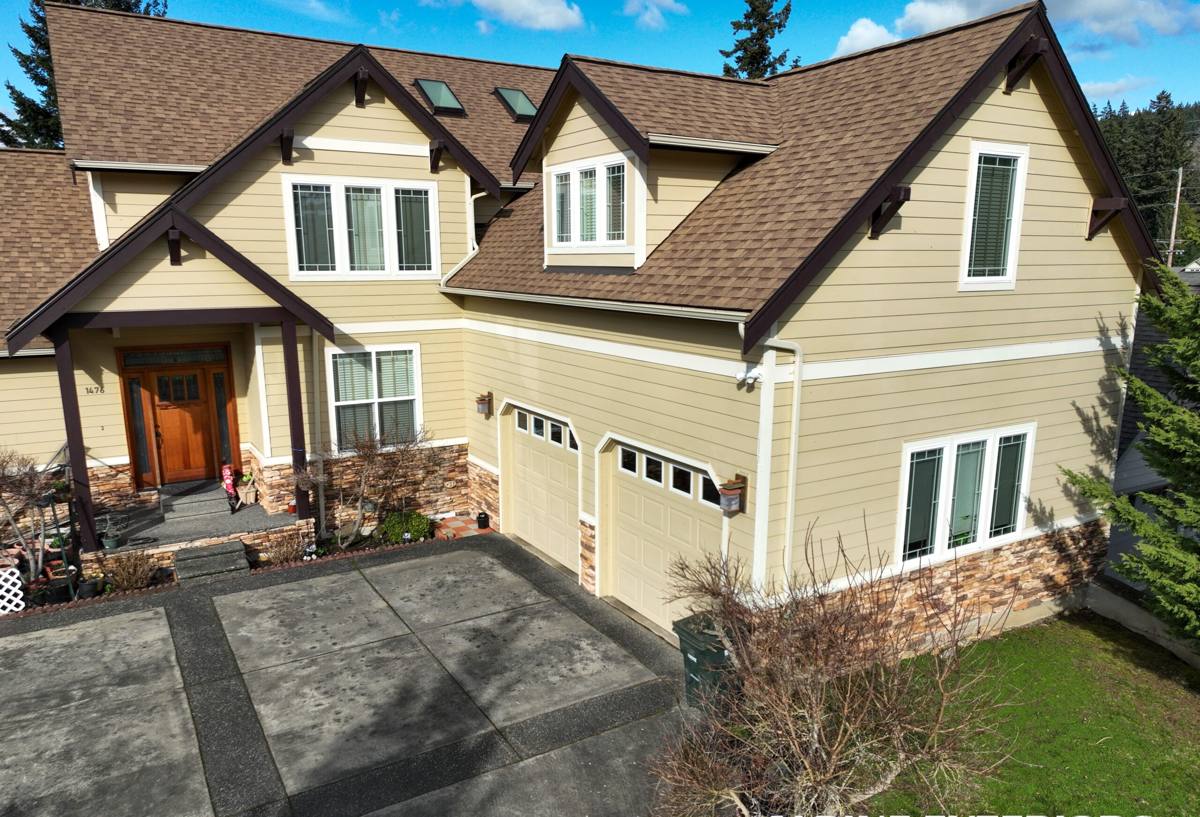
What Salt Air, Driving Rain, and Moss Season Do to Siding
Salt Air
Proximity to Bellingham Bay means airborne salt settles on exterior surfaces even a mile or two inland. Salt is corrosive to metal fasteners and trim, and it's abrasive to finishes that aren't formulated to handle it. Over years, siding with a thin or poorly bonded finish can chalk, fade unevenly, or start showing surface degradation faster than the same product would inland.
Driving Rain
Bellingham doesn't just get a lot of rain — a good share of it arrives horizontally during winter storms. That matters because siding isn't just a weather-facing surface; it's the outer layer of a water-management system. Wind-driven rain finds every gap in flashing, every under-caulked joint, and every place where the water-resistive barrier behind the siding wasn't lapped correctly. A siding job that looks fine on a calm day can leak during a January storm if the details underneath weren't done right.
Moss Season
Between shade, humidity, and mild temperatures, Whatcom County effectively has a moss and algae season that runs most of the year. Siding that stays damp longer — because it's shaded, because of poor airflow behind the panels, or because the material itself absorbs and holds moisture — becomes a growth surface. Once moss or algae take hold, they hold moisture against the siding even longer, accelerating whatever underlying problem let them start.
What This Means for a Happy Valley Home
- Fasteners and flashing need to be corrosion-resistant, not just "standard grade."
- Every horizontal joint, window, and door needs flashing and sealant detailing sized for wind-driven rain, not just gravity-fed drainage.
- The siding material itself needs to resist moisture absorption and support a factory finish that won't degrade quickly in salt air.
- Ventilation behind the siding matters — trapped moisture is what turns a normal moss season into a rot problem.
Why We Install Only James Hardie Fiber Cement Here
We don't install vinyl, LP SmartSide, primed spruce, cedar, or other fiber cement brands. That's a deliberate standard, and Happy Valley's climate is a big part of why we hold it.
Vinyl siding expands and contracts with temperature swings, and its seams and panel laps are a common entry point for wind-driven rain if not installed with generous clearances. It's also a petroleum-based product that can become brittle over time, and it does nothing to resist moss growth — it just gets pressure-washed or replaced when it fades.
Wood-based products, including cedar and primed spruce, are the most vulnerable to Bellingham's rain and moss cycle. Wood absorbs moisture, and once moisture is trapped against or inside a wood substrate, rot is a matter of time, not chance. These products can look excellent when new, but they demand a maintenance commitment — refinishing, caulking, moss treatment — that most homeowners underestimate.
James Hardie fiber cement is engineered specifically to resist moisture absorption, and it's non-combustible, which matters given Washington's increasing wildfire smoke and ember exposure in recent summers. Hardie's ColorPlus factory finish is baked on and warrantied against fading and cracking in a way that field-applied paint isn't, which is a real advantage in salt air. Hardie also makes climate-engineered product lines (their HZ5 line is built for wetter, colder regions like the Pacific Northwest) — this isn't a one-size-fits-all product, and we install the version specified for our climate zone.
What Correct Siding Installation Actually Involves
The siding itself is maybe half the equation. The other half is what's underneath it, and this is where most siding problems in this region actually originate — not from the panels, but from the water-management system behind them.
- Substrate inspection and repair. Before any new siding goes on, the sheathing underneath gets inspected for existing rot or moisture damage, especially around windows, doors, and any past flashing failures. Covering up a damaged substrate is the single most common corner-cutting mistake in this trade.
- Water-resistive barrier. A correctly lapped weather-resistive barrier goes over the sheathing, shingle-style (upper courses over lower) so water sheds outward rather than working its way in.
- Rain screen gap. For a wet climate like ours, a drainage gap between the barrier and the siding allows any moisture that does get behind the panels to drain and the wall to dry out, rather than staying wet against the sheathing.
- Flashing at every penetration. Windows, doors, hose bibs, light fixtures, and any other wall penetration get proper flashing and integrated with the water-resistive barrier — not just caulked over.
- Corrosion-resistant fastening. Fasteners are matched to Hardie's specifications and rated for coastal exposure, so they don't become the weak point in a few years.
- Manufacturer-spec installation. Hardie's warranty depends on installation to their written specifications — clearances above grade and roofing, panel gaps, fastener spacing and placement. Skipping these doesn't just risk performance, it can void the warranty.
Our Process for a Happy Valley Siding Project
1. On-Site Assessment
We walk the property, note sun and shade exposure (which affects moss risk on different sides of the house), check for existing moisture damage, and assess what's driving the need for new siding — age, damage, or a desire to move off a maintenance-heavy material.
2. Scope and Product Selection
We spec the Hardie product line, profile, and color for the home, and walk through what's involved in prep, tear-off, and installation timeline.
3. Tear-Off and Substrate Repair
Old siding comes off, and any compromised sheathing or framing is repaired before anything new goes up. This step is non-negotiable — new siding over a damaged substrate just hides the problem for a while.
4. Water Management Installation
Barrier, rain screen, and flashing go in first, with particular attention to window and door details, since these are the most common leak points in wind-driven rain.
5. Hardie Installation to Spec
Panels are installed to manufacturer clearances and fastening requirements, keeping the warranty intact and ensuring the assembly performs the way it's engineered to.
6. Final Walkthrough
We review the finished work with the homeowner, including basic care expectations for the first year.
Comparing Siding Materials for Happy Valley's Climate
| Factor | Vinyl | Wood / Primed Spruce / Cedar | James Hardie Fiber Cement |
|---|---|---|---|
| Moisture absorption | Low, but seams leak under wind-driven rain | High — primary failure mode | Engineered to resist moisture |
| Moss/algae resistance | No inherent resistance | Poor — holds moisture, feeds growth | Better resistance; factory finish sheds growth more easily |
| Salt air / coastal finish durability | Fades, can become brittle | Field finish degrades faster in salt air | Baked-on ColorPlus finish, warrantied against fading |
| Fire resistance | Combustible | Combustible | Non-combustible |
| Maintenance burden | Low but limited lifespan | High — regular refinishing, moss treatment | Low — periodic washing, no refinishing |
Signs Your Current Siding Is Losing the Battle
- Persistent green or black growth that returns quickly after cleaning
- Paint or finish peeling, chalking, or bubbling, especially on the water-facing side of the home
- Soft or spongy spots when you press on the siding near the bottom or around windows
- Visible cupping, warping, or gaps between boards
- Interior signs like musty smells or staining near exterior walls, which can point to moisture getting through
- Rising energy bills that suggest air and moisture infiltration behind the siding
Why Hiring a Crew That Works Happy Valley Already Matters
Siding installation isn't uniform across Whatcom County. A crew that mostly works drier, more sheltered areas may not default to the flashing details, rain screen approach, or fastener spec that a wind-and-salt-exposed Happy Valley property needs. Working this neighborhood regularly means we already know which elevations tend to take the worst weather, where moss problems typically start, and what the older housing stock in this part of Bellingham commonly needs addressed at the substrate level before new siding goes on. That local pattern recognition is the difference between a siding job that looks good for a season and one that performs correctly for decades.
What to Ask Before You Hire Anyone for a Siding Project
- Do you install to the manufacturer's written specifications, and will the manufacturer's warranty apply?
- What water-resistive barrier and flashing approach do you use, and how do you handle window and door penetrations?
- Do you include a rain screen or drainage gap, and why or why not for this specific home?
- What happens if you find rot or damage once the old siding comes off?
- Are you licensed and insured in Washington, and can you provide proof?
Ready to Talk About Your Siding?
If your Happy Valley home is showing signs of wear — moss that won't quit, peeling finish, or siding that's simply reached the end of its useful life — we're happy to take a look and talk through what a correct James Hardie installation would involve for your specific property. Reach out for a free, no-pressure estimate using the form below.