 Bellingham Exterior
 Puget homeowners deal with a specific combination of weather that a lot of siding simply isn't built to handle long-term: salt-laden air, wind-driven rain that hits walls sideways instead of falling straight down, and a moss and algae season that stretches for most of the year in this part of Whatcom County. If you're researching siding installation for a home in this area, the climate isn't a footnote — it's the whole reason certain products perform well here and others quietly fail years ahead of schedule.
This page covers what siding installation actually involves for a Puget-area home, what correct workmanship looks like in this climate, and why we've standardized on one product system instead of offering the usual menu of options.
What Puget's Climate Actually Does to Siding
Bellingham sits close enough to saltwater that airborne salt is a real factor for homes in low-lying, wind-exposed spots like Puget. Salt air accelerates corrosion on anything metal — fasteners, flashing, trim edges — and it settles into porous or poorly sealed siding surfaces over time. Combine that with rain that comes in at an angle during winter storms, and you get moisture pushed into seams, laps, and butt joints that a straight-down rain would never reach.
Then there's moss. Whatcom County's damp, mild winters and shaded lots give moss and algae a long growing season — often close to year-round on north-facing or tree-covered walls. Moss holds moisture against the siding surface, and where it takes hold on a material that isn't dimensionally stable or properly finished, it accelerates whatever decay process is already underway underneath.
Why This Matters More in Puget Specifically
Not every Bellingham neighborhood gets the same exposure. Homes in Puget that sit near open water or on wind-exposed slopes take a harder hit from driving rain than homes tucked into more sheltered parts of the city. If your lot has mature trees, limited afternoon sun, or a north-facing wall that rarely dries out, you're dealing with the worst-case combination for siding: constant moisture plus limited drying time.
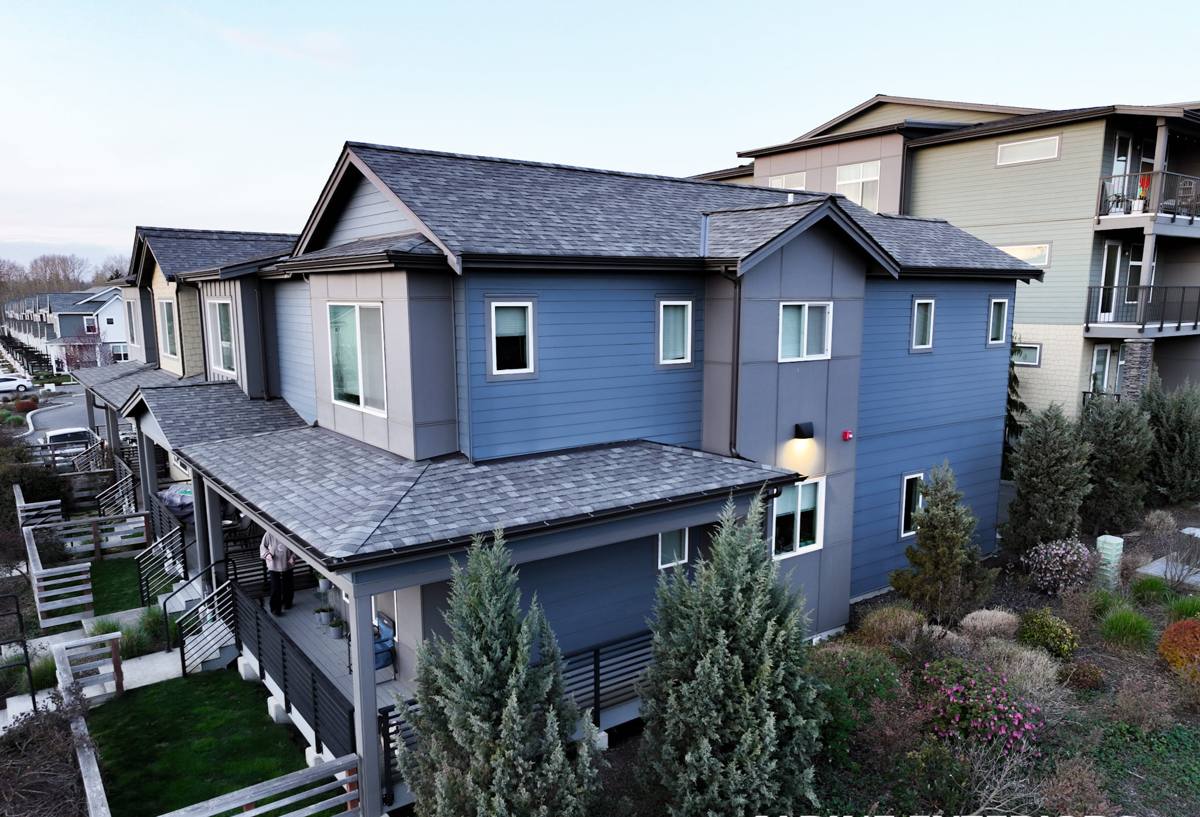
What a Correct Siding Installation Involves
Siding failures in this climate are rarely about the siding material alone — they're almost always about what's happening behind it. A correct installation gets the details right in an order that matters:
- Weather-resistive barrier installed continuously and lapped correctly, shingle-style, so water sheds outward rather than working its way behind the barrier at seams.
- Flashing at every penetration — windows, doors, hose bibs, light fixtures, vents — installed so water is directed out and down, never trapped behind the siding.
- Proper fastener placement and type — corrosion-resistant fasteners, driven correctly (not overdriven), in the fastener zone the manufacturer specifies.
- Correct gaps and clearances — expansion gaps at butt joints and trim, and proper clearance from grade, roofing, and decks so siding isn't sitting in standing water or snow load.
- Caulking and sealant only where specified — sealing every joint sounds thorough but often traps moisture that should be allowed to drain and dry.
Skip or rush any one of these steps and the siding itself becomes almost irrelevant — water will find its way behind even the best material and start rotting sheathing and framing from the inside, where nobody sees it until the damage is extensive.
Why We Install Only James Hardie Fiber Cement
We don't offer vinyl, LP SmartSide, Cemplank, Allura, primed spruce, or cedar as options — not because those products don't have their place somewhere, but because we've made a professional decision about what we're willing to warranty and stand behind on homes in this climate. Here's the honest reasoning:
Vinyl expands and contracts significantly with temperature swings, and in wind-driven rain it relies almost entirely on lap geometry rather than a water-resistant material to keep moisture out. It also softens and warps under sustained heat exposure and becomes brittle in cold snaps — neither extreme is common here, but the material's moisture management is the bigger issue in a place like Puget.
Wood-based products — cedar, primed spruce, and engineered wood siding like LP SmartSide — perform reasonably well when maintenance stays current, but they depend on that maintenance. In a moss-heavy, high-moisture environment, any lapse in repainting, caulking, or moss treatment lets water into the wood fiber, and once that starts, it spreads. These products ask homeowners to stay ahead of the climate every single year.
Other fiber cement brands (Cemplank, Allura) are legitimate fiber cement products, but we've standardized on one manufacturer so our crews install one system daily, know its specifications cold, and can back a single, clear warranty rather than juggling install specs and warranty terms across multiple product lines.
James Hardie fiber cement is non-combustible, dimensionally stable across our seasonal swings, and finished with a factory-applied ColorPlus finish that's baked on and warranted against fading — which matters directly here, since moss and algae growth are easier to wash off a factory finish than a field-painted surface without stripping color along with it. Hardie's HZ5 product line is engineered specifically for climates like ours, with moisture and freeze-thaw performance built into the product rather than dependent on a homeowner's maintenance schedule.
Our Process for Puget Homes
1. On-Site Assessment
We walk the exterior and look at exposure — which walls take direct wind-driven rain, where moss is already established, where the existing siding shows signs of moisture damage (soft spots, staining, bubbling paint), and where trim and flashing need attention regardless of what siding goes up.
2. Removal and Sheathing Inspection
Once old siding comes off, we inspect the sheathing underneath. This is the step that gets skipped by crews trying to move fast, and it's the step that matters most in a wet climate — hidden rot behind old siding is common, and it has to be repaired before anything new goes up, not covered over.
3. Weather Barrier and Flashing
New weather-resistive barrier goes on continuous and correctly lapped, with flashing detailed at every window, door, and penetration before a single piece of siding is hung.
4. Hardie Installation to Manufacturer Spec
Panels or planks go up per James Hardie's published installation instructions — fastener spacing, gaps, clearances, and caulking locations followed exactly, because deviating from spec is one of the fastest ways to void a manufacturer warranty.
5. Final Walkthrough
We walk the finished job with you, checking trim lines, caulk joints, and clearances, and go over basic care so you know what (if anything) to watch for going forward.
Hardie vs. Other Siding Options in This Climate
| Factor | James Hardie Fiber Cement | Vinyl | Wood / LP SmartSide |
|---|---|---|---|
| Moisture resistance | Engineered for wet climates (HZ5 line) | Depends on lap installation, not the material itself | Good only with consistent maintenance |
| Moss/algae resistance | Factory finish resists staining, cleans easily | Can stain and is hard to clean without damage | Absorbs moisture where moss sits, feeds decay |
| Salt air performance | Non-porous cement composition holds up well | Fasteners and trim corrode faster than the panel itself | Vulnerable if finish is compromised |
| Maintenance burden | Low — occasional wash, repaint on a long cycle | Low, but limited repair options if damaged | High — regular repainting and sealing required |
| Fire resistance | Non-combustible | Combustible, can melt/warp near heat | Combustible |
Cost Factors for Puget Homeowners
Every siding job is priced around the specifics of the home, but a few factors consistently move the number for houses in this area:
- Sheathing condition — hidden moisture damage discovered during tear-off adds repair scope that can't be quoted until the old siding is off.
- Wall exposure and access — steep grades, multiple stories, and limited access around trees or property lines add labor time.
- Trim and detail work — homes with more windows, dormers, and architectural detail require more flashing and cutting.
- Siding profile chosen — lap width, panel style, and accent details (soffit, trim boards, batten style) affect material and labor cost.
- Color and finish — ColorPlus factory finishes vary slightly in cost by color line but eliminate the need for field painting.
Signs Your Puget Home May Need New Siding
Given how much moisture and salt exposure this area gets, it's worth checking your siding for these signs before small problems become structural ones:
- Soft or spongy spots when you press on siding, especially near the bottom courses
- Persistent moss or algae that returns quickly after cleaning
- Peeling, bubbling, or chalking paint that keeps recurring in the same spots
- Visible warping, cupping, or gaps opening up at seams and corners
- Rising energy bills that suggest air and moisture are getting past the exterior wall
- Interior signs — musty smell, staining, or soft drywall near exterior walls
Why a Crew That Already Works in Puget Matters
Siding installation isn't just about the product — it's about a crew that understands how wind, rain direction, and moss pressure actually behave on homes in this specific part of Bellingham. A crew that's installed Hardie siding on Puget-area homes already knows which walls typically need extra flashing attention, how local permitting and inspection works in Whatcom County, and what wind exposure looks like on this stretch of the Puget Sound region. That local pattern recognition is the difference between an installation that meets code and one that's actually built for the conditions your specific home faces.
If you're weighing your options for siding installation in Puget, we're happy to walk your property, look at your current siding's condition, and give you a straightforward, no-pressure estimate — no invented urgency, just an honest look at what your home needs.