 Bellingham Exterior
 Siding Replacement Built for Ferndale's Climate
Ferndale sits close enough to the water and the Nooksack lowlands that its homes take a specific kind of beating: salt-tinged air rolling in off Bellingham Bay and the Strait, driving rain that comes in sideways during winter storms, and a moss season that seems to stretch longer every year. Siding here isn't just a cosmetic decision. It's the one layer standing between your framing and a wet, salty, fungus-friendly climate for 300+ days a year.
We're a Bellingham-based crew, and Ferndale is inside our normal working radius, not a special trip. That matters more than it sounds like it should. A crew that already knows which Ferndale streets sit low and collect standing moisture, which lots get hammered by wind off open fields, and how the coastal fog behaves differently than it does ten miles inland in Bellingham proper, makes better calls on your job before the first board ever comes off the wall.
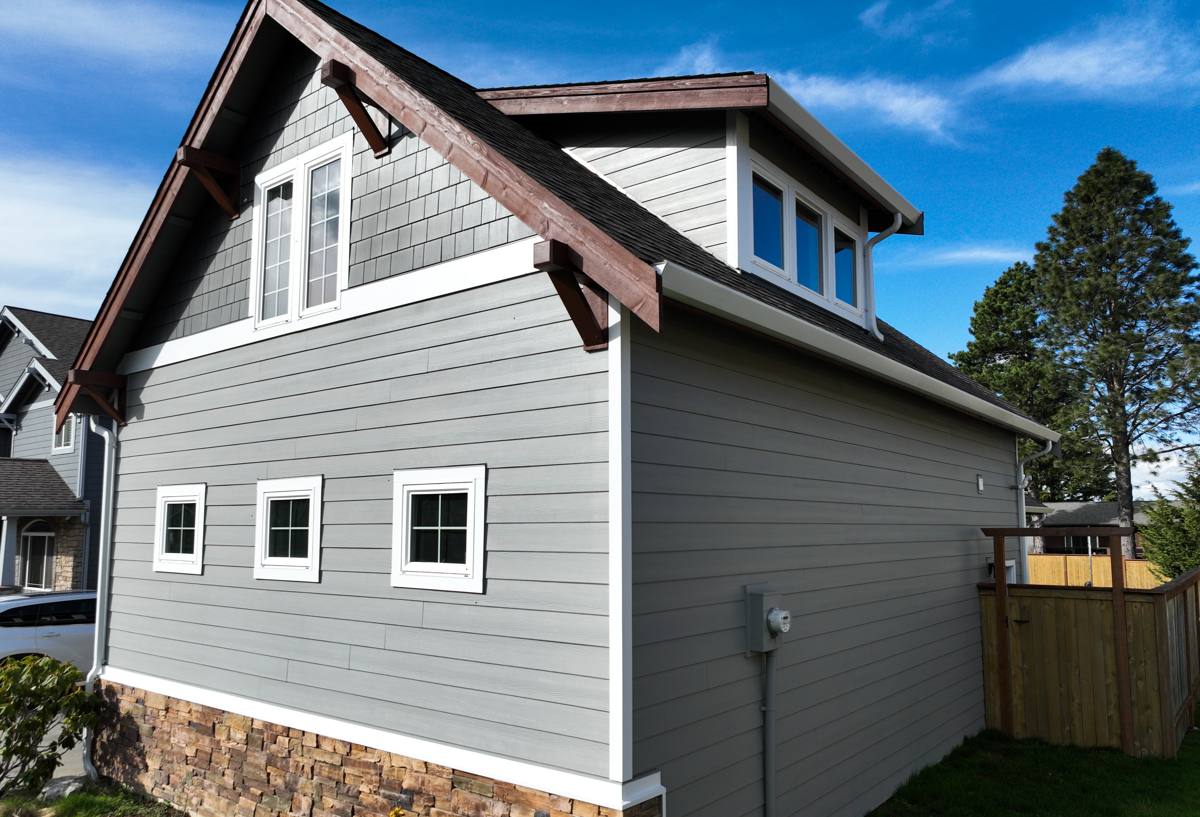
What Ferndale Homes Actually Need From Their Siding
Whatcom County's climate isn't extreme in the way hurricane or wildfire zones are. It's relentless in a quieter way. Consistent moisture, mild temperatures that never fully dry things out, and salt-laden air near the water create ideal conditions for three specific failure modes:
- Moisture absorption at seams and cut edges — any siding product that swells, wicks water, or delaminates when saturated will eventually show it, usually at the bottom courses and around windows first.
- Moss and algae growth — shaded north and west walls in Ferndale hold moisture long after a storm passes, and organic growth accelerates coating breakdown on lower-grade finishes.
- Salt-air corrosion of fasteners and trim — proximity to the bay means airborne salt reaches further inland than most homeowners expect, which is why fastener choice and trim detailing matter as much as the siding panel itself.
Any siding replacement plan for a Ferndale home needs to answer all three of those, not just the one that's visibly failing today.
Signs Your Current Siding Is Losing the Fight
- Soft or spongy spots when you press on the siding, especially near the bottom of walls
- Paint that's peeling or bubbling rather than just fading evenly
- Visible moss or dark streaking that comes back within weeks of cleaning
- Gaps opening up at seams, corners, or trim boards
- Warping or bowing panels, particularly on the north or west-facing walls
- Rising energy bills that point to a compromised weather barrier behind the siding
Why We Only Install James Hardie Fiber Cement
We don't install vinyl, LP SmartSide, primed spruce, cedar, or other fiber cement brands like Cemplank or Allura. That's a deliberate standard, not an oversight, and it's worth explaining why — especially in a climate like Whatcom County's.
Vinyl is inexpensive and low-maintenance in dry climates, but it expands and contracts with temperature swings, and in driving coastal rain it relies almost entirely on the water-resistive barrier behind it rather than the panel itself to keep a house dry. Wood-based products like LP SmartSide and cedar look good going up, but they depend on flawless caulking, painting, and ongoing maintenance to resist the exact moisture exposure Ferndale delivers year-round — miss a maintenance cycle here and the clock on rot starts fast. Other fiber cement brands make reasonable products, but James Hardie is the one we've found consistently delivers on factory-cured finish quality, moisture engineering, and warranty follow-through when installed to spec.
James Hardie fiber cement is non-combustible, dimensionally stable across our wet-to-dry swings, and comes with a factory-applied ColorPlus finish that's baked on rather than field-painted — which removes the single biggest maintenance variable in this climate. Hardie also engineers specific product lines (their HZ5 designation) for climates like ours, meaning the product itself is formulated for regions with sustained moisture exposure rather than a one-size-fits-all national spec.
What This Means in Practical Terms for a Ferndale Homeowner
| Factor | Vinyl / Wood-Based Siding | James Hardie Fiber Cement |
|---|---|---|
| Moisture response | Wicks, swells, or relies fully on barrier behind it | Engineered for wet climates (HZ5), resists moisture-driven failure |
| Finish maintenance | Field-painted or bare; repaint every 5-10 years | Factory ColorPlus finish; repaint cycle 15+ years |
| Moss/algae resistance | Coating breaks down faster under organic growth | Factory finish holds up better to cleaning and scrubbing |
| Fire rating | Vinyl melts; wood is combustible | Non-combustible material |
| Warranty | Varies widely, often prorated | Strong transferable manufacturer warranty when installed to spec |
What a Correct Ferndale Siding Replacement Involves
Siding is only as good as what's underneath it. A Ferndale replacement done right isn't just pulling old panels off and nailing new ones on — it's a full envelope inspection and rebuild where needed.
The Steps We Don't Skip
- Full tear-off and sheathing inspection — we don't side over rot. Any water-damaged sheathing or framing gets identified and repaired before anything new goes up.
- Weather-resistive barrier replacement — the house wrap or building paper behind your siding is doing real work in this climate; if it's compromised, it gets replaced, not reused.
- Proper flashing at every penetration — windows, doors, and any wall penetration get flashed correctly. This is where most siding failures in wet climates actually originate, not the panels themselves.
- Correct fastener spec — fastener choice and spacing matter for wind exposure and long-term corrosion resistance in salt-influenced air.
- Manufacturer-spec installation — proper clearances, caulking (or intentionally caulk-free joinery where Hardie's system allows it), and panel gapping so the material can perform as engineered.
- Trim and transition details — corners, butt joints, and roofline transitions are where moisture finds its way in if they're rushed.
Skip any one of these and you can install the best siding material available and still end up with a callback in five years. This is the part of the job that separates a crew that installs siding from a crew that manages a building envelope.
Our Process for Ferndale Jobs
Because we're already working throughout Bellingham and Whatcom County, a Ferndale project fits naturally into our scheduling without added travel logistics or unfamiliar-territory guesswork.
- On-site assessment — we look at your current siding, sheathing condition where accessible, drainage around the foundation, and wall exposure to prevailing wind and rain direction.
- Honest scope conversation — if your sheathing needs repair or your window flashing needs attention, we tell you before the quote, not after demo starts.
- Written estimate — clear line items, not a vague lump sum, so you know what you're paying for.
- Tear-off and envelope repair — done section by section so your home isn't fully exposed to weather for longer than necessary.
- Hardie installation to manufacturer spec — including correct fastening, flashing, and trim detail.
- Final walkthrough — we go over the finished work with you directly.
Cost Factors Specific to Ferndale Projects
Every home is different, but a few factors consistently move the price on siding replacement in this area:
| Factor | Why It Affects Cost |
|---|---|
| Sheathing condition | Hidden rot found during tear-off adds repair scope; homes with prior moisture issues cost more to bring back to spec |
| Home size and wall complexity | More corners, dormers, and transitions mean more labor and trim detail per square foot |
| Current siding type | Removing brittle old fiber cement or multiple layers of prior siding takes longer than a single vinyl layer |
| Hardie product line chosen | Lap siding, panel systems, and shingle-style products carry different material costs |
| Access and site conditions | Steep lots, tight setbacks, or landscaping that limits scaffolding access adds time |
We give real, project-specific numbers after an on-site look — not a phone estimate — because guessing on any of these factors from a distance does you a disservice.
Why Local Experience in Ferndale Actually Matters
A crew that's never worked west of I-5 in Whatcom County doesn't automatically know that a home two miles from the bay needs different fastener and flashing attention than one further inland. They don't know which neighborhoods hold moisture longer into spring, or how moss growth patterns differ on shaded lots near tree lines versus open exposure closer to the water. None of that is exotic knowledge, but it's the accumulated kind that only comes from doing this work here, repeatedly, not reading a regional climate summary once.
That's the practical case for hiring a Bellingham-based crew for a Ferndale job over a contractor who covers a wider, less specific territory: fewer surprises, better-informed material and detailing decisions, and a crew that's still local if a warranty question comes up five years down the road.
Ready to Talk About Your Ferndale Home
If your siding is showing moss you can't get rid of, paint that won't stop peeling, or soft spots that worry you, it's worth getting an honest, no-pressure look before winter rain finds any weak points. Fill out the form below and we'll set up a time to walk your home and talk through what James Hardie siding replacement would actually involve for your specific house.