 Bellingham Exterior
 South Hill's Climate Is Hard on Decks
South Hill sits up above downtown Bellingham with tree cover, elevation, and views out toward the bay — and all three of those things work against an outdoor deck. Mature trees mean more shade and more organic debris landing on deck boards year-round. Elevation and proximity to Bellingham Bay mean the salt-laden marine air that moves through Whatcom County reaches hardware and fasteners here just as it does closer to the water. And our long, wet stretch from fall through spring means any deck surface that holds moisture is going to grow moss and algae, whether it's wood or composite.
None of this is a reason to avoid decking a home in this neighborhood — it's a reason to build correctly for it. A deck designed and installed with South Hill's specific conditions in mind will outperform a generic install by years, and the difference usually comes down to decisions made before the first board is ever screwed down.
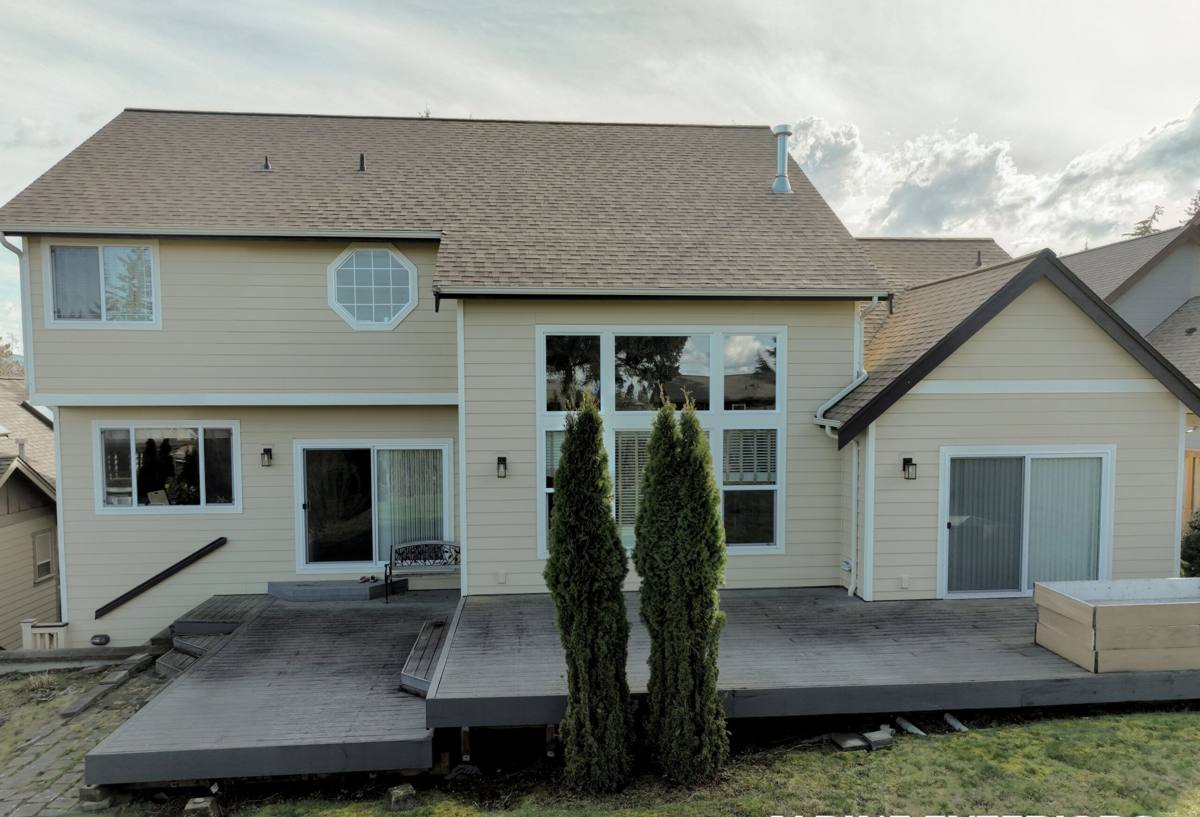
Why Composite Makes Sense Here
Composite decking — a blend of wood fiber and recycled plastic, usually capped with a protective polymer shell — doesn't absorb water the way solid wood does, doesn't need annual staining or sealing, and doesn't splinter or rot from repeated wet-dry cycles. In a climate where "driving rain most of the year" is a fair description of the forecast, that matters more than it does in drier parts of the state.
Moss and Algae Under Shade
Composite boards are more resistant to moss and algae growth than untreated wood because they don't provide the same porous surface for spores to take hold in, but they're not immune — especially under heavy tree canopy where a deck rarely gets direct sun to dry out. Board orientation, gap spacing, and airflow underneath the deck all affect how much moss pressure a South Hill deck will actually see. This is a site-specific decision, not something you can pull off a spec sheet.
Salt Air and Hardware
Marine air corrodes standard steel fasteners and connectors faster than most homeowners expect, and a slow leak from a rusted-through bracket is one of the more common causes of deck failure we see on homes in this part of Whatcom County. Every ledger bolt, joist hanger, and screw on a deck we build uses stainless steel or a coating rated for coastal exposure — not because code requires the upgrade everywhere, but because it's the standard we hold ourselves to on any home this close to the water.
What a Correct Composite Deck Installation Involves
The composite boards themselves get most of the attention, but the boards are the easiest part to get right. Everything underneath them is where a deck either lasts or starts failing early.
Substructure and Drainage
Joists need to be spaced correctly for the specific composite product being used — composite has different span ratings than wood, and using wood-frame spacing with composite decking is a common mistake that leads to a bouncy, sagging deck within a few years. On a sloped South Hill lot, grading and drainage under the deck also need to move water away from the foundation rather than letting it pool, which is a bigger factor here than on flat ground.
Ledger Attachment and Flashing
Where a deck attaches to the house is the single most common failure point in our region's climate. Proper flashing at the ledger board keeps driving rain from working its way behind the siding and into the wall framing — a slow, hidden problem that can go unnoticed for years in a climate that never really dries out. This is not an area to cut corners, and it's worth asking any contractor bidding your deck exactly how they're flashing that connection.
Fastening System
Face-screwed boards are visible and easy to inspect but show more fastener heads. Hidden fastener clip systems give a cleaner look and reduce standing water around screw heads, but they're also less forgiving of installer error — a clip system installed slightly wrong is harder to spot and harder to fix than a visible screw. We choose the fastening approach based on the board profile being used and the homeowner's priorities, not by defaulting to whichever is faster to install.
Composite vs. the Alternatives
| Decking Type | Moisture Behavior | Maintenance | Typical Lifespan |
|---|---|---|---|
| Pressure-treated wood | Absorbs water; prone to cupping and splintering in wet climates | Annual staining/sealing recommended | 10-15 years before major repair |
| Cedar | Naturally rot-resistant but still absorbs moisture over time | Regular sealing to maintain appearance and resistance | 15-20 years with upkeep |
| Composite (capped) | Does not absorb water into the core; surface can still hold moss without airflow | Periodic washing; no staining or sealing | 25-30 years, backed by manufacturer warranty |
| PVC / vinyl | Fully water-resistant | Lowest maintenance | 25-30+ years, higher upfront cost |
We install composite on the large majority of South Hill deck projects because it's the best balance of moisture performance, appearance, and cost for this climate. Solid wood decking still has a place for homeowners who specifically want that look and are willing to keep up with annual maintenance, and we'll say so honestly if that's a better fit for a particular project.
Choosing the Right Composite Board for This Neighborhood
Not all composite decking performs the same in shade and moisture. A few things we walk homeowners through:
- Capped vs. uncapped composite — a full polymer cap on all four sides resists moisture and staining significantly better than boards capped on only the top and sides. In a shaded, damp yard, this difference shows up within a few seasons.
- Board color — lighter colors show moss and pollen build-up more visibly than darker, mottled tones, which is worth factoring in under heavy tree cover.
- Surface texture — a more textured, wood-grain finish can hide the mineral deposits and biofilm that build up in a wet climate better than a smooth, glossy surface.
- Warranty terms — composite warranties vary on what's covered for fading, staining, and structural integrity. We review the actual warranty language with homeowners rather than just quoting the years.
Our Process
- On-site assessment — we look at sun exposure, tree cover, slope, and how the deck ties into the existing structure before recommending a board or layout.
- Design and material selection — we walk through composite options, fastening systems, and railing that fits the home, with straightforward pricing at each level.
- Permitting — most deck projects in Bellingham and unincorporated Whatcom County require a permit; we handle that process so it's not left to the homeowner.
- Framing and flashing — the structural work and ledger flashing get done to a standard built for our climate, not the minimum code requirement.
- Decking installation — boards are laid with the spacing and orientation appropriate to the site's drainage and sun exposure.
- Final walkthrough — we go over basic care with the homeowner before calling the job finished.
Maintenance Realities in a Wet Climate
Composite is low-maintenance, not no-maintenance. A deck under tree cover in a neighborhood like South Hill still needs some seasonal attention:
- Sweep leaves and debris off the deck regularly, especially in fall — trapped organic matter is the main driver of moss and staining.
- Rinse the deck surface periodically with water and a soft brush; avoid pressure washers on composite unless the manufacturer specifically allows it at low PSI.
- Check that gaps between boards stay clear so water can drain through rather than pool.
- Inspect railing posts and stair connections once a year for any looseness — hardware is the first thing affected by coastal air.
- Trim back overhanging branches where possible to improve sun exposure and airflow across the deck surface.
Why a Crew That Already Works South Hill Matters
A lot of what makes a deck last in this neighborhood isn't on the spec sheet — it's knowing that a particular street sits in near-constant shade by early afternoon, or that a lot's grade means water needs to be routed a certain way, or that homes at this elevation still get enough salt air off the bay to matter for hardware choice. A crew that's worked other decks in this part of Bellingham brings that knowledge to your project instead of treating it as a first attempt. It also means we're a known, findable local business if a warranty question or adjustment ever comes up down the road — not a name that only shows up for the install and disappears.
If you're weighing composite decking for a South Hill property, we're happy to take a look at the site, talk through board options, and give you a straightforward estimate — no pressure, no hard sell. The form below is the easiest way to get that started.