 Bellingham Exterior
 Roofing for South Hill's Particular Climate
South Hill sits up on the bluff above downtown Bellingham, close enough to Bellingham Bay to catch the salt-laden air coming off the water, and high enough to take the full brunt of Pacific storms rolling in off the Strait of Georgia. Add in the mature tree canopy that shades many of the older streets up there, and you've got a roofing environment that's tougher than it looks. Salt air accelerates corrosion on exposed metal fasteners and flashing. Driving, wind-blown rain finds every weak seam and undersized flashing detail. And the long, wet Whatcom County shoulder seasons — fall through spring — give moss and algae months at a time to take hold on any surface that doesn't drain and dry quickly.
None of that means a South Hill roof needs anything exotic. It means the ordinary parts of a roofing job — underlayment, flashing, ventilation, fastener choice — have to be done right, not just done fast. A roof that would hold up fine in a drier inland climate can fail early here if those details get shortchanged.
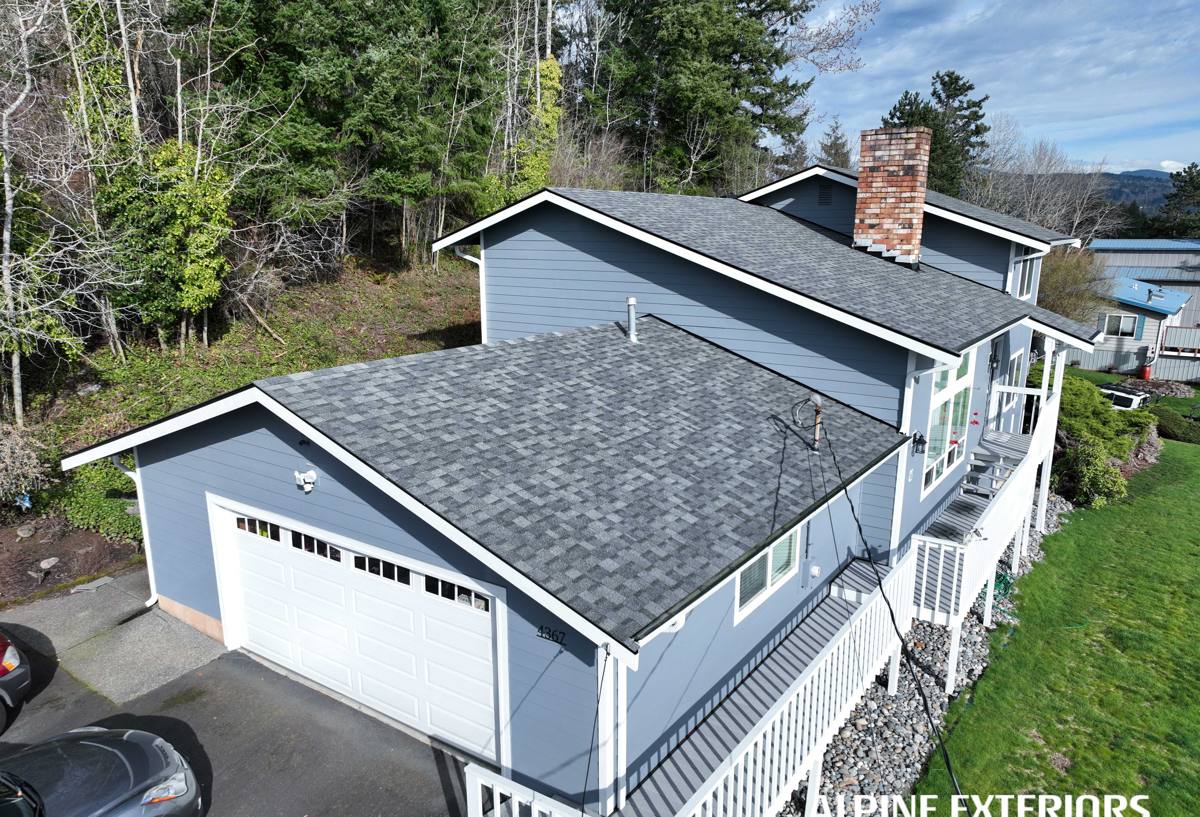
Signs a South Hill Roof Needs Replacement, Not Repair
A lot of the roofs we look at in this neighborhood are older, and the homeowner's real question is whether another repair is worth it or whether it's time to start fresh. A few signs tip that decision toward replacement:
- Granule loss heavy enough that you can see bare asphalt on multiple slopes, not just one worn patch
- Moss that keeps coming back within a season or two of cleaning, especially on north-facing or shaded slopes
- Soft or spongy decking felt underfoot during inspection, which points to moisture already in the sheathing
- Multiple past repairs in different areas, which usually means the underlayment and flashing system as a whole is past its service life
- Daylight visible at the ridge or through the attic, or water staining on interior ceilings during heavy rain
If it's one isolated issue — a cracked pipe boot, a section of lifted shingles from wind — repair is almost always the right call. Replacement makes sense when the problems are spread across the roof or when the underlying materials (deck, underlayment, flashing) are compromised, not just the top layer.
What a Correct Roof Replacement Actually Involves
Tear-Off and Deck Inspection
We don't install new roofing over old. A full tear-off lets us see the actual condition of the roof deck, which is the part homeowners can't check from the ground or the attic. Any soft, rotted, or delaminated sheathing gets replaced before anything new goes down — skipping this step is one of the most common reasons a "new" roof fails early.
Underlayment and Water Barrier
Given how much sustained rain this area gets, we don't treat underlayment as an afterthought. Synthetic underlayment across the field, with self-adhering ice-and-water barrier at eaves, valleys, and anywhere water tends to pool or back up, gives the roof a real second line of defense if wind-driven rain gets under the primary surface.
Flashing Details
Chimneys, skylights, dormers, and wall-to-roof transitions are where most leaks actually start — not in the open field of shingles. Flashing has to be replaced, not just reused and caulked over, and formed to shed water rather than rely on sealant to do the work long-term.
Ventilation
Balanced intake and exhaust ventilation keeps the attic close to outdoor temperature and moisture levels. That matters here because a poorly ventilated attic traps humidity, which shortens the life of the decking from underneath and contributes to moss growth from condensation dripping back onto the roof surface.
Field Installation
Manufacturer nailing patterns, fastener spacing, and starter course details all affect wind resistance — which matters on an exposed hillside site more than it does in a sheltered valley lot.
Choosing a Roofing Material for South Hill
There's no single "best" material — the right choice depends on your home's age, roof pitch, budget, and how much upkeep you want to take on. Here's how the common options compare for a home in this specific climate:
| Material | Moss & Moisture Resistance | Wind/Rain Performance | Maintenance | Relative Cost |
|---|---|---|---|---|
| Architectural (laminate) shingle | Good, especially with algae-resistant granules | Strong when installed with correct nailing pattern | Low to moderate | Moderate |
| 3-tab shingle | Fair — thinner profile sheds moss less effectively | Adequate, more wind-sensitive than laminate | Moderate | Lower |
| Standing seam metal | Excellent — smooth surface sheds moisture and moss readily | Excellent | Low | Higher |
| Synthetic/composite shake | Good, engineered for consistent moisture behavior | Strong | Low | Higher |
| Cedar shake | Requires regular upkeep to manage moisture retention | Good when well maintained | High | Higher |
On cedar specifically: it's a good-looking, traditional material, and we're glad to install it if that's what a homeowner wants. Our professional standard is to be upfront that it needs more consistent maintenance in a climate this wet — periodic cleaning, moss treatment, and attention to ventilation underneath — to get a full service life. For homeowners who want that look with less upkeep, synthetic shake products have closed a lot of that gap in recent years.
Ventilation and Moisture — Why It's a Bigger Deal Here
Bellingham's climate doesn't give roofs much of a break. Between the rain totals and the humidity coming off the bay, a roof assembly that can't manage moisture — both from outside and from inside the attic — is working against the odds from day one. Balanced ventilation, correctly installed underlayment, and adequate attic insulation work together as a system. Get one piece wrong and the others can't fully compensate, which is why we look at the whole assembly during an estimate, not just the shingles on top.
Our Process for a South Hill Roof Replacement
- On-site inspection and estimate — we walk the roof (or use safe access methods on steep pitches) and check the attic, not just the exterior, before quoting anything.
- Material and scope discussion — we walk through the options above in the context of your home's age, pitch, and budget, no pressure toward the most expensive choice.
- Access and staging plan — South Hill's narrower streets, sloped driveways, and mature trees mean we plan material delivery and dumpster/staging placement before the crew shows up, not on the fly.
- Tear-off and deck repair — old roofing comes off, decking is inspected and any damaged sections replaced.
- Underlayment, flashing, and installation — done in the sequence and with the fastening detail the manufacturer requires, not shortcuts.
- Cleanup and magnetic sweep — yard, driveway, and street cleared of debris and stray fasteners.
- Final walkthrough — we go over the finished roof with you before calling the job done.
Working on South Hill's Terrain
Steep Lots and Limited Access
Several streets on South Hill sit on grades steep enough to affect how equipment gets staged and how materials are moved to the roof. A crew that hasn't worked the neighborhood before can lose real time — and add real cost — figuring that out on your job. We plan for it up front.
Tree Canopy
Mature trees are part of what makes the neighborhood what it is, and we're careful about protecting landscaping and root zones during tear-off and material delivery, rather than treating the yard as an afterthought.
Older Home Considerations
A number of South Hill homes are older builds, which sometimes means non-standard roof framing, older ventilation setups, or decking that needs more attention than a newer subdivision home. We flag anything unusual during the inspection so there are no surprises mid-job.
Maintaining Your New Roof Through Moss Season
A correctly installed roof still benefits from basic upkeep, especially through Whatcom County's long wet season:
- Clean gutters at least twice a year — clogged gutters back water up under the roof edge
- Trim back branches that overhang the roofline to reduce shade, debris, and moss-friendly moisture
- Have moss and algae growth treated early rather than letting it spread across a slope
- Avoid pressure washing shingles — it strips granules and shortens their life
- Check the attic once a year for signs of moisture, unusual odors, or daylight at the eaves
- Schedule a roof check after any major windstorm to catch lifted shingles or flashing early
Why a Crew That Already Works in South Hill Matters
Roofing a house on a steep South Hill lot, under a tree canopy, with limited street access, is a different job than roofing a flat-lot house in a newer development — even if the materials on the invoice look the same. A crew that already knows the neighborhood's grades, typical home ages, and access constraints plans the job more accurately from the first estimate, which means fewer surprises and fewer change orders once work starts. It also means someone who's seen how roofs in this specific microclimate actually age, not just how a manufacturer's spec sheet says they should.
If you're weighing repair versus replacement, or just want a straight read on where your roof stands, we're happy to take a look. Fill out the form below for a free, no-pressure estimate.