 Bellingham Exterior
 Why Birch Bay Decks Wear Out Faster Than People Expect
Birch Bay sits right on the water, and that changes what a deck has to survive. Salt-laden air moves in off the bay and settles into anything porous — wood grain, fastener heads, the gaps between deck boards. Add Whatcom County's long wet season, where driving rain comes in sideways off the water for days at a stretch, and you've got a recipe for wood decks that cup, gray, and soften years before a homeowner expects to replace them. Then there's moss. Bellingham's moss season isn't a two-week nuisance like it is in drier parts of the state — it's a standing condition from fall through spring, and any deck surface that stays damp and shaded for that long will grow something on it.
None of this is unusual for the area. It's just the baseline a deck has to be built for if it's going to last. A lot of the deck problems we get called out for in Birch Bay aren't failures of the decking material itself — they're failures of a design or installation that didn't account for how much moisture this specific location deals with, every single year.
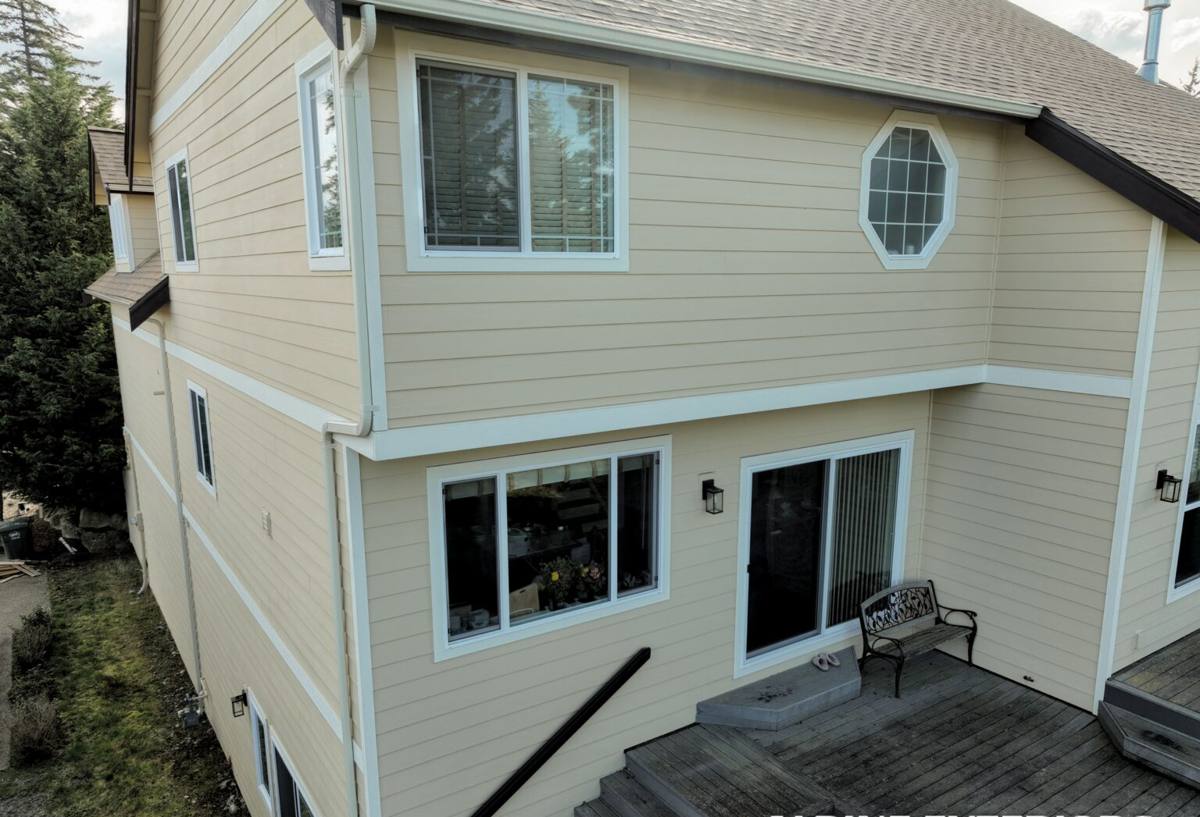
Why Composite Makes Sense for This Location
Composite decking — a blend of wood fiber and recycled plastic, usually with a protective cap layer — was built to solve exactly the problems Birch Bay's climate causes. It doesn't absorb water the way solid wood does, so it doesn't swell, cup, or rot from constant damp exposure. It doesn't need to be refinished every year or two to hold up against salt exposure. And a capped composite surface gives moss and algae a much harder time finding a foothold than open wood grain does.
That doesn't mean composite is maintenance-free — we'll get into what it actually needs later on — but it shifts the maintenance burden from "constant" to "occasional," which matters a lot for a second home or a property near the water where nobody wants to be out there sanding and sealing every spring.
Where Composite Still Has Trade-Offs
We tell homeowners the honest version of this, not the sales version. Composite decking costs more upfront than pressure-treated lumber. It can run warmer underfoot in direct summer sun, though that's less of an issue here than it would be in a hot, dry climate. And not all composite is equal — cheaper, uncapped boards can still take on moisture at cut edges and fastener holes if they're not detailed correctly during installation. The material is only as good as the installation around it, which is really the core of what we bring to a Birch Bay project.
Choosing the Right Composite Board for a Waterfront-Adjacent Property
Not every composite product is designed with salt exposure in mind, and this is where a lot of decks in coastal-adjacent neighborhoods get shortchanged. We look at a few things before recommending a board line for a specific Birch Bay property:
| Factor | Why It Matters Here |
|---|---|
| Cap type (full wrap vs. three-side) | A full polymer cap protects the underside too, which matters when boards sit low over damp substructure or near ground-level moisture |
| Fastener system | Hidden clip systems reduce exposed fastener heads, which are a common spot for salt corrosion and staining over time |
| Surface texture | Low-gloss, textured finishes resist slickness better once moss spores and algae film start to build in shaded, damp areas |
| Color | Darker boards show mineral and salt deposits less; very light boards can show water spotting sooner in a wet climate |
| Manufacturer warranty terms | Some warranties exclude or limit coverage in coastal or high-moisture environments — worth reading before you commit |
We don't push one brand as the answer for every yard. A shaded, low-airflow deck under mature trees needs a different board and drainage plan than an open, wind-exposed deck closer to the water. Part of our job is matching the product to the actual site conditions, not just installing whatever's in stock.
What a Correct Installation Actually Involves
Composite decking fails prematurely almost exclusively because of what's underneath and around it, not because the boards themselves gave out. In a climate like this, the substructure work matters as much as the visible surface.
Framing and Substructure
Pressure-treated joists and framing still need to be protected from constant moisture cycling, even under composite decking. We use joist tape over the top of framing members to keep water from wicking into cut ends and fastener penetrations — a detail that's easy to skip and impossible to see once the deck is finished, but it's one of the biggest factors in how long a deck's frame lasts in a wet climate.
Ledger Board Attachment
Where a deck attaches to the house, that ledger connection is one of the most common sources of hidden water intrusion into the home itself. Proper flashing at the ledger — not just caulk — is what keeps driving rain from working its way behind the siding over years of exposure. This is a spot we're careful about on every project, since it protects more than just the deck.
Spacing and Airflow
Composite boards need correct gapping for both drainage and thermal expansion. Too tight, and water sits on the surface longer and the boards can buckle; too wide, and you get an uneven, uncomfortable walking surface. In a high-moisture area, we also pay attention to airflow underneath the deck itself — a deck built low to the ground with poor ventilation stays damp longer after every rain, which extends the window for moss and mildew to establish.
Fastening
Stainless steel or coated, corrosion-resistant fasteners are non-negotiable this close to salt air. Standard galvanized hardware can start showing rust streaks on a light-colored deck within a couple of seasons out here.
Railings, Fascia, and Drainage Details
The decking surface gets most of the attention, but railings and edge details are where a lot of coastal decks show wear first. Aluminum and composite railing systems generally outperform painted wood rail in this environment — no repainting, no rot at the post bases. Fascia boards along the deck edge should be composite or well-protected material as well, since they take direct rain exposure without the benefit of foot traffic wearing water off the surface.
Drainage is the other piece people underestimate. Water needs somewhere to go once it comes off the deck — away from the house foundation, away from crawlspace vents, and off the walking surface itself. On sloped Birch Bay lots, we look at how water moves across the whole property, not just the deck footprint, before finalizing a drainage plan.
Living With a Composite Deck Through Moss Season
Composite resists moss and algae far better than wood, but "resists" isn't "never." Shaded, low-airflow areas of any deck in this climate will need periodic attention. Here's what actually keeps a composite deck clean through a Whatcom County winter:
- Sweep debris (leaves, needles, seed pods) off the surface regularly — trapped organic material holds moisture and gives moss spores something to grip
- Rinse the deck with a garden hose every few weeks during the wettest months, especially in shaded corners
- Use a soft-bristle broom and a mild soap-and-water solution for general cleaning — avoid pressure washers on composite, which can damage the cap layer if used too close or at too high a setting
- Keep nearby plantings trimmed back so sunlight and airflow can reach shaded deck areas
- Check railing post bases and stair stringers each fall, since these lower, less-visible areas tend to collect moisture and debris first
- Address any early green film with a composite-safe cleaner before it spreads — it's far easier to remove early than after a full season of growth
None of this is heavy lifting. It's the difference between a deck that looks the same in ten years and one that starts looking tired after three.
What Composite Decking Typically Costs, and Why
Every deck is different in size and complexity, so we won't quote a number without seeing the site, but it helps to understand what drives cost up or down on a composite deck project in this area.
| Cost Factor | Effect |
|---|---|
| Board tier (entry-level vs. premium capped composite) | Biggest swing in material cost; premium capped boards cost more but need less long-term attention |
| Deck height and substructure complexity | Elevated decks and those requiring engineered footings or additional support cost more in labor and material |
| Railing system | Composite and aluminum rail systems cost more than basic wood rail but require far less upkeep long-term |
| Site access | Waterfront and sloped lots common around Birch Bay can add labor time for material staging and equipment access |
| Demolition and disposal of existing deck | Removing an old wood deck adds cost but is usually necessary since old framing rarely meets current substructure standards |
Broadly, composite decking projects run higher upfront than pressure-treated wood but lower over a ten-plus year window once you account for staining, sealing, and repair costs a wood deck requires in this climate.
Why a Local Bellingham Crew Matters for This Job
A deck built to a generic spec sheet doesn't account for the fact that Birch Bay sits in a specific microclimate within Whatcom County — closer to open water, more direct exposure to salt spray and wind-driven rain than properties further inland toward Bellingham proper. A crew that works this specific area regularly knows which board lines and hardware have actually held up locally, which lots have drainage challenges, and which installation shortcuts show up as problems within a few winters rather than holding for decades.
That local knowledge is the difference between a deck that's technically built to code and one that's actually built for where it sits. We'd rather walk a property, look at sun exposure, prevailing wind and rain direction, and existing drainage patterns before recommending a board or a framing approach — not after.
Get a Straight Answer for Your Property
If you're weighing a composite deck rebuild or a new deck for a Birch Bay property, we're happy to come take a look and give you a straightforward assessment — what your site needs, what it doesn't, and a realistic estimate with no pressure attached. Use the form below to request a free estimate.