 Bellingham Exterior
 Blaine's Siding Takes a Different Kind of Beating
Blaine sits right on the water at the northern edge of Whatcom County, and that location shapes everything about how siding ages here. Homes close to Semiahmoo Bay and the Salish Sea shoreline deal with a steady drift of salt-laden air, near-constant marine humidity, and driving rain that comes in sideways off the water during winter storms. Add in the long gray stretch from fall through spring when moss and algae get a real foothold on anything shaded or north-facing, and you have a climate that is genuinely harder on exterior siding than most inland parts of the county.
None of this means Blaine homes are doomed to constant repair. It means the siding has to be installed correctly the first time, and repairs have to address the actual cause of failure rather than just patching the symptom. We see a lot of siding in this area that was never wrong on the surface — it just wasn't built to handle salt exposure and sustained moisture, and it's now paying the price.
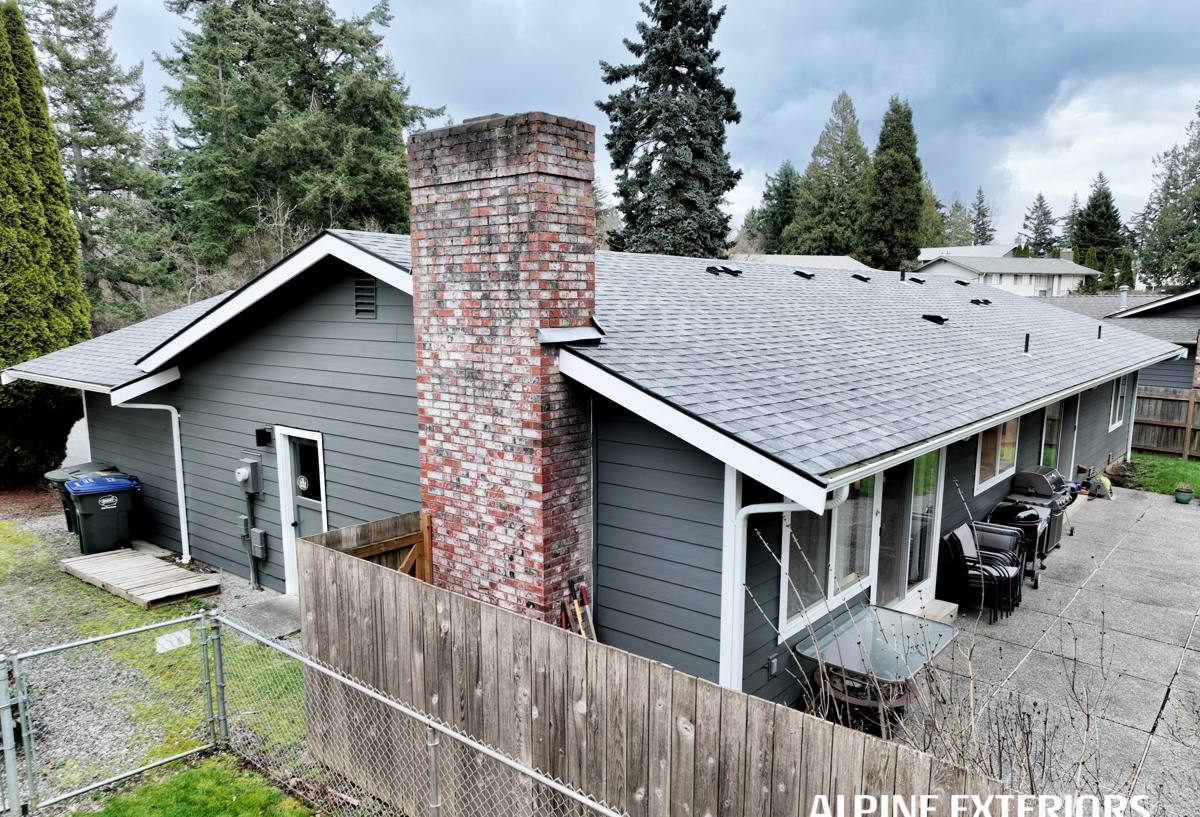
How Salt Air, Rain, and Moss Actually Damage Siding
Salt Air and Corrosion
Airborne salt doesn't just sit on the surface — it works into fasteners, trim joints, and any exposed edge or cut end of siding material. Over years, this accelerates corrosion in nails and metal flashing, and it can degrade the surface finish on materials that weren't engineered for coastal exposure. Paint and coatings on lower-grade products break down faster near the water, which is why a home a mile inland can look fine while a similar house near the bay is already chalking, fading, or showing rust streaks at the fasteners.
Wind-Driven Rain
Blaine's exposure to wind off the water means rain doesn't just fall — it gets pushed sideways and upward into laps, seams, and any gap where siding meets trim, windows, or corner boards. Ordinary lap siding relies on gravity and a proper overlap to shed water. Wind-driven rain defeats that if the laps are too shallow, the caulking has failed, or flashing was skipped at a transition. Once water gets behind the siding, the damage usually shows up on the sheathing and framing long before it's visible from the street.
Moss and Sustained Moisture
Whatcom County's long wet season keeps north- and west-facing walls, and anything shaded by trees or eaves, damp for extended stretches. Moss and algae take hold on textured or porous surfaces and hold moisture against the siding even after the weather clears. On wood-based products this speeds up rot. On any siding, unaddressed moss buildup traps grit and organic material that keeps the surface wet far longer than it should be.
Signs Your Siding Needs Repair
Most siding failures give warning signs well before they become structural problems. Catching these early is the difference between a contained repair and a full wall reconstruction.
- Soft or spongy spots when you press on the siding, especially near the bottom courses or around windows
- Visible cracking, splitting, or buckling in individual boards or panels
- Persistent dark staining, streaking, or a musty smell near exterior walls
- Paint that's peeling, bubbling, or failing in patches rather than evenly across the wall
- Gaps opening up at seams, corners, or where siding meets trim and window casings
- Moss or algae that keeps coming back in the same spot no matter how often it's cleaned
- Fasteners backing out, rust streaks below nail heads, or visible corrosion at metal flashing
- Interior signs — bubbled paint, soft drywall, or musty odor on a wall that faces the weather
Any one of these on its own might be minor. Several showing up in the same area of the house is usually a sign that moisture has been getting behind the siding for a while.
What a Correct Repair Actually Involves
Diagnosis Before Anything Gets Replaced
A repair that only replaces the visibly damaged board is often just a temporary fix. Before we touch any siding, we pull back the affected area to check the condition of the water-resistive barrier, flashing, and sheathing underneath. If water has been getting in, the entry point is rarely exactly where the damage is most visible — it's often higher up, at a seam or penetration, with gravity carrying the moisture down.
Fixing the Cause, Not Just the Symptom
If we find failed flashing, missing kick-out flashing at a roof-wall intersection, or caulking that's done its job and given out, that gets corrected as part of the repair. Replacing siding over an unresolved moisture path just buys a year or two before the same spot fails again.
Matching and Blending
On smaller repairs, matching existing siding profile, texture, and color is a real consideration. James Hardie's ColorPlus finish and consistent product lines make this more predictable than many alternatives, since the factory finish and panel dimensions stay consistent across production runs. On older homes with discontinued products, an exact match isn't always possible, and we'll tell you honestly when a full wall or elevation replacement will look better than a visibly patched repair.
Sealing and Detailing
Every repair gets finished with correct fastening, proper caulking at the joints that need it (and none at the joints that shouldn't be sealed, since some laps are designed to breathe), and touch-up or full-panel finish work so the repair holds up rather than becoming the next weak point.
Repair or Replace? An Honest Look at the Trade-offs
Not every damaged section needs full replacement, and not every repair is worth doing instead of replacing. The right call depends on the extent of the damage, the age and condition of the rest of the siding, and what's actually causing the problem.
| Factor | Favors Repair | Favors Replacement |
|---|---|---|
| Extent of damage | Isolated to one or two boards/panels | Spread across multiple walls or elevations |
| Underlying cause | One-time event (impact, isolated flashing failure) | Systemic moisture issue behind the siding |
| Age of existing siding | Newer, still within useful life | Near or past expected service life |
| Material match | Product still available, close match possible | Discontinued or badly faded, patch would be visible |
| Cost over time | Lower upfront cost | Better long-term value if failures are recurring |
We'll walk you through where your situation falls on this table before recommending anything. A repair should genuinely solve the problem — if the honest answer is that repeated patching on an aging wall is just delaying a replacement you'll need anyway, we'll say so.
Our Repair Process in Blaine
1. On-Site Inspection
We look at the damaged area and the surrounding siding, check for moisture intrusion behind the surface, and identify whether the cause is weather exposure, a flashing or installation defect, or normal wear reaching the end of its life.
2. Clear Explanation and Options
You get a straightforward explanation of what we found, what's causing it, and what a proper fix requires — including whether repair or replacement is the more sensible route for that section of the house.
3. The Repair Itself
Damaged material comes out, the substrate and moisture barrier get inspected and corrected as needed, and new material goes in with proper fastening, flashing, and sealing. We match siding profile and finish as closely as the existing product allows.
4. Final Check
Before we consider the job done, we check that laps, seams, and trim transitions are shedding water the way they're supposed to — not just that the repair looks right from the curb.
Why Local Experience in Blaine Matters
Siding repair looks straightforward from the outside, but coastal exposure changes the calculus. A crew that mostly works drier, inland neighborhoods can miss how much punishment a bay-facing wall in Blaine actually takes, or under-spec the flashing and fastening a waterfront exposure needs. Working regularly in this part of Whatcom County means we already know which elevations tend to take the worst of the wind-driven rain, where moss builds up fastest, and which older installation shortcuts tend to fail first in a salt-air environment.
We also only install James Hardie fiber cement siding, and that shapes how we approach repairs. Hardie's engineered HZ product lines are built for exactly this kind of climate exposure, its ColorPlus factory finish holds color and resists the fading and chalking that salt air accelerates on lesser products, and it's non-combustible — a real consideration anywhere close to dry summer conditions inland. When a repair on non-Hardie siding turns out to be the third patch in the same spot, we'll tell you plainly that a transition to Hardie is the more durable long-term answer, rather than selling you another short-term fix.
Maintaining Repaired Siding in a Coastal Climate
- Rinse salt residue and grime off exterior walls a couple of times a year, especially on sides facing open water
- Keep gutters and downspouts clear so water isn't overflowing onto siding below
- Trim back vegetation that shades walls and keeps them damp longer than the rest of the house
- Check caulking at trim, windows, and seams annually and have any cracked or missing sealant redone promptly
- Address moss buildup early with a gentle wash rather than letting it establish and hold moisture against the surface
- Have any soft spots, staining, or recurring paint failure inspected before it spreads to adjacent boards
Get a Straight Answer on Your Siding
If you're seeing damage, staining, or recurring issues on your Blaine home's siding, we're happy to take a look and give you an honest read on what's going on and what it will take to fix it right. There's no pressure and no obligation — just a clear assessment from a crew that knows what this coastal stretch of Whatcom County does to exterior siding. Fill out the form below to schedule a free estimate.