 Bellingham Exterior
 What Cordata's Climate Actually Does to Siding
Cordata sits in north Bellingham, close enough to Bellingham Bay and the Salish Sea that the air carries a steady dose of marine moisture, and close enough to the open Whatcom County landscape that wind-driven rain hits exterior walls with real force during fall and winter storms. Add in the long stretch of overcast, damp months that Whatcom County gets every year, and you have three separate stresses working on a home's exterior at the same time: salt-tinged air that accelerates corrosion on fasteners and finishes, driving rain that pushes water sideways into seams and laps, and a moss season that can run from October through May on shaded or north-facing walls.
None of that is unique to Cordata, but it is a real, specific load on siding materials. Products that perform fine in a drier climate — or even in a milder wet climate — can fail early here if they weren't engineered for it or weren't installed with this climate in mind. That's the lens we use on every Cordata siding job: not "what's an acceptable install," but "what will actually hold up through another twenty Whatcom County winters."
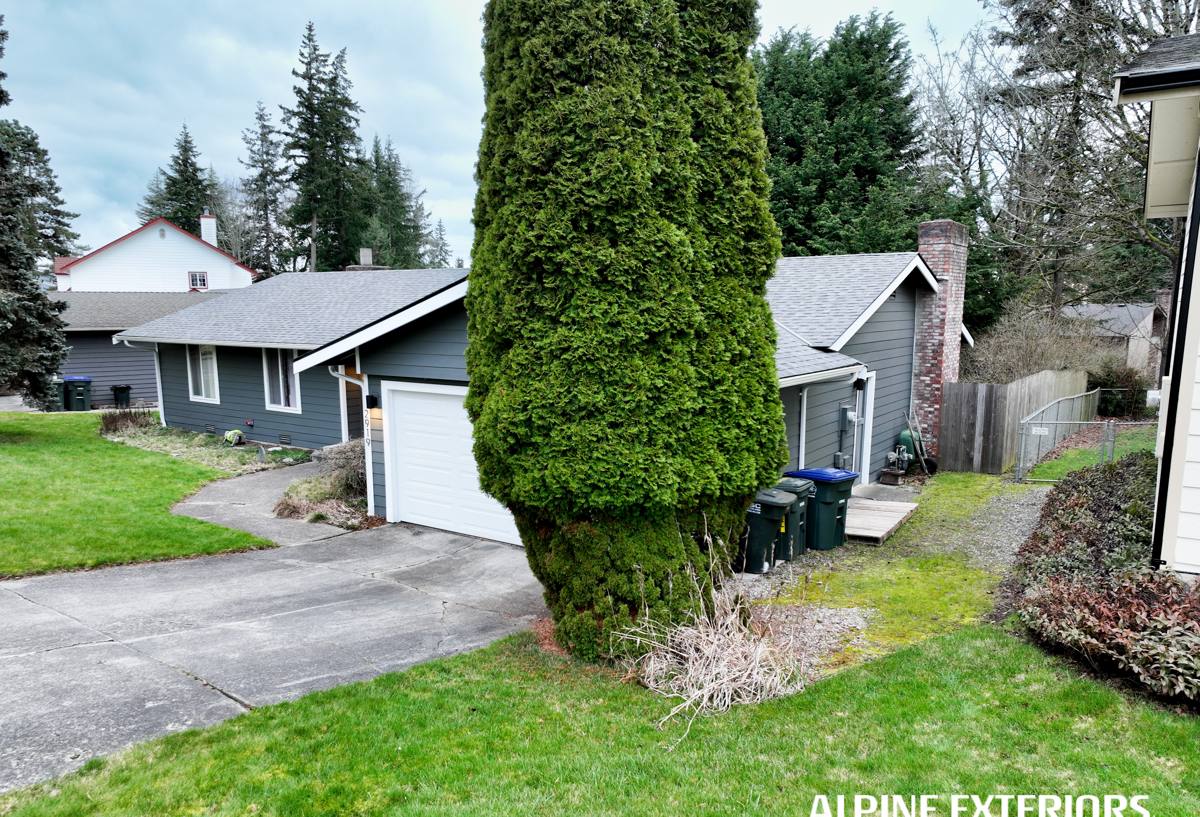
What Correct Fiber Cement Siding Requires Here
Fiber cement siding is a strong material on paper, but its real-world performance depends almost entirely on how it's installed. In a climate like Cordata's, a handful of details separate a siding job that lasts decades from one that starts showing problems in five or six years.
A Drainage Gap Behind the Siding
Any wall that takes driving rain needs a way for the small amount of moisture that gets past the cladding to drain and dry out, rather than sitting against the sheathing. A rainscreen gap — a thin airspace between the water-resistive barrier and the back of the siding — lets bulk water drain down and out, and lets airflow dry the wall assembly between storms. Skipping this step is one of the most common shortcuts we see on older installs in this area, and it's usually the root cause when a homeowner calls us about soft spots or staining years after a "new" siding job.
A Water-Resistive Barrier Installed in the Right Order
Housewrap or building paper has to be installed and lapped so that every layer sheds water to the layer below it — including around windows, doors, and any wall penetration. Flashing at those transitions matters as much as the siding itself; most of the moisture problems we find during tear-offs in this area trace back to bad flashing detail, not the siding material.
Fastening and Clearances That Match Manufacturer Spec
Fiber cement panels need to be fastened at the correct spacing and depth, with the right clearance from rooflines, decks, and grade. Too tight to the ground or a roof surface, and the bottom edge stays wet longer than it should — which, combined with a long moss season, is exactly the setup that lets organic growth get a foothold.
Why We Install Only James Hardie
We standardized on James Hardie fiber cement and don't install LP SmartSide, vinyl, Cemplank, Allura, or unfinished wood siding. That's a deliberate call, not a brand preference for its own sake. Hardie's fiber cement formulation is non-combustible, dimensionally stable in wet-dry cycling, and backed by a factory finish system (ColorPlus) that's baked on and warrantied separately from the substrate — which matters a lot in a climate that's hard on paint. Just as important for this region, Hardie engineers specific product formulations by climate zone.
HZ5: The Formulation Built for the Pacific Northwest
Hardie's HZ5 product line is formulated for regions with more moisture cycling and freeze-thaw exposure — the category Whatcom County falls into. It's a different mix than the HZ10 formulation used in hot, humid Southeast climates. Installing the wrong regional formulation, or a generic fiber cement product not engineered by zone at all, is one of the quieter mistakes that shortens a siding job's life without anyone noticing until years later.
Product Lines We Work With
- HardiePlank lap siding — the standard horizontal siding profile, available in several exposure widths and textures.
- HardieShingle siding — a shingle profile for accent gables, dormers, or a full shingle-style exterior.
- HardiePanel vertical siding — often used for board-and-batten looks or modern accent panels.
- HardieTrim boards — matched trim so corners, fascia, and window surrounds age at the same rate as the field siding.
Signs a Cordata Home's Siding Needs Attention
Because moisture problems in this climate build slowly, homeowners often don't notice siding failure until it's advanced. A few checks worth doing once or twice a year:
- Soft, spongy spots when you press on siding near the bottom edge or below windows
- Persistent moss or dark streaking on north- or shade-facing walls that comes back soon after cleaning
- Visible gaps, warping, or separation at butt joints and corners
- Paint that's peeling or bubbling rather than just fading — a sign moisture is trapped behind the finish
- Interior clues: musty smell, discolored drywall, or peeling interior paint on an exterior wall
- Caulking that's cracked, shrunk, or missing at trim and window edges
Any one of these on its own isn't necessarily an emergency, but they're worth a professional look — especially on a home more than 15-20 years old with its original siding.
Our Installation Process, Step by Step
- On-site assessment. We look at existing siding condition, sheathing underneath (where accessible), trim, flashing details, and any problem areas the homeowner has already noticed.
- Tear-off and sheathing check. Old siding comes off and we inspect the sheathing for rot or damage before anything new goes up — covering a compromised wall with new siding just hides the problem.
- Water-resistive barrier and flashing. A new WRB is installed and properly lapped, with flashing detailed at every window, door, and penetration.
- Rainscreen installation. A drainage gap goes in behind the siding field so the wall assembly can drain and dry.
- Hardie siding installation. Panels or lap siding go up to manufacturer fastening spec, with correct clearances from grade, roofs, and decks.
- Trim, caulking, and touch-up. HardieTrim is installed and joints are sealed with a product compatible with the ColorPlus finish.
- Final walkthrough. We go over the finished work with the homeowner and flag anything worth watching over the first year.
Fiber Cement vs. Other Siding Materials in This Climate
| Material | Moisture Behavior | Moss/Mildew Resistance | Maintenance | Typical Lifespan |
|---|---|---|---|---|
| James Hardie fiber cement | Dimensionally stable; doesn't swell or rot | Resists growth on the material itself; surface can still need periodic cleaning | Low — factory finish, occasional caulk check | 30-50+ years with correct install |
| Cedar / primed wood | Absorbs moisture; prone to swelling, cupping, rot | Susceptible without diligent upkeep | High — repainting, sealing, moisture monitoring | 15-30 years, shorter without upkeep |
| Vinyl | Doesn't rot, but can warp, crack in cold, and trap moisture behind it | Moderate — grows on surface film in shaded areas | Low, but limited repair options if damaged | 20-40 years, fades over time |
| LP SmartSide (engineered wood) | Treated but still wood-based; edge and cut-end exposure is a known failure point | Moderate with intact finish | Moderate — finish and edge sealing matter | 25-30 years typical |
What Drives Cost on a Cordata Siding Project
Every home is different, but a few factors consistently move the price up or down on fiber cement projects in this area:
| Factor | Why It Matters |
|---|---|
| Tear-off vs. new construction | Removing existing siding, disposal, and any sheathing repair adds labor beyond a bare-wall install |
| Home size and wall complexity | More corners, gables, and trim detail mean more cutting, fitting, and material |
| Sheathing condition | Rot or water damage found during tear-off has to be repaired before new siding goes on |
| Product mix | Lap siding, shingle accents, and vertical panel combinations cost differently than a single simple profile |
| Trim scope | Full HardieTrim replacement costs more than reusing sound existing trim where appropriate |
We give homeowners a written estimate that breaks these factors out, rather than a single lump number, so it's clear what's driving the cost.
Why a Crew That Already Works in Cordata Matters
Siding installation isn't just a product choice — it's a set of judgment calls about flashing details, drainage, and fastening that need to match the actual conditions on that wall. A crew that regularly works in Cordata and the rest of Bellingham has already seen how this specific microclimate treats siding: which wall exposures collect moss fastest, how much clearance actually holds up through a wet Whatcom County winter, and where local permitting and inspection requirements come into play. That local pattern recognition is hard to substitute with a generic install, and it's also worth something after the job is done — if a warranty question or a maintenance question comes up in year eight, a local, established crew is easy to reach.
Caring for Fiber Cement Siding Long-Term
James Hardie siding is genuinely low-maintenance, but "low" isn't "none," especially in this climate:
- Rinse the exterior once or twice a year to clear pollen, dust, and early moss growth before it establishes
- Check caulking at trim, windows, and joints annually and re-seal where it's cracked or shrunk
- Keep gutters clear so overflow doesn't run down the siding face repeatedly in one spot
- Trim back vegetation that keeps a wall section shaded and damp longer than the rest of the house
- Address any soft spots or persistent staining promptly rather than waiting for it to spread
If you're weighing a siding replacement for a Cordata home, or you've noticed some of the warning signs above, we're happy to take a look and give you a straightforward, no-pressure estimate — no obligation, just an honest read on what your home actually needs.