 Bellingham Exterior
 Siding Installation Built for Cordata's Climate
Cordata sits in north Bellingham, close enough to Bellingham Bay and the Salish Sea that salt-laden air is a real factor in how exterior materials age here, not a theoretical one. Add Whatcom County's driving winter rain, the marine humidity that never fully lets up, and a moss season that can stretch from October well into May, and you have a climate that is quietly hard on siding. Homes here don't fail dramatically — they fail slowly, from moisture that gets in at a seam, a fastener, or a poorly flashed window and works its way behind the cladding for years before anyone notices a soft spot or a stain.
Siding installation in this neighborhood isn't just about picking a color and nailing up boards. It's about building a water-management system: the housewrap, the flashing details, the fastener pattern, the gaps and clearances, and the material itself all have to work together to shed water and resist the organic growth that Whatcom County's damp, shaded lots are so good at growing. Get any one of those wrong and the siding looks fine for a season or two before the problems start.
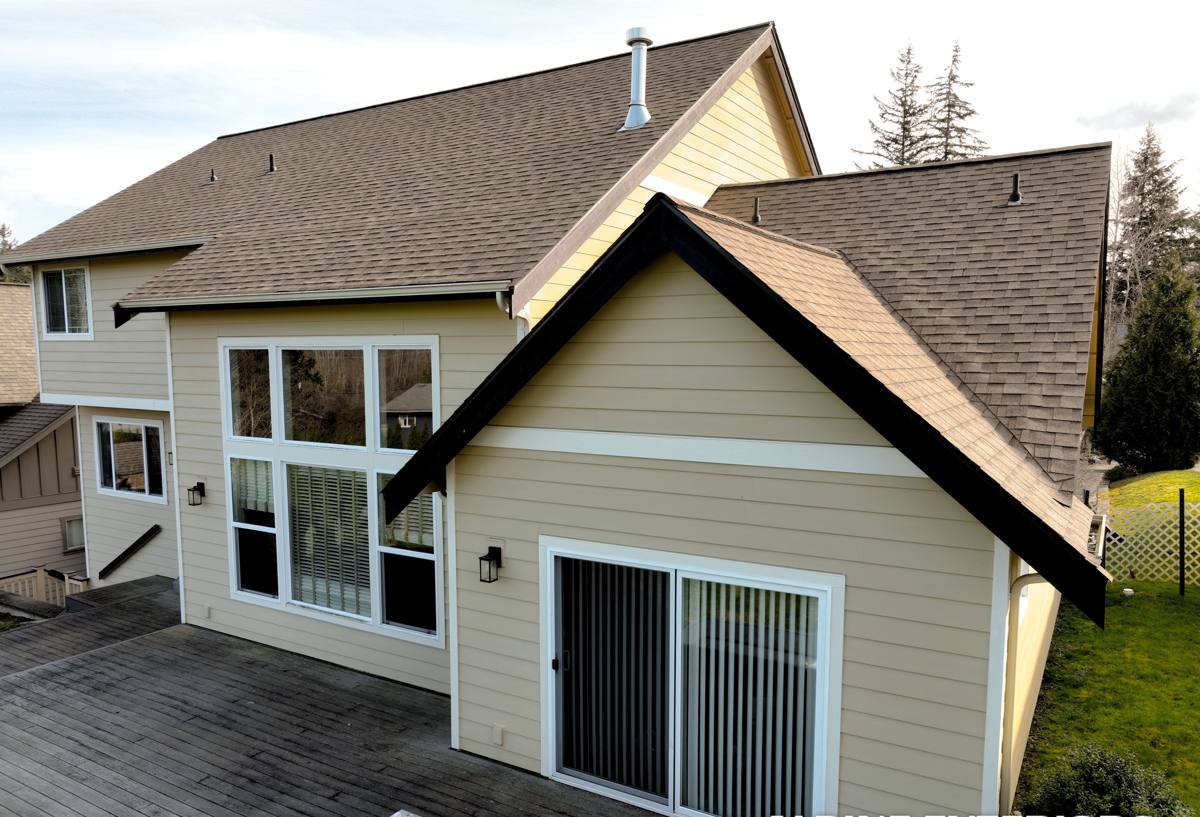
What Bellingham Bay's Salt Air and Long Wet Season Do to the Wrong Siding
Salt air accelerates corrosion in exposed metal fasteners and trim, and it degrades painted or coated surfaces faster than it would inland. Combine that with rain that comes in sideways during winter storms and a growing season that keeps trees, gutters, and north-facing walls damp for months at a stretch, and you get conditions that expose the weaknesses in certain siding products fast:
- Wood-based composite panels can swell, delaminate, or develop edge damage where cut ends and seams take on moisture repeatedly.
- Vinyl siding can warp or buckle with temperature swings and doesn't stop moss and algae from taking hold in shaded, damp corners.
- Untreated or primed wood needs a repainting and caulking schedule that most homeowners underestimate, especially on north- and west-facing walls that stay wet longest.
None of these materials are automatically doomed in Cordata — plenty of homes get by on them for years. But they all put more of the long-term maintenance burden on the homeowner, and in a climate this consistently wet, that burden shows up sooner than it would in a drier part of the state.
Why We Install Only James Hardie Fiber Cement
We standardized on James Hardie fiber cement siding because it's engineered specifically for climates like this one. It's non-combustible, it doesn't rot or delaminate the way wood-based products can when they take on moisture, and its ColorPlus factory finish is baked on under controlled conditions rather than field-applied — which matters a great deal when your painting season is short and your rain season is long. Hardie's HardieZone system is built around real regional climate data, and Whatcom County falls into the HZ5 zone, meaning the panels, fasteners, and installation specs we use are matched to Pacific Northwest moisture exposure rather than a national average.
We don't install vinyl, LP SmartSide, Cemplank, Allura, primed spruce, or cedar. That's a deliberate standard, not a lack of familiarity with those products — we've simply seen how each of them performs over a decade or two in this exact climate, and fiber cement gives Cordata homeowners the best combination of moisture resistance, fire resistance, finish durability, and a strong transferable warranty.
What a Correct Fiber Cement Installation Actually Involves
Fiber cement is only as good as the installation behind it. A correct job includes:
- A continuous, properly lapped weather-resistive barrier behind the siding, with no gaps at seams or penetrations.
- Correct flashing at every window, door, and roofline intersection, integrated with the WRB rather than just caulked over it.
- Proper fastener type, spacing, and depth per the Hardie installation spec — over-driven or under-driven nails are one of the most common causes of early panel failure.
- Correct clearances between the siding's bottom edge and the roofline, deck, or grade, so splashback and standing water can't wick into the material.
- Factory-mitered or properly caulked joints, with butt joints backed and sealed to keep water from tracking behind the panel.
Any one of these details done wrong can undercut everything the material itself is good at. This is the part of the job that doesn't show up in a photo but determines whether the siding is still performing well in fifteen years.
How We Approach a Siding Installation in Cordata
1. Inspection and Assessment
We start by looking at the existing siding, sheathing, and trim to understand what's driving the replacement — cosmetic wear, moisture damage, or both — and to check for problems hiding behind the current cladding, particularly around windows, at wall-roof intersections, and on the sides of the house that take the most wind-driven rain.
2. Tear-Off and Substrate Repair
Old siding comes off, and we address any water damage, soft sheathing, or rot before anything new goes up. Installing new siding over a compromised substrate just hides the problem for a while — it doesn't fix it.
3. Weather Barrier and Flashing
We install a continuous weather-resistive barrier and properly integrate flashing at every window, door, and penetration. This step is what actually keeps water out; the siding itself is the second line of defense, not the first.
4. James Hardie Installation to Spec
Panels, planks, or shingles go on per the Hardie fastening and clearance requirements for our HZ5 zone, with attention to joint placement, corner detailing, and consistent reveal lines.
5. Trim, Caulking, and Final Walkthrough
We finish trim work, seal the joints that need it, clean up the site, and walk the exterior with the homeowner before calling the job done.
James Hardie Product Lines That Fit Cordata Homes
Different Hardie profiles suit different home styles common around Cordata's mix of newer subdivisions and older north Bellingham construction:
| Product | Best For | Why It Works Here |
|---|---|---|
| HardiePlank Lap Siding | Traditional and craftsman-style homes | Most common profile; wide range of ColorPlus finishes and textures |
| HardiePanel Vertical Siding | Modern builds, accent walls, gable ends | Clean lines, pairs well with board-and-batten detailing |
| HardieShingle | Cottage and Craftsman accents | Staggered or straight-edge shingle look without cedar's maintenance |
| HardieTrim | Window, door, and corner trim | Matches fiber cement's moisture resistance so trim doesn't become the weak point |
What Drives the Cost of a Siding Project in Cordata
| Factor | Why It Matters |
|---|---|
| Home size and number of stories | More surface area and more scaffolding/staging on multi-story homes |
| Full tear-off vs. install over prepped substrate | Tear-off costs more up front but is often the right call when moisture damage is found |
| Substrate repair needed | Rotted sheathing or framing found during tear-off adds cost but shouldn't be skipped |
| Siding profile and trim complexity | Multiple profiles, extensive trim, or architectural detailing take more labor |
| Window and door count | Each opening needs its own flashing and detail work |
| Access and site conditions | Tight lots, slopes, or landscaping close to the house affect staging time |
We give homeowners a written estimate that breaks these factors out so it's clear what's driving the price, rather than a single lump number.
Signs a Cordata Home May Need New Siding Soon
- Visible cracking, warping, or bulging in siding panels or boards
- Soft spots when you press on the siding near the bottom of walls or below windows
- Peeling or bubbling paint that keeps coming back in the same spots
- Persistent moss or algae streaking that pressure washing doesn't keep off for long
- Rising energy bills that suggest the wall assembly isn't performing the way it used to
- Visible gaps, missing caulk, or separated joints at corners and trim
- Interior signs like musty smells, staining, or peeling paint on walls that back up to exterior siding
Why Hiring a Crew That Already Works in Cordata Matters
A siding installer who works regularly in and around Bellingham knows the difference between a detail that's optional in a drier climate and one that's mandatory here. That includes how much clearance to leave at grade given our rainfall totals, how to handle the moss and algae exposure on shaded, tree-lined lots common in this part of the city, and how to sequence a job around Whatcom County's wet-weather windows so the substrate isn't left exposed longer than it has to be. It also means familiarity with local permitting requirements and an understanding of how Cordata's mix of newer and older housing stock tends to be built, which affects what we typically find once the old siding comes off.
If your Cordata home is due for new siding, or you're not sure whether what you're seeing is cosmetic or something more serious, we're happy to take a look and give you a straightforward, no-pressure estimate — just fill out the form below.