 Bellingham Exterior
 Why Decks in Ferndale Take More Abuse Than People Expect
Ferndale sits close enough to the water that homes here deal with a specific combination of stresses most decking products were never designed around: salt-laden air drifting in off the Salish Sea, long stretches of driving rain through fall and winter, and a moss season that can run from October well into spring. Any one of those on its own is manageable. Together, they shorten the life of a poorly built deck fast and quietly.
Salt air accelerates corrosion on fasteners, brackets, and any exposed metal hardware. Driving rain doesn't just fall straight down here — wind pushes it sideways under railings and into board gaps, which means drainage and ventilation matter more than they would in a drier climate. And moss doesn't need much: shade, moisture, and a surface that holds both. A north-facing deck under a few fir trees can grow a slick green film within a season if it wasn't built or finished with that in mind.
None of this is a knock on composite decking as a product — it's actually one of the better options for this climate when it's specified and installed correctly. The problems we see almost always trace back to a build that didn't account for local conditions, not the material itself.
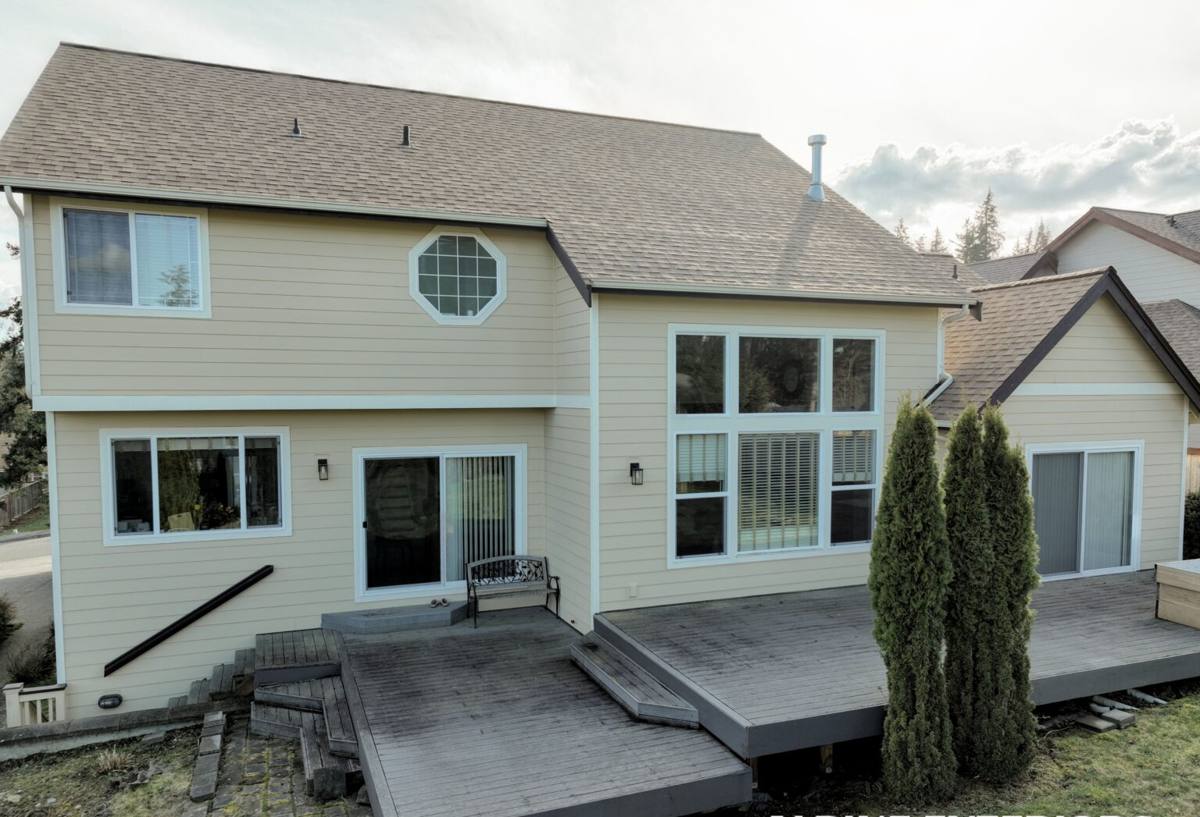
What "Correct" Actually Means for a Ferndale Deck
A composite deck built for a drier inland climate and one built for Whatcom County's coastal weather can look identical on day one and perform very differently by year five. The difference is in details that aren't visible once the project is finished:
Framing and Ventilation
Composite boards don't rot the way wood does, but the framing underneath usually still is wood, and it needs to breathe. We keep joist spacing tight enough to prevent board flex under foot traffic and standing water, and we make sure there's real airflow beneath the deck — not just a gap, but enough clearance and cross-ventilation that moisture doesn't sit trapped against the substructure through a wet Northwest winter.
Board Gapping
Composite boards expand and contract with temperature and moisture more than solid lumber. Gapping that's too tight traps water and debris between boards, which is exactly the environment moss and algae need. Gapping that's too wide looks sloppy and catches heels and furniture legs. We set gaps based on the specific board profile's manufacturer spec, adjusted slightly for our wetter-than-average install season.
Slope and Drainage
A deck surface should never be perfectly flat. A slight, consistent slope away from the house keeps water moving instead of pooling — critical here, where a deck can see rain on more days than not for months at a time. Poor drainage under a deck also feeds the mildew and moss problem from underneath, not just on the walking surface.
Choosing a Composite Board That Actually Suits This Climate
Not all composite decking is built the same way, and the differences matter more in a wet, salt-air environment than they would somewhere dry. The main split is between capped and uncapped composite boards.
Capped composite boards have a plastic (usually polymer) shell wrapped around a wood-fiber composite core. That cap is what resists moisture absorption, staining, and — importantly for this area — surface mold and algae growth. Uncapped composite is more exposed wood fiber at the surface, which absorbs moisture more readily and gives moss and mildew something to grip. We install capped composite almost exclusively for coastal Whatcom County projects for this reason; it's a maintenance and longevity decision, not a brand preference.
Color and texture matter too. Very dark boards run hotter in direct sun but also tend to show less green staining between cleanings. Boards with heavy wood-grain embossing look great but can hold more surface moisture in the grain lines than a smoother finish. None of this is disqualifying — it's a tradeoff worth talking through based on how shaded your specific lot is and how the deck faces.
| Cost Factor | Relative Impact | Why It Matters Here |
|---|---|---|
| Capped vs. uncapped composite | Medium-High | Capped boards cost more upfront but resist the moisture and moss exposure Ferndale sees most of the year |
| Substructure material (wood vs. composite/steel framing) | Medium | Rot-resistant framing options add cost but reduce long-term risk under a deck that stays damp much of the year |
| Fastener and hardware grade | Low-Medium | Marine-grade or coated stainless hardware costs more than standard but resists salt-air corrosion significantly longer |
| Deck height and railing complexity | Variable | Taller decks and code-required guardrails add engineering and labor, independent of climate |
| Site access and tear-out of existing deck | Variable | Older wood or failing composite decks often need full removal, which affects timeline and cost |
Fasteners and Hardware: The Detail Most Homeowners Never See
Salt air is hard on metal, full stop. It doesn't need to be a beachfront lot for this to matter — Ferndale's proximity to the water means airborne salt reaches homes further inland than people expect. Standard galvanized fasteners can start showing rust streaks on light-colored composite boards within a few seasons in this kind of exposure.
We use coated or stainless-steel fasteners and hidden fastening systems rated for coastal exposure, along with structural hardware (joist hangers, post bases, ledger flashing) that matches. It costs more than the hardware-store standard, but it's the difference between a deck that still looks clean in ten years and one with rust bleed streaking down the boards by year three. This is one of those choices that's invisible on install day and very visible later — which is exactly why it's worth asking any contractor what hardware they're actually using, not just what decking brand.
Our Process for a Ferndale Composite Deck
- On-site assessment — we look at sun exposure, shade patterns, existing drainage, and how exposed the lot is to prevailing wind and salt air before recommending a board and structure.
- Permitting — most deck work in Whatcom County requires a permit, especially for anything attached to the house or above a certain height. We handle that paperwork rather than leaving it on the homeowner.
- Tear-out (if applicable) — old wood or failing composite decking is removed, and we inspect the ledger board and house connection for hidden water damage before building anything new on top of it.
- Framing and flashing — proper ledger flashing at the house connection is one of the most common failure points on older decks in wet climates, and we address it directly rather than reusing questionable existing flashing.
- Decking installation — boards installed with manufacturer-spec gapping, hidden or color-matched fasteners, and a consistent drainage slope.
- Railing and finish work — code-compliant railing height and baluster spacing, with hardware matched to the same corrosion-resistance standard as the decking fasteners.
- Site cleanup — full cleanup of old material and job debris before we consider the project done.
Living With a Composite Deck Through Whatcom County's Moss Season
Even a well-built, capped composite deck benefits from a little seasonal attention here — it's just far less than a wood deck would need, and none of it involves staining or sealing.
- Sweep debris (needles, leaves, seed pods) off the surface regularly in fall — trapped organic matter is what feeds moss and mildew growth
- Rinse the deck surface periodically through the wet months, especially in shaded areas, to keep spores from taking hold
- Use a soft-bristle brush and a mild soap-and-water solution for any green staining — avoid pressure washing directly into board seams, which can force water into the substructure
- Check that gaps between boards stay clear of packed debris, particularly at board ends near the house or railing posts
- Confirm gutters and downspouts above or near the deck are clear, since overflow is a common source of unexpected concentrated water exposure
- Inspect fastener heads and any visible hardware once a year for early rust staining, which is easier to address early than after it's bled into the board
Why It's Worth Hiring a Crew That Already Works in Ferndale
A lot of decking problems we get called out to fix weren't caused by bad materials — they were caused by a build that would have held up fine somewhere drier. Framing without adequate ventilation, gapping set for a climate that doesn't see six months of rain, fasteners rated for general use rather than salt-air exposure — all defensible choices somewhere else, all problems here.
Working regularly in Ferndale and the surrounding Bellingham area means we're not guessing at how a deck will hold up against this specific combination of salt air, rain, and shade. We're also familiar with Whatcom County's permitting requirements, which keeps the paperwork side of the project from becoming a delay. That local familiarity is a practical advantage, not a marketing line — it shows up in the framing decisions, the hardware spec, and the drainage details that don't get inspected after the fact.
Getting Started
If you're weighing composite decking for a home in Ferndale, we're happy to walk the site, talk through board options suited to your lot's sun and shade exposure, and give you a straightforward estimate — no pressure, no sales script. Use the form below to request a free estimate and we'll go from there.