 Bellingham Exterior
 Puget's Climate Is Harder on Siding Than Most Homeowners Realize
Homes in the Puget area near Bellingham sit in a specific climate pocket within Whatcom County: close enough to salt water to pick up airborne salt on windward walls, exposed to the driving, wind-pushed rain that comes off the Sound in fall and winter, and shaded enough by conifers and cloud cover to support a long moss season that can run eight months or more. None of these factors is dramatic on its own. Together, over years, they are exactly the combination that finds every weakness in a siding system — every gap in the weather barrier, every place paint was asked to do a job it wasn't built for, every panel that trapped moisture instead of shedding it.
This page is about one service, done right, in this one area: fiber cement siding installation for Puget homes. We install James Hardie fiber cement exclusively, and we want to explain why that product and this process match what your home is actually up against — not in generic terms, but in terms of what salt air, driving rain, and moss do to a wall over time.
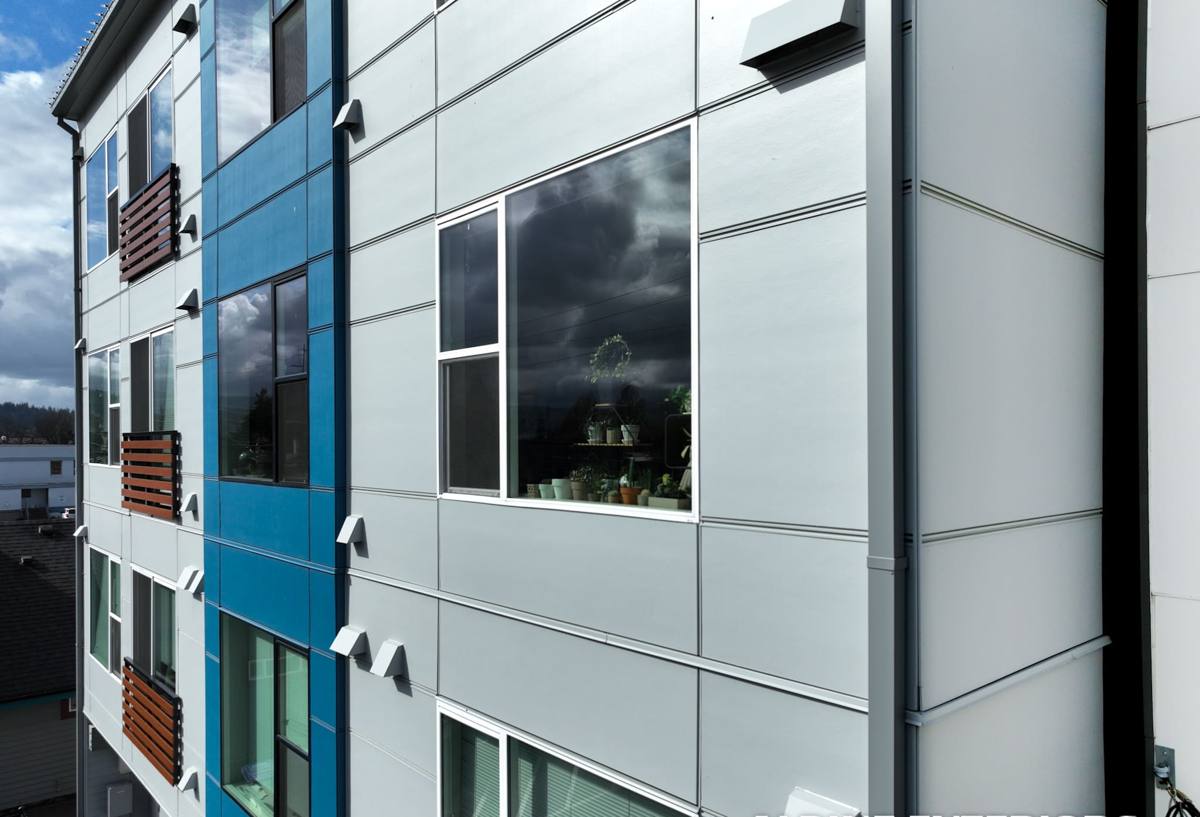
What "Driving Rain" Actually Does to a Wall Assembly
Driving rain isn't just more rain — it's rain pushed sideways by wind, which means it hits siding at an angle instead of running straight down. That changes what the siding has to do. A product that sheds water fine in a calm, vertical rain can still let moisture drive up and under laps, into fastener holes, and behind trim in a wind-driven storm off the water. This matters more on the windward-facing walls of Puget homes than on sheltered elevations, which is one reason a proper installation treats each side of the house a little differently — more attention to lap depth, flashing, and sealant detail where the weather actually hits hardest.
Fiber cement handles this well because it doesn't rely on a paint film alone to keep water out. James Hardie's ColorPlus finish is baked on at the factory and backed by the panel's own dense, engineered composition, so the material underneath isn't absorbing water the way wood fiber or OSB-based products can. But the product only performs as well as the installation. A correctly lapped, correctly fastened, correctly flashed Hardie wall resists driving rain. A rushed one doesn't — regardless of what siding is on it.
Salt Air and Slow Corrosion
Proximity to the Sound means Puget homes deal with low-level salt exposure that most inland Whatcom County properties don't. Salt air accelerates corrosion of fasteners, flashing, and any exposed metal trim. It's rarely dramatic — it's slow, cumulative pitting and rust that shows up years later as staining or failure at exactly the points where water intrusion starts. This is why fastener choice and flashing material matter as much as the siding panel itself in this specific location, and it's a detail that's easy to skip if a crew is following a generic spec instead of paying attention to where the house actually sits.
Moss Season and What It Means for Siding, Not Just Roofs
Most homeowners think of moss as a roof problem, but on shaded, north-facing, or tree-adjacent walls in Puget, moss and algae growth on siding is common too — especially on textured or porous surfaces that hold moisture. A long moss season means more time with a damp surface against the siding face, which is a slow but real stressor on paint film and substrate. Factory-cured fiber cement with a baked-on finish resists this better than field-painted wood or lower-grade composites, but proper spacing, drainage, and ventilation behind the siding still matter — moss thrives where air can't move and water can't escape.
Why We Install James Hardie and Nothing Else
We made a deliberate decision to install only James Hardie fiber cement siding — not vinyl, not LP SmartSide, not Cemplank or Allura, not primed spruce or cedar. That's not a marketing position; it's a standard we hold because we've seen what each of those alternatives asks a homeowner to accept in exchange for a lower upfront cost, and in a climate like Puget's, those trade-offs show up faster.
- Vinyl siding can warp or buckle in temperature swings and doesn't offer the fire resistance or impact durability of fiber cement.
- Wood-based composite siding (like LP SmartSide) relies on engineered wood strand technology that, however well-treated, is more moisture-sensitive at cut edges and fastener points than a true fiber cement panel.
- Primed cedar or spruce requires ongoing repainting and is genuinely vulnerable to the rot cycle that damp, shaded, moss-prone walls invite.
- Other fiber cement brands may be dimensionally similar to Hardie, but we standardized on one manufacturer so our crews install one system, to one spec, with one warranty structure — consistency that shows up in the finished product.
James Hardie's HZ10 product line is engineered specifically for the Pacific Northwest's wet-cold climate zone, which includes Whatcom County and the Puget area. That's an actual engineering distinction, not a marketing label — the formulation and finish are matched to sustained moisture exposure rather than a hot, dry climate.
What a Correct Fiber Cement Installation Involves
The siding panel is one part of a system. A correct installation in a climate like this one includes several details that are easy to shortcut and hard to inspect once the job is finished:
The Weather-Resistive Barrier
Before any siding goes up, the wall needs a continuous, properly lapped weather-resistive barrier with all penetrations — windows, doors, vents, hose bibs — flashed correctly. This layer is what actually keeps bulk water out of the wall assembly; the siding is the first line of defense, not the only one.
Clearance and Drainage
Fiber cement siding needs proper clearance from grade, roof lines, decks, and other horizontal surfaces, plus a drainage gap where required, so water has somewhere to go instead of wicking up into the bottom of the panel. This is one of the most common shortcuts on rushed jobs and one of the least visible until moisture damage shows up years later.
Fastening and Lap Depth
Hardie panels have a specified nailing pattern and minimum lap depth for a reason — get either wrong and you introduce the exact vulnerability that driving rain is designed to find. Fastener type also matters in a salt-air environment, where the wrong metal corrodes faster than it should.
Caulking and Trim Details
Joints, corners, and trim transitions need the right sealant, applied correctly, at every point where two materials meet. This is finish-level work that determines whether a house looks sharp and stays sealed for the long haul, or starts showing hairline gaps within a few seasons.
Our Process for a Puget Installation
- Assessment: We walk the property and evaluate wall-by-wall exposure — which elevations take the worst of the driving rain, where moss and shade are already a factor, and where existing moisture damage may be hiding under current siding.
- Tear-off and inspection: Old siding comes off and the sheathing underneath gets inspected for rot or damage before anything new goes on. Problems found here get addressed, not covered up.
- Weather barrier and flashing: A continuous, correctly lapped barrier goes on with proper flashing at every penetration.
- Hardie installation: Panels are installed to manufacturer spec — correct fastening, lap depth, clearances, and drainage gaps, with attention to which elevations need extra care against wind-driven rain.
- Trim and finish work: Corners, joints, and transitions are sealed and finished cleanly.
- Final walkthrough: We review the completed work with you before calling the job done.
Comparing Siding Options for a Climate Like Puget's
| Factor | James Hardie Fiber Cement | Vinyl | Wood / Engineered Wood |
|---|---|---|---|
| Moisture resistance | Strong — engineered for wet climates, factory finish | Doesn't absorb water but can allow drainage issues behind panels | Vulnerable at cut edges, joints, and over time |
| Salt air / coastal exposure | Handles well with correct fasteners and flashing | Can become brittle and discolor with UV and salt exposure | Prone to accelerated wear near salt air |
| Moss and algae resistance | Baked-on finish resists growth better than field-painted surfaces | Can support surface growth in shaded, damp areas | Porous surface is more hospitable to moss and mildew |
| Fire resistance | Non-combustible | Combustible | Combustible |
| Maintenance | Periodic cleaning; repaint interval much longer than field-finished materials | Low maintenance but limited repair options if damaged | Regular repainting and moisture monitoring required |
Signs Puget Homeowners Should Watch For
Because moisture damage from driving rain and moss buildup develops slowly, it's worth knowing the early signs rather than waiting for something obvious:
- Soft or spongy spots when you press on siding, especially near the bottom courses or under windows
- Persistent moss or algae staining that returns quickly after cleaning
- Paint that's bubbling, peeling, or chalking unevenly across the same wall
- Visible gaps opening up at seams, corners, or trim joints
- Rust streaking below fasteners or metal flashing
- A musty smell near exterior walls inside the home
Maintaining Fiber Cement Siding in This Climate
Fiber cement is genuinely low-maintenance compared to wood, but "low-maintenance" doesn't mean "no maintenance" in a climate with an eight-month moss season. A simple annual routine goes a long way:
- Rinse siding with a garden hose (not a high-pressure washer, which can force water behind panels or damage the finish) to clear pollen, dust, and early moss growth
- Trim back vegetation and tree branches that keep walls shaded and damp longer than necessary
- Check caulking at trim and joints yearly and have any cracked sealant addressed before winter rains
- Keep gutters clear so overflow isn't running down the siding face
- Have a professional look at any soft spots, staining, or gaps as soon as you notice them, rather than waiting for the next scheduled project
Why Hiring a Crew That Already Works in Puget Matters
A siding crew that mostly works dry, inland, or non-coastal jobs may install a technically correct system that still isn't matched to what this specific location needs — the extra attention to windward-wall lap depth, the fastener choice for salt exposure, the drainage detailing that keeps moss-prone shaded walls dry. None of that is exotic knowledge, but it's the kind of judgment that comes from doing this work repeatedly in this climate, on homes with the same exposure your home has. A crew that already understands Puget's mix of salt air, driving rain, and moss season isn't guessing at how to adapt the manufacturer's general installation spec to your specific walls — they've already made those calls on homes like yours.
If you're weighing a siding replacement or want a second opinion on the condition of what's currently on your home, we're happy to take a look. Reach out for a free, no-pressure estimate using the form below — we'll walk the property, answer your questions honestly, and tell you what we'd actually recommend for your home's specific exposure.