 Bellingham Exterior
 Birch Bay's Climate Is Harder on Siding Than Most Whatcom County Homes
Birch Bay sits right on the water, and that changes what siding has to deal with day to day. Homes closer to the shoreline take on salt-laden air that settles into every seam, joint, and fastener on the exterior. Add wind-driven rain coming off the Strait of Georgia, long stretches of gray, damp weather, and tree-shaded lots that never fully dry out, and you've got an environment that's genuinely tougher on siding than a typical inland Whatcom County property.
Most of the siding problems we see in Birch Bay trace back to one of three things: moisture that got behind the cladding and had nowhere to go, a material that couldn't handle sustained dampness without swelling or rotting, or a finish that broke down under salt exposure and UV faster than expected. None of that is unusual for a marine environment — it's just a reason to be more deliberate about material choice and installation detail than you might be a few miles inland in Bellingham proper.
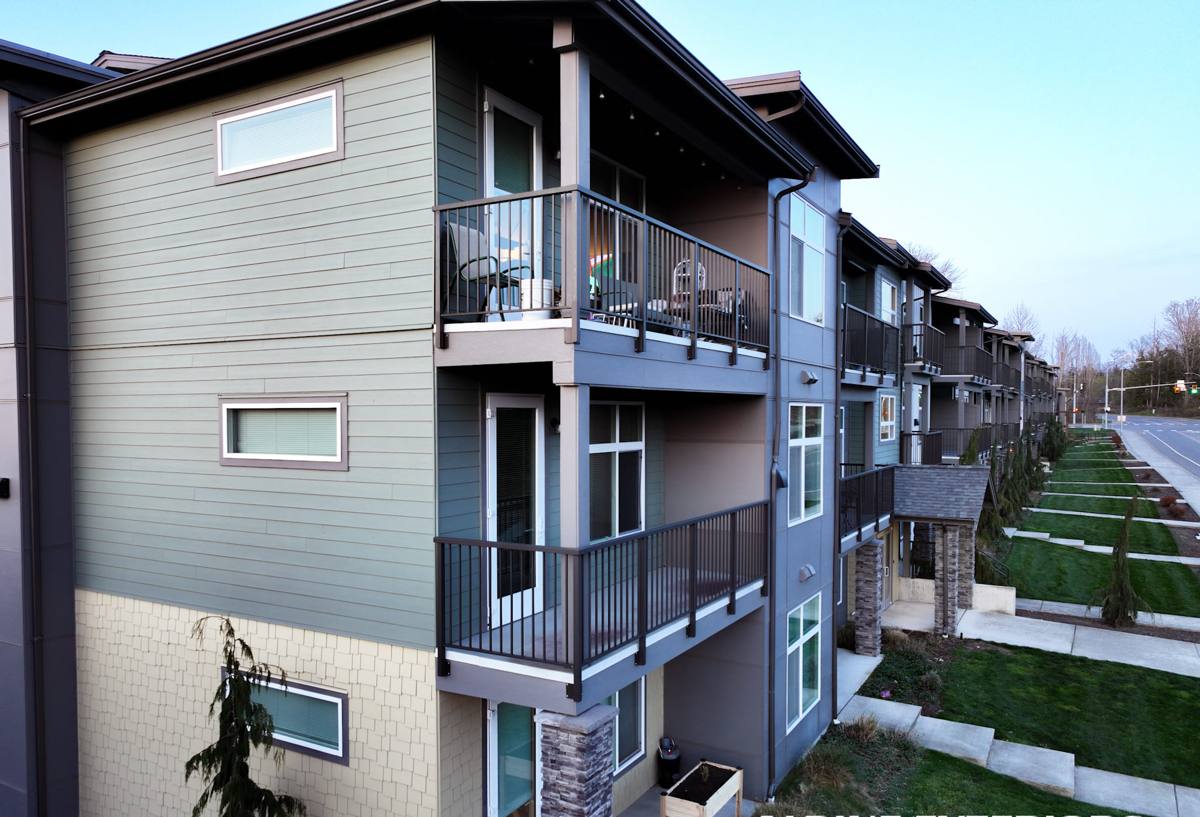
Why We Only Install James Hardie Fiber Cement Here
We made the call years ago to install James Hardie fiber cement exclusively — no vinyl, no LP SmartSide, no Cemplank or Allura, no primed spruce or cedar. That standard matters even more on a coastal job like Birch Bay, because fiber cement handles the specific stresses of salt air and sustained moisture better than the alternatives we chose not to carry.
A Non-Combustible, Dimensionally Stable Core
Hardie siding is made from cement, sand, and cellulose fibers. It doesn't expand and contract with humidity swings the way wood does, and it won't soften or warp from repeated wetting the way some engineered wood products can under long-term damp exposure. That stability matters on a shoreline lot where the siding is rarely bone dry for more than a day or two at a stretch during the wetter months.
ColorPlus Factory Finish
Most Hardie products we install carry the ColorPlus factory-applied finish rather than a field-applied paint job. It's baked on in a controlled environment with multiple coats, and it's built to resist fading and hold up to UV and moisture better than a site-painted finish. On a house that's catching salt spray and constant damp air off the bay, a finish that doesn't need repainting every few years is worth a lot.
HardieZone Engineering
Hardie engineers its products by climate zone, and the HZ5 formulation used across the Pacific Northwest is built around exactly the conditions Whatcom County throws at a house — sustained rain, humidity, and moisture cycling. It's not a generic siding adapted for our climate; it's specified for it.
What a Correct Installation Looks Like on a Birch Bay Home
The siding material is only half the equation. How it's installed determines whether it actually performs the way it's engineered to. On coastal and near-coastal homes we pay particular attention to a handful of details that matter less in drier inland settings.
Moisture Management Behind the Cladding
Every job starts with a proper water-resistive barrier, correctly lapped and taped, with flashing installed at every window, door, and horizontal transition so water is directed out and down rather than trapped behind the siding. On a house exposed to sustained wind-driven rain, a shortcut here is where rot and hidden damage start — often years before it shows on the surface.
Rain Screen Gap and Fastening
Hardie siding needs to be installed with the manufacturer's specified clearances, fastening pattern, and gaps at butt joints and trim so the material can drain and dry properly. We follow Hardie's published installation specs rather than shortcutting them, because that's what keeps the warranty valid and the wall assembly doing its job over decades, not just years.
How Materials Compare in a Coastal, High-Moisture Setting
| Material | Behavior in Salt Air & Sustained Moisture | Ongoing Maintenance |
|---|---|---|
| James Hardie fiber cement | Dimensionally stable, non-combustible, factory finish resists fading and moisture damage when installed to spec | Occasional cleaning; no repainting needed for the ColorPlus finish under normal conditions |
| Vinyl siding | Can warp or become brittle with UV and temperature cycling; seams can allow moisture intrusion behind panels | Low, but panels are difficult to repair invisibly and can fade unevenly over time |
| Cedar or primed wood | Absorbs moisture readily; salt air and sustained damp accelerate swelling, checking, and rot risk | Regular repainting or resealing; more frequent inspection for rot |
| Engineered wood siding | Better than raw wood but still moisture-sensitive at cut edges and joints if not sealed and maintained | Periodic inspection of edges and caulk joints; repainting on a cycle |
Moss and Algae: Managing Shade, Airflow, and Growth
A lot of Birch Bay lots carry mature tree cover, and that shade combined with near-constant moisture is exactly what moss and algae need to take hold. Moss on siding isn't just cosmetic — it holds moisture against the surface longer than it would otherwise sit there, which works against whatever material is underneath it.
We can't change how much shade a lot gets, but installation choices help: proper drainage behind the cladding so water doesn't linger, correct grading and gutter placement so runoff isn't sheeting down the wall face, and trimming back vegetation that's crowding the siding all reduce how aggressively moss and algae establish. Hardie's factory finish also resists the kind of surface staining and biological growth that dulls a painted wood finish faster in shaded, damp spots.
Our Process for Birch Bay Siding Projects
The steps are the same discipline we use on every job, adjusted for what a shoreline-exposed or heavily shaded lot actually needs.
- Site walk and assessment — we look at wind exposure, shade patterns, existing moisture damage, and how water currently moves around the house.
- Scope and product selection — we spec the right Hardie plank, panel, and trim profiles and colors for the home and its exposure.
- Tear-off and sheathing check — old siding comes off and we inspect sheathing for hidden moisture damage before anything new goes up.
- Water-resistive barrier and flashing — installed and detailed at every penetration, window, and transition.
- Hardie installation to manufacturer spec — correct fastening, clearances, and joint treatment throughout.
- Final walkthrough — we review the finished work with you before calling the job done.
Why Hiring a Crew That Already Works Birch Bay Matters
Installing Hardie siding correctly requires the same technical discipline anywhere, but knowing a specific area helps in practical ways. A crew that regularly works Birch Bay and the surrounding Whatcom County coastline has a feel for which lots get hit hardest by wind-driven rain, which properties need extra attention to shaded, moss-prone walls, and how local permitting works for exterior projects in unincorporated Whatcom County versus inside Bellingham city limits. That familiarity shortens the guesswork and reduces surprises once tear-off starts.
It also means we're not learning the region on your project. We've seen how salt air and sustained damp actually affect siding over years, not just in theory, and that shapes the choices we make about flashing details, product selection, and where to spend extra care on a given house.
Signs Your Birch Bay Home May Need New Siding
- Soft or spongy spots when you press on the siding, especially near the bottom edges or around windows
- Visible warping, buckling, or gaps between siding boards or panels
- Paint that's peeling, bubbling, or failing faster than it should, particularly on shaded walls
- Persistent moss, algae, or dark staining that keeps returning after cleaning
- Rising energy bills that suggest the wall assembly isn't insulating or sealing the way it used to
- Visible rot, cracking, or insect damage at corners, trim, or butt joints
If you're seeing more than one of these, it's worth having someone take a real look rather than waiting for it to get worse — moisture problems behind siding tend to compound quietly before they show up as a bigger repair.
Caring for Hardie Siding After Installation
One of the practical advantages of switching to James Hardie in a place like Birch Bay is how little upkeep it demands compared to wood or a field-painted product. A periodic rinse to knock off salt residue, pollen, and surface grime, an eye kept on caulking at trim and joints over the years, and prompt attention if a gutter starts overflowing onto a wall are really the extent of it. There's no repainting cycle to plan around and no annual sealing routine to keep on top of.
If you're weighing a siding project on a Birch Bay home and want a straight answer about what your house actually needs, we're happy to take a look and put together a free, no-pressure estimate — no obligation either way.