 Bellingham Exterior
 Siding Repair in York: A Bellingham Neighborhood With Its Own Wear Pattern
York is one of Bellingham's established neighborhoods, and like the rest of the city it sits inside a climate that doesn't go easy on exterior materials. Salt-tinged marine air moves through year-round, rain arrives sideways as often as it falls straight down, and a moss and mildew season stretches across most of the calendar on shaded and north-facing walls. None of that shows up as sudden damage. It shows up slowly, as a soft spot near a window trim, a hairline crack that widens each winter, or a stain that keeps coming back no matter how many times it's washed off.
We work on homes throughout York and the surrounding Bellingham area, and siding repair calls here tend to follow a recognizable pattern once you've seen enough of them: the damage is usually smaller than the homeowner fears, but it's rarely purely cosmetic. Something let moisture in, and the repair only holds if that something gets found and fixed, not just covered over.
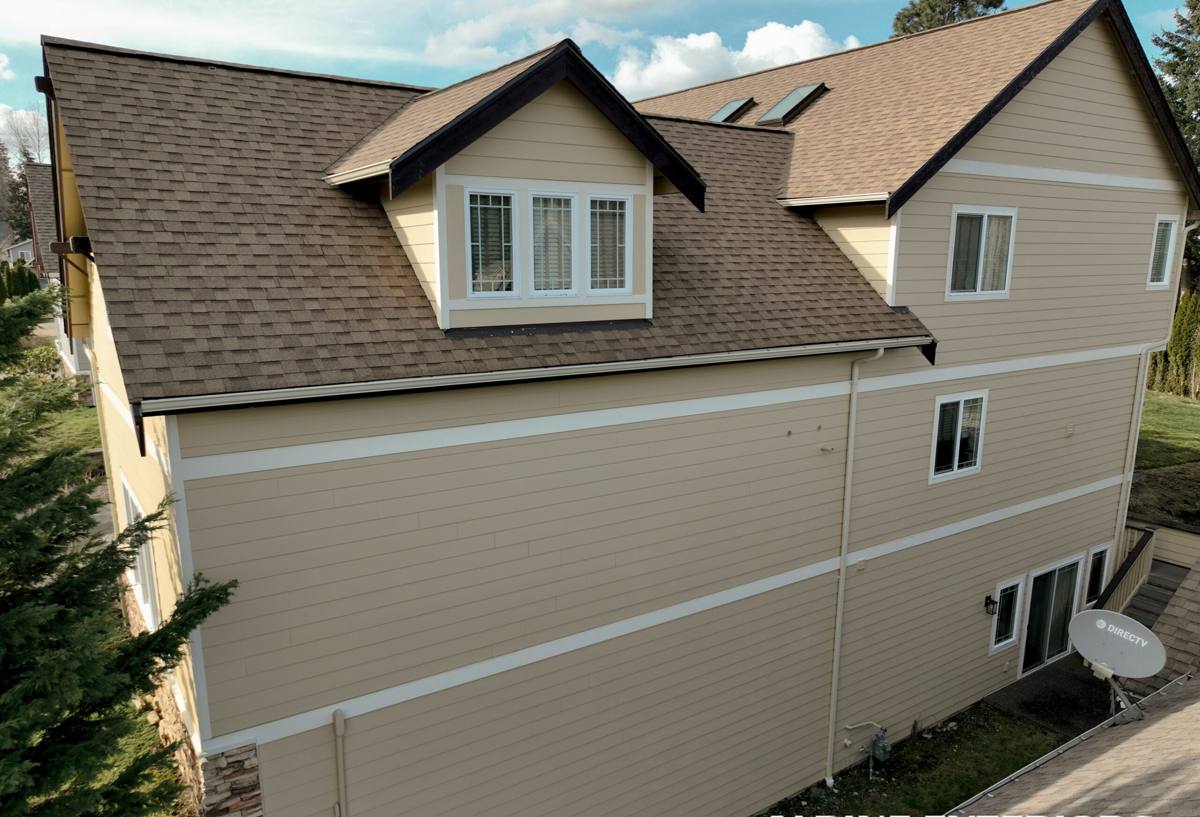
What's Actually Causing the Damage
Salt Air and Slow Corrosion
Bellingham's proximity to the bay means a steady flow of moisture-laden, salt-tinged air moving across the city, York included. That kind of exposure is harder on fasteners, flashing, and lower-grade finishes than an inland climate would be. It's a quiet process, corrosion working on a nail head or a piece of trim flashing for years before it ever becomes visible from the ground.
Wind-Driven Rain Finding the Gaps
Rain that's pushed sideways by wind behaves differently than rain that just falls straight down. It gets forced into lap joints, trim seams, and fastener penetrations that a calmer, drier climate wouldn't test nearly as hard. A lot of the repair calls we get in this area trace back to one of those small gaps: a piece of caulk that failed, a flashing detail that was a little short, a joint that wasn't lapped correctly the first time.
A Moss Season That Doesn't Really End
Mild temperatures, tree cover, and consistent dampness add up to extended moss and mildew growth on shaded walls, and York has its share of mature landscaping that keeps certain wall sections wet longer than others. Any siding material with even slight porosity, or one that holds moisture against the substrate instead of shedding it, becomes a growth surface over time. That growth isn't just unattractive — sustained dampness against a moisture-absorbent material is what eventually leads to softening and rot at seams and edges.
How to Tell If You Need a Repair, Not a Full Re-Side
Most homeowners call us worried they're looking at a full replacement. In a lot of cases, that's not true. Isolated impact damage, a section that's failed around a single window, or trim that's come loose can usually be repaired and matched into the existing siding without touching the rest of the house. The question that actually matters is whether the problem is contained or whether it's a symptom of something bigger happening behind the wall.
- Cracked, chipped, or dented boards from storm debris or accidental impact, with the surrounding siding still solid
- Soft or spongy spots limited to a small area, usually near grade, a window, or a trim joint
- A section with peeling or bubbling paint while the rest of the wall still looks sound
- Gaps or separation at a single seam or corner rather than throughout the whole elevation
- Moss or staining that returns quickly in one specific spot rather than across multiple walls
- Trim or fascia pulling away in one area, often where flashing failed
If damage shows up in one contained area and the material around it is still sound, a repair usually makes sense. If we find soft sheathing, damage that keeps recurring in the same spot after prior patch jobs, or moisture tracking well beyond where it's visible from outside, that's usually a sign the wall assembly itself has a problem a patch won't solve.
What a Correct Siding Repair Actually Involves
A siding repair that actually holds isn't just pulling off a damaged board and nailing up a new one. It's a diagnostic process first and a carpentry job second.
- Find the real cause. Before anything gets removed, we figure out why that section failed — a flashing gap, a caulk joint that gave out, a grade or clearance issue, or just an isolated impact with no underlying cause.
- Open it up and check what's behind it. Once the damaged siding is off, we look at the house wrap and sheathing underneath. This is the step that gets skipped on rushed repairs, and it's exactly where hidden rot or trapped moisture gets found — or doesn't.
- Repair or replace the substrate if needed. If sheathing or framing has taken on moisture damage, that gets addressed before any new siding goes back on. Closing a wall back up over a compromised substrate just hides the problem for another season.
- Match the material correctly. New boards need to match the existing siding's profile, exposure, and color as closely as possible, and they need to tie into the surrounding house wrap and flashing as one continuous system, not a patch sitting on top of it.
- Fasten and flash to spec. Correct nailing patterns, proper clearance from grade, and flashing that sheds water outward rather than trapping it are what determine whether the repair lasts or fails again in a year or two.
- Seal and finish. Joints get caulked where the manufacturer calls for it, and the seams are finished so the repair blends into the surrounding wall rather than standing out as an obvious patch.
Why We Only Repair With James Hardie Materials
We install and repair one siding system: James Hardie fiber cement. We don't install or patch with LP SmartSide, vinyl siding, Cemplank, Allura, primed spruce, or cedar, and that standard applies to repair work just as much as it does to full replacements. Patching a damaged wall with a mismatched or lower-grade material might close the gap for now, but it introduces a second material with different moisture behavior, expansion characteristics, and finish life into a wall assembly that has to perform as one system for decades.
Hardie's non-combustible fiber cement doesn't swell, cup, or feed rot the way wood-based products can, which matters when we're repairing a spot that already had a moisture problem once. Its ColorPlus factory finish is baked on under controlled conditions rather than brushed on in the field, which gives us a much better shot at a repair that blends in and keeps its color over time instead of visibly aging differently from the surrounding boards. And Hardie's HZ product lines are engineered for regions with sustained moisture and freeze-thaw cycling, which fits Bellingham's climate better than a generic national spec. Repairing with the same system that's already on the house, installed to the same standard, is what keeps a patch from becoming next year's callback.
Repair vs. Replacement: How We Make the Call
| Situation | Usual Recommendation | Why |
|---|---|---|
| Isolated impact damage, surrounding siding sound | Repair | Damage is contained and doesn't indicate a systemic wall problem |
| Single failed seam or trim joint | Repair | Localized moisture entry point that can be corrected and resealed |
| Recurring damage in the same spot after a prior patch | Investigate further, often replace a larger section | Suggests the underlying cause was never actually fixed |
| Soft sheathing found behind multiple sections | Larger repair or full replacement | Points to a wall assembly problem rather than an isolated failure |
| Siding at or near the end of its expected service life | Replacement | Patching aging material usually just delays a bigger job rather than solving it |
We'll walk the property, tell you plainly which category your situation falls into, and explain why — not just quote a number and move on.
Our Siding Repair Process for York Homes
Repair jobs in York generally follow the same process, adjusted for what we actually find once the wall is open:
- On-site inspection. We look at the damaged area, the surrounding siding, and the home's overall exposure to sun, wind, and shade to understand why that spot failed.
- Honest scope and estimate. We tell you whether we're looking at a contained repair or something bigger, and what that means for cost and timeline, before any work starts.
- Site protection. Landscaping, walkways, and anything near the work area get protected before removal starts.
- Removal and inspection behind the wall. Damaged siding comes off and we check the house wrap and sheathing before deciding on final scope.
- Repair and reinstallation. Matched Hardie material goes back in, fastened, flashed, and sealed to spec.
- Cleanup and walkthrough. We clear debris and walk the repair with you so you know exactly what was found and fixed.
Siding Repair Cost Factors in York
| Factor | What It Affects | Why It Matters Here |
|---|---|---|
| Extent of hidden moisture damage | Whether sheathing or framing repair is needed before new siding goes on | Years of wind-driven rain and trapped moisture can damage a wall well before it's visible from outside |
| Color and profile matching | Whether the repair blends in or stands out | ColorPlus factory finishes fade and weather differently than field-applied paint, so matching an older wall takes care |
| Access and location on the home | Labor time and equipment needs | York's mix of lot sizes and mature landscaping can add setup time on some properties |
| Number and location of affected sections | Whether it's a single-spot patch or a broader section replacement | Recurring or spread-out damage often points to a flashing or wrap issue that needs addressing, not just patching |
| Trim and flashing condition | Whether trim needs replacement alongside the siding itself | Failed trim flashing is one of the more common root causes we find behind damaged siding in this climate |
Real numbers depend on what we find once the damaged area is opened up, which is why we inspect in person rather than quoting from a photo or a phone description.
Roofing, Windows, and Decks: Where Siding Damage Often Really Starts
A lot of siding repair calls turn out not to be siding problems at all. A roof valley dumping water onto a wall below, a window that was flashed incorrectly when it was installed, or a deck ledger trapping moisture against the house can all surface as damaged siding, even though the siding is just where the water finally showed itself. Because we also handle roofing, windows, and decks, we can look at a York property as one connected exterior system and trace a problem back to where it actually started, instead of patching siding over a leak that's still active underneath.
Why a Local Crew Matters for a Repair Job
Repair work rewards local knowledge more than a full re-side does, because a repair has to blend into decades of existing weathering and match a specific wall's exposure history. A crew that works Bellingham exteriors regularly has a feel for which wall orientations in a neighborhood like York take the most wind-driven rain, where moss tends to establish first given the tree cover and shade patterns common here, and how a ColorPlus finish from a few years back is likely to have weathered compared to a brand-new board. That's the difference between a repair that disappears into the wall and one that's obviously a patch. It also means fewer surprises on cost and timeline, since a local crew has already seen how this specific climate tends to hide moisture damage behind siding that still looks fine from the sidewalk.
If you've got a damaged section of siding on a York-area home, or you're not sure whether what you're looking at is a quick repair or something bigger, we're happy to take a look. Reach out using the form below to schedule a free, no-pressure estimate.