 Bellingham Exterior
 Cordata's Weather Doesn't Go Easy on Roofs
If you own a home in Cordata, you already know Whatcom County weather isn't gentle on a roof system. This part of north Bellingham sits close enough to Bellingham Bay and the Strait of Georgia to pick up salt-laden air, and it gets the same long, wet Pacific Northwest storm season as the rest of the county — months of driving rain, gusty windstorms rolling in off the water, and a moss season that can run from early fall through late spring. None of that is unusual for this area. What is unusual is how many roofs in Cordata are carrying storm damage the homeowner doesn't know about yet, because the damage doesn't always show up as a hole or a missing shingle. Sometimes it shows up eighteen months later as a stain on a bedroom ceiling.
We repair storm-damaged roofs on Cordata homes because it's part of the territory we already work, not because we're passing through. That matters more than it sounds like it should — we'll get into why further down.
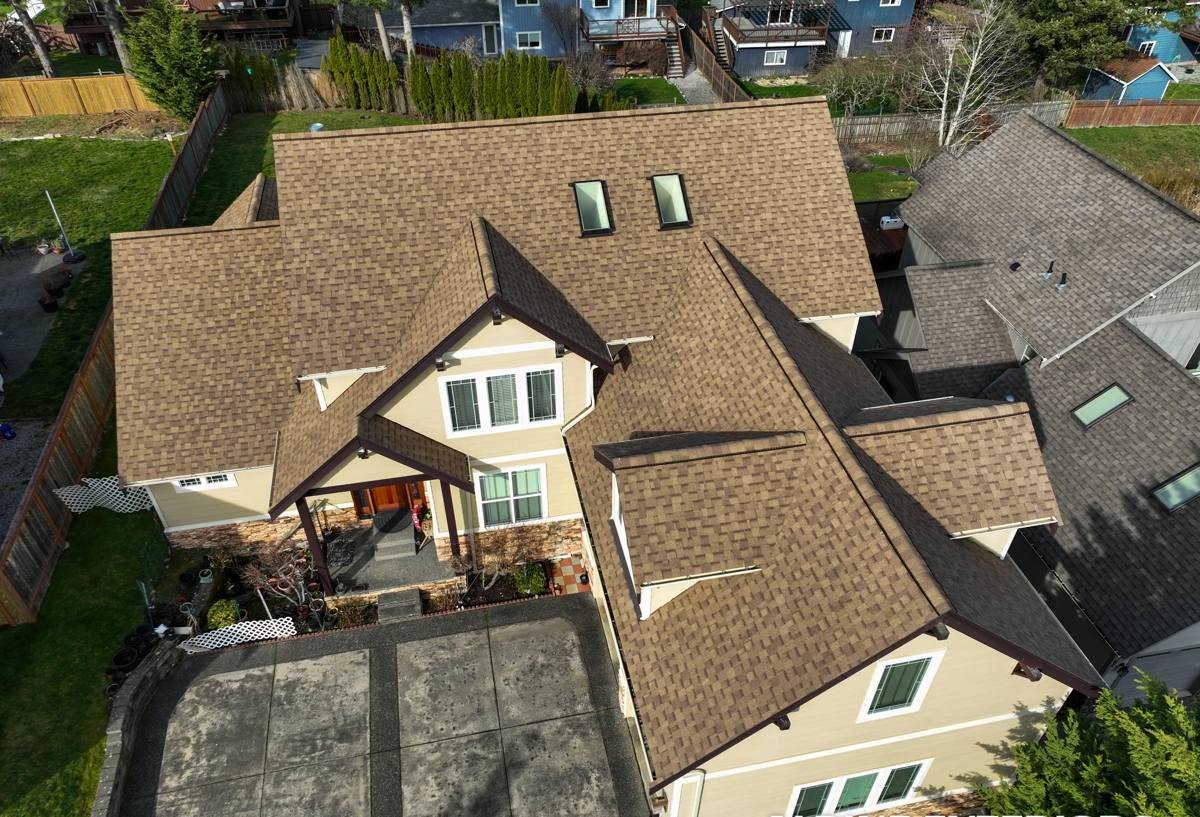
What Storm Damage Actually Looks Like on a Cordata Roof
"Storm damage" covers more than a tree limb through the decking. In this climate, most of what we get called out for falls into a few categories.
Wind-Driven Damage
Bellingham-area windstorms don't need to be dramatic to do real damage. Sustained wind combined with gusts is enough to lift shingle tabs, crease or crack ridge caps, and work fasteners loose over repeated cycles. A roof doesn't have to lose a whole shingle for wind to have compromised its seal — a lifted tab that lays back down looking mostly normal can still have a broken adhesive strip underneath, which is an open invitation for wind-driven rain the next time a storm comes through.
Wind-Driven Rain and Water Intrusion
Whatcom County storms rarely bring rain straight down. It comes in sideways off the water, which means water gets pushed up under shingle edges, around flashing, and into any gap that would stay dry in a calmer climate. Flashing around chimneys, skylights, and roof-to-wall transitions is one of the most common failure points we find after a storm — not because the flashing blew off, but because it flexed, separated slightly, or had its sealant fail, and now it's letting water in during every heavy rain.
Moss and Long-Term Moisture Damage
Cordata's moss season isn't a separate issue from storm damage — the two feed each other. Storm damage that opens even a small gap gives moss and moisture a foothold. Moss then holds water against the roof surface, which accelerates granule loss on asphalt shingles and can work its way under shingle edges and lift them further. A roof that took minor storm damage last winter and wasn't inspected often shows up a year later with moss-driven deterioration that looks like a separate problem but started with the storm.
What's Actually Happening Under the Surface
The reason we push homeowners to get a post-storm inspection even when the roof "looks fine" from the driveway is that most storm damage starts as something invisible from ground level. A missing shingle is obvious. A cracked shingle that's still nailed down, a flashing seam that's separated a quarter inch, or decking that's gotten damp underneath a shingle that still looks intact — none of that is visible without getting on the roof and checking.
Left alone through one more wet season, that kind of hidden damage tends to turn into:
- Soft or spongy decking from repeated moisture exposure
- Interior water stains on ceilings or in attic spaces, often far from the actual entry point
- Insulation that's lost its effectiveness because it's been wet
- Mold or mildew growth in the attic, which is a much bigger job than a roof repair
- Accelerated granule loss and premature aging of the surrounding shingles
Catching it early is almost always a repair. Catching it late is often a much larger project.
Our Storm Damage Repair Process
1. Inspection, Not Guesswork
We start on the roof, not from photos or a drive-by. We check the obvious damage first, then work outward — flashing, valleys, penetrations (vents, skylights, chimneys), ridge lines, and the areas most exposed to whatever direction the storm came from. We also check the attic where accessible, since interior signs of moisture often tell us more than the exterior does.
2. Temporary Protection If Needed
If a roof has active exposure — a hole, missing section, or compromised flashing that's letting water in right now — the first priority is stopping further water intrusion, not scheduling a full repair for next week. We'll get the vulnerable area protected before anything else.
3. A Clear, Written Scope
Before any repair work starts, you get a specific explanation of what's damaged, what needs to be repaired versus what's just cosmetic, and what the repair will involve. We don't pad a scope with work that isn't needed, and we don't quietly under-scope it either — both approaches cost homeowners money down the line.
4. The Repair Itself
Depending on what the storm did, this might mean replacing a section of shingles and underlayment, re-securing and re-sealing flashing, replacing damaged decking, or a combination. We match materials to the existing roof as closely as possible so the repair blends in rather than looking like a patch.
5. Cleanup and Final Check
We clear debris — old material, nails, granules — from the roof, gutters, and yard, and do a final check of the repaired area and its surroundings before calling the job done.
Repair or Replace? How We Help You Decide
Not every storm-damaged roof needs a full replacement, and not every roof is a good candidate for another round of patching. We base the recommendation on the roof's age, condition, and how the damage is distributed — not on which option is bigger.
| Factor | Leans Toward Repair | Leans Toward Replacement |
|---|---|---|
| Roof age | Under 12-15 years, asphalt shingle | Nearing or past expected service life |
| Damage extent | Isolated to one area or slope | Widespread across multiple slopes |
| Underlying decking | Dry, solid where checked | Soft, delaminated, or repeatedly wet |
| Moss/granule condition | Localized, surface-level | Heavy moss coverage, significant granule loss overall |
| Repair history | This is a first or isolated repair | Multiple prior repairs in different spots |
Most storm calls we get in Cordata are legitimately repair jobs. We'll tell you plainly if we think replacement is the better long-term value, but we're not going to steer a sound roof toward a full tear-off just because it's a bigger job.
Materials and Methods We Use in This Climate
Whatcom County's combination of moisture, salt air, and moss pressure is hard on roofing materials that aren't suited to it. For storm repairs, we use materials chosen for how they perform here specifically, not just what's cheapest to source.
- Underlayment: we favor synthetic or high-quality underlayment with strong water resistance in repair areas, since a repair is only as good as what's underneath the visible shingle
- Flashing: properly formed and sealed metal flashing at every transition point, not just caulk over an existing gap
- Fasteners: corrosion-resistant fasteners appropriate for coastal-influenced air, since standard fasteners can corrode faster this close to the water
- Shingles: matched as closely as possible in style, weight, and color to what's already on the roof, from manufacturers with a track record in wet Pacific Northwest climates
We're honest about product trade-offs rather than making blanket claims. Some lower-cost shingle lines simply don't hold up as well to repeated wet-dry cycling and moss exposure, and some flashing shortcuts save an hour of labor now at the cost of a callback in two years. We'll walk you through the actual trade-offs — cost, expected lifespan in this climate, and maintenance — rather than just upselling the most expensive option.
Working With Insurance on a Storm Claim
Many storm repairs in this area are at least partially covered by homeowners insurance, particularly for sudden events like wind or falling debris. We're not a public adjuster and we don't handle your claim for you, but we can document the damage clearly — with a written inspection summary and photos of the affected areas — so you have what you need when you file. If your insurer sends out their own adjuster, we're glad to walk the roof with them and point out what we found.
One thing worth knowing: moss and general wear-related deterioration typically aren't covered the way sudden storm damage is. Part of an honest inspection is telling you clearly which portion of what we're seeing is storm-related and which is longer-term maintenance, so you're not surprised by what an insurer will or won't pay for.
After the Repair: Keeping Moss and Moisture From Coming Back
A good repair fixes the storm damage. Keeping the roof in good shape through the next few wet seasons takes a bit more. A few habits make a real difference for Cordata homes specifically:
- Keep gutters clear through fall and winter — clogged gutters back water up under the roof edge, which is one of the most common causes of edge rot we see
- Have moss growth addressed before it spreads, rather than after it's covering a whole slope
- Trim back tree branches that overhang the roof, since they hold moisture against the surface and drop debris that traps water
- Get a roof checked after any significant windstorm, even if nothing looks obviously wrong from the ground
- Address small flashing or sealant issues promptly — they're inexpensive to fix early and expensive to ignore
Why It Matters That We Already Work in Cordata
A roofing crew that mainly works elsewhere and takes the occasional Bellingham job doesn't have the same day-to-day read on how local storms actually behave — which slopes catch the worst of the wind-driven rain in this neighborhood, how fast moss establishes itself in this particular mix of shade and moisture, or which flashing details tend to fail first on the housing stock common to this area. A crew that already works Cordata regularly has seen a wide range of these roofs in a wide range of conditions, which shows up in faster, more accurate diagnosis and repairs that are built for what actually happens here, not for a generic climate.
It also means we're not a stranger showing up once and disappearing. If a repair needs a follow-up check after the next storm season, or if a question comes up six months later, we're still working in the neighborhood.
If a recent storm has you wondering whether your roof took damage, or you've noticed a stain, a lifted shingle, or moss creeping in faster than usual, we're glad to take a look. Fill out the form below for a free, no-pressure estimate — we'll tell you honestly what we find, whether that's a small repair or nothing to worry about at all.