 Bellingham Exterior
 Why Birch Bay Decks Wear Out Faster Than Decks Inland
Birch Bay sits right on the water, and that changes what a deck has to survive. A deck built the same way you'd build one in a sheltered inland neighborhood a few miles away will often show corrosion, soft spots, and moss growth years before an identical deck built for the coast would. The combination that does the damage is specific: salt-laden air off the water, wind-driven rain that gets pushed sideways under railings and against ledger boards, and a long stretch of the year where surfaces simply don't dry out between storms.
None of that means a deck in Birch Bay can't last decades. It means the material choices, fastener selection, and drainage details matter more here than they would in a lot of other parts of Whatcom County, and cutting corners on any one of them shows up early rather than late.
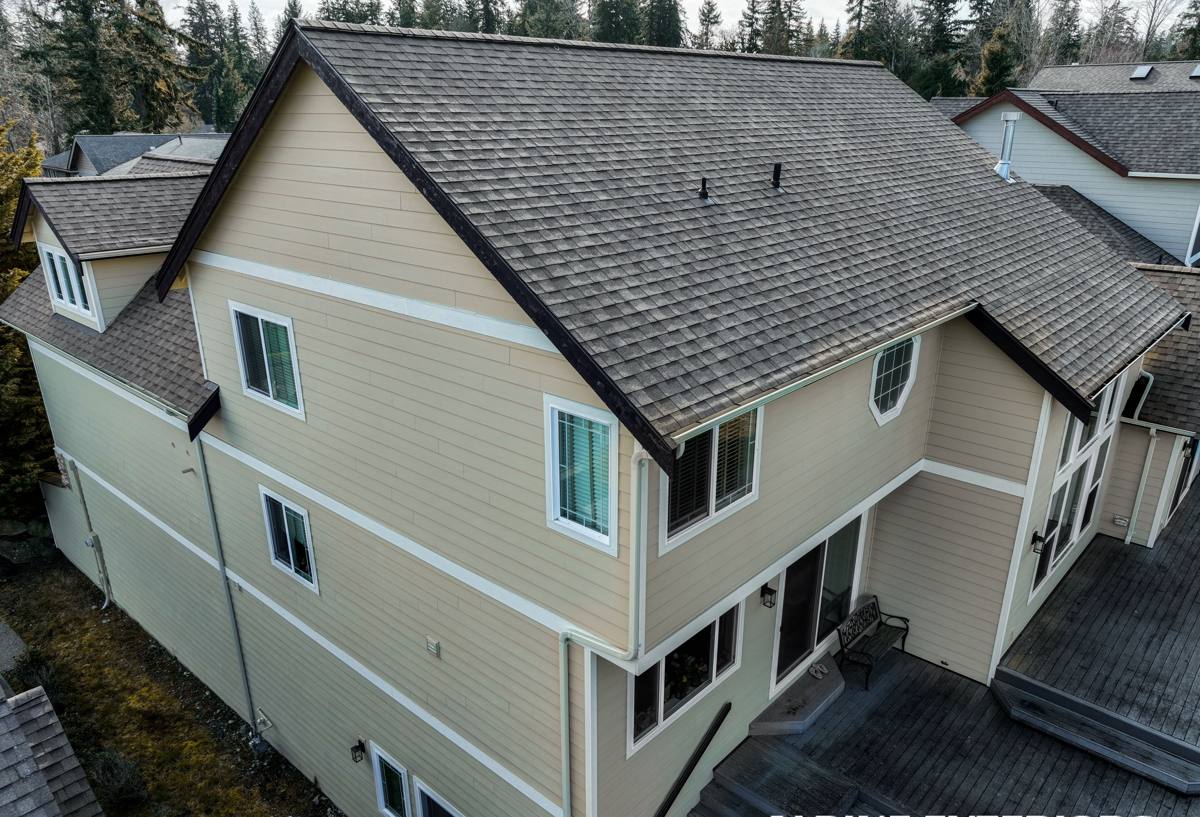
What Salt Air Actually Does to a Deck
Corrosion Starts Where You Can't See It
Salt in the air accelerates corrosion on any exposed metal — fasteners, joist hangers, post bases, and railing hardware. The visible parts of a deck can look fine while the fasteners holding it together are rusting from the inside of the wood. By the time a screw head is visibly bleeding rust through the decking, the corrosion has usually been working for a while.
Wind-Driven Rain Finds the Gaps
Driving rain off the bay doesn't just fall straight down — it comes in at an angle and gets pushed into joints, under flashing, and behind railing posts that would stay dry in a calmer inland setting. That means flashing details at the house ledger and around post connections need to be done correctly the first time, because a small gap that would be a non-issue elsewhere becomes a chronic leak point on a waterfront lot.
Choosing Decking Material for a Coastal Property
There's no single "right" decking material for every Birch Bay home — it depends on budget, how much upkeep you want to do, and how close the deck sits to open water versus being somewhat sheltered by trees or the house itself. Here's how the common options actually compare under coastal conditions:
| Material | Moisture & Salt Air Behavior | Moss/Algae Tendency | Maintenance | Typical Lifespan |
|---|---|---|---|---|
| Pressure-treated wood | Absorbs moisture readily; needs sealing to resist salt-driven checking and warping | Higher — porous surface holds moisture | Annual cleaning and re-sealing recommended | 10-15 years with upkeep |
| Cedar | Naturally rot-resistant but still needs finish maintenance near salt air | Moderate | Periodic cleaning and oil/stain | 15-20 years with upkeep |
| Capped composite | Doesn't absorb moisture or salt; dimensionally stable | Lower, but still needs periodic washing | Occasional washing, no sealing | 25-30 years, manufacturer-warrantied |
| PVC decking | Fully moisture-proof, unaffected by salt exposure | Lowest of the group | Occasional washing | 25-30+ years, manufacturer-warrantied |
We don't push one product on every job. Real wood still has a place when a homeowner wants that look and is willing to keep up with sealing on a coastal schedule rather than an inland one. Composite and PVC cost more up front but make sense on decks that get direct salt spray or heavy shade where wood would stay damp longer between dry spells.
Framing and Hardware: Where Coastal Decks Actually Fail First
Most deck failures we see near the water start in the framing and fasteners, not the decking boards themselves. This is the part of the job that doesn't show in a finished photo but determines whether the structure is sound in year three or year fifteen.
- Stainless steel or heavy hot-dip galvanized fasteners and hardware — standard electro-galvanized coatings wear through faster in salt air
- Joist hangers and post bases rated for the same corrosion resistance as the fasteners, not just the visible screws
- Ledger board flashing installed to shed water away from the house band joist, not just tucked behind siding
- Post bases set above grade and away from standing water or splashback
- Footings sized and set to the depth Whatcom County code requires for frost and soil conditions on the lot
It's tempting to save money on hardware since it's hidden once the deck is finished. On a Birch Bay lot, that's the one place we don't recommend cutting cost — mismatched hardware is the most common reason we get called out to look at a deck that's only a few years old and already has soft framing or rust staining bleeding through.
Managing Moss, Algae, and Standing Water
Whatcom County's wet season runs long, and a shaded or water-facing deck in Birch Bay can stay damp for weeks at a stretch. Moss and algae need exactly that — shade, moisture, and organic debris — and once established they hold water against the deck surface and make it slick underfoot.
Design Details That Reduce Moss
A correctly built deck sheds water instead of holding it. That comes down to a few things done right at construction: proper slope away from the house, consistent board spacing so water drains through rather than pooling on top, and enough clearance underneath for air to move instead of trapping ground moisture against the joists. None of these are things you can fix easily after the fact — they need to be right when the deck is built.
What You Can Control Afterward
Keeping gutters clear so runoff doesn't dump onto the deck, sweeping leaves and needles off the surface before they compost in place, and an occasional wash with a deck-safe cleaner go a long way toward keeping moss from getting a foothold in the first place.
Permits and Code Considerations Near the Water
Deck projects in unincorporated Whatcom County, including Birch Bay, typically require a building permit, and decks attached to the house or built above a certain height above grade generally need engineered footings and guardrails that meet current code. Properties close to the shoreline can also fall under additional shoreline-related review, depending on exactly where the lot sits relative to the water and any bluff or bank. We handle the permit application and inspection scheduling as part of the job so you're not the one figuring out which rules apply to your specific lot — but if your property is close enough to the water that shoreline setback rules might come into play, that's something we flag early, before design work goes too far down one path.
Our Process for a Birch Bay Deck Project
Every deck we build starts with an on-site visit rather than a phone estimate, because the exposure on a Birch Bay lot can vary a lot from one property to the next depending on how close you sit to the water and how much wind and rain the site actually takes.
- Site visit and assessment — we look at sun/shade, prevailing wind and rain exposure, existing drainage, and how the deck will tie into the house
- Design and material selection — we walk through the tradeoffs between wood and composite/PVC honestly, based on your budget and how much maintenance you want to take on
- Permit handling — we prepare and submit the permit application and coordinate required inspections
- Construction — corrosion-resistant fasteners and hardware throughout, correct ledger flashing, proper drainage slope and board spacing from the start
- Final walkthrough — we go over basic care so you know what to expect from the material you chose in this climate
Protecting Your Deck After It's Built
A well-built deck in Birch Bay still needs some seasonal attention — the difference is that a properly built one is far more forgiving if maintenance slips for a season here and there.
- Clear leaves, needles, and debris off the surface and out of gaps between boards regularly
- Keep nearby gutters and downspouts clear so runoff isn't draining onto the deck
- Wash the surface periodically to keep moss and algae from establishing, especially on shaded sections
- Re-seal or re-stain wood decking on a coastal schedule — check yearly rather than assuming it'll go two or three years like it might inland
- Watch for soft spots near posts and the ledger board, which are early signs of hidden moisture or hardware corrosion
- Have railings and structural connections checked periodically, since hardware failure isn't always visible from the top side
Why Local Experience in Birch Bay Matters
A contractor who mostly builds decks inland can still build you a deck — but they may not think to spec stainless hardware over standard galvanized, or to double-check drainage slope on a lot that takes direct wind off the water. Those aren't exotic details; they're just things that matter more here than they do a few miles inland, and they're easy to miss if you don't build in this specific area regularly. We work throughout Bellingham and Whatcom County, and Birch Bay's coastal exposure is part of what we plan around from the first site visit, not an afterthought.
If you're planning a new deck or replacing one that hasn't held up to the salt air and rain, we're happy to come take a look and give you a straightforward, no-pressure estimate — fill out the form below and we'll get in touch.