 Bellingham Exterior
 Why Blaine's Climate Is Hard on Siding
Blaine sits at the edge of Whatcom County, close to open water, which means homes here take on a combination of stresses that inland Bellingham neighborhoods see less of. Salt-laden air moves off the water and settles on exterior surfaces year-round. Driving rain, pushed sideways by wind off the water, gets forced into joints and laps that would stay dry on a calmer site. And the long gray stretch from fall through spring gives moss and algae months to establish themselves on any surface that stays damp. None of this is exotic — it's just Pacific Northwest coastal weather doing what it does, consistently, for decades. The siding on a Blaine home has to shrug off all three at once, every year, without a break.
This is the context we design every Blaine project around. It's not enough to install a product correctly on paper — it has to be installed correctly for this specific combination of salt exposure, wind-driven moisture, and moss pressure. That's the difference between siding that looks good for five years and siding that still looks good in twenty-five.
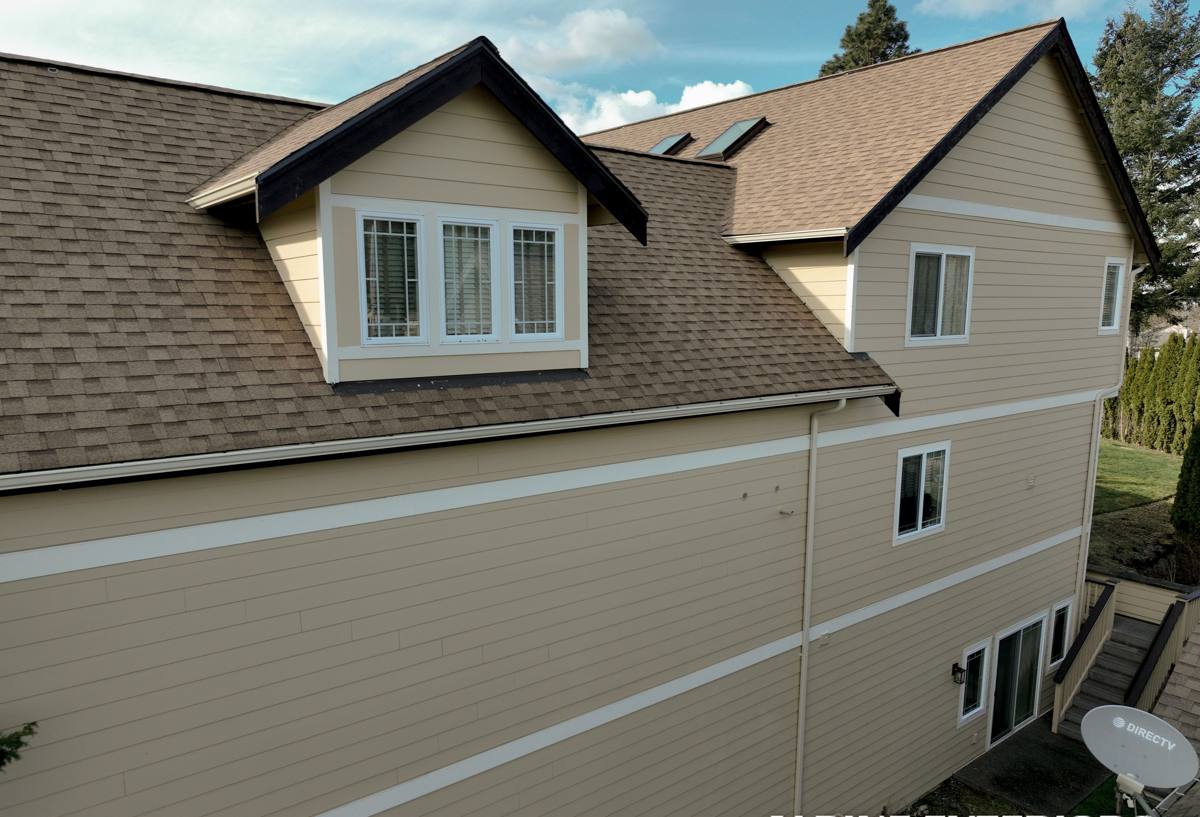
What Salt Air, Rain, and Moss Actually Do Over Time
Salt Air and Metal Components
Airborne salt accelerates corrosion on anything metal — fasteners, flashing, trim connectors. Standard hardware that would hold up fine forty miles inland can start showing rust streaks within a few years near the water. Once a fastener corrodes, it loses grip strength, and once flashing corrodes, it stops shedding water the way it's supposed to.
Driving Rain and Wind-Loaded Water
Rain that falls straight down mostly runs off a wall. Rain that's being pushed sideways by wind behaves differently — it finds its way under laps, around window trim, and into any gap that wasn't sealed or flashed with that wind direction in mind. Over time, water that gets behind siding rather than running down the face of it causes rot in the sheathing and framing underneath, which is a far more expensive problem than the siding itself.
Moss and Sustained Moisture
Moss and algae need moisture and shade to take hold, and Blaine's long wet season provides both. On siding, moss growth isn't just cosmetic — it holds water against the surface longer than it would otherwise sit there, which speeds up whatever damage the moisture would have caused on its own.
Why We Install Only James Hardie Fiber Cement
We standardized on James Hardie siding for every job we do, including here in Blaine, because it holds up to this exact combination of conditions better than the alternatives we used to install. Fiber cement doesn't rot, doesn't provide the same food source for moss and algae that wood-based products can, and isn't dimensionally reactive to moisture swings the way engineered wood siding is. It's also non-combustible, which matters anywhere in Washington given wildfire smoke and ember exposure in dry summer stretches.
We're not going to pretend every siding product on the market is interchangeable — vinyl, engineered wood, and fiber cement each behave differently in a coastal, high-moisture climate, and we made our call based on which one holds up with the least maintenance burden and the fewest moisture-related failure points over a 30-plus year service life. James Hardie is what we put on our own bids, and it's what we stand behind with our installation warranty.
Choosing the Right Hardie Product Line for a Blaine Home
James Hardie makes several distinct product lines, and picking the right one depends on the home's style, exposure, and the look the owner wants. For a house with direct water exposure or an unusually windy lot, we pay close attention to which HZ (HardieZone) engineering the product is rated for, since Hardie manufactures its boards to perform differently depending on regional climate.
| Product Line | Best For | Notes for Blaine Conditions |
|---|---|---|
| HardiePlank Lap Siding | Most single-family homes, classic or modern look | Most common choice; needs correct lap overlap and fastening for wind-driven rain |
| HardiePanel Vertical Siding | Modern facades, accent walls, gable ends | Requires careful joint treatment and battens to shed water properly |
| HardieShingle | Craftsman and cottage-style homes | More labor-intensive install; benefits from extra attention at butt joints in wet climates |
| HardieTrim | Window and door casings, corner boards | Pairs with any of the above; critical for sealing penetration points against driving rain |
All of these come with Hardie's factory-applied ColorPlus finish as an option, which is baked on and cured under controlled conditions rather than sprayed on-site. In a salt-air environment, that matters — a factory finish resists fading and holds its bond to the board better than field-applied paint, which means fewer repaint cycles over the life of the siding.
What Correct Installation Actually Requires Here
James Hardie siding performs the way it's designed to only when it's installed to spec — and in a wind-and-water-exposed area like Blaine, the margin for shortcuts is smaller than it is on a sheltered inland lot. A few specifics we treat as non-negotiable on every Blaine job:
- Corrosion-resistant fasteners. We use fasteners rated for the exposure level, not whatever is cheapest, because standard hardware corrodes faster this close to salt air.
- Correct clearances. Hardie specifies minimum clearance from grade, roofing, and decks so water can't wick into the bottom edge of the siding. We don't shortcut these numbers even when it would make a tricky elevation easier to finish.
- Weather-resistive barrier and flashing integration. The siding is the visible layer, but the water-resistive barrier and flashing behind it do the real work of keeping wind-driven rain out of the wall assembly. Every window, door, and penetration gets flashed to shed water outward, not just caulked over.
- Correct lap and joint spacing. Hardie's specs for minimum overlap and gapping exist specifically to handle wind-driven rain; tightening them up "for a cleaner look" defeats the purpose.
- Factory-cut edges sealed where required. Cut ends need to be treated per manufacturer spec so raw fiber cement edges aren't left absorbing moisture at joints.
None of this is unique to Blaine — it's the Hardie installation standard everywhere. What's different here is that skipping any one of these steps shows up faster, because the climate doesn't give a bad detail time to dry out between rain events.
Our Process for a Blaine Siding Project
We run every project the same disciplined way, adjusted for the specific house and lot:
- On-site assessment. We walk the exterior, check for existing moisture damage, moss buildup, and problem areas around windows, decks, and rooflines before quoting anything.
- Scope and product selection. We recommend the Hardie line and finish that fits the home's style and exposure, and explain why — no upselling for its own sake.
- Tear-off and sheathing check. Old siding comes off and we inspect the sheathing underneath for rot or hidden moisture damage before anything new goes up. This step matters more in a wet climate, since problems can be hiding behind siding that looks fine from the outside.
- Water-resistive barrier and flashing installation. This is the layer that actually keeps water out; we don't rush it.
- Hardie installation to manufacturer spec. Correct fasteners, clearances, laps, and joint treatment, as above.
- Final walkthrough. We go over the finished job with the homeowner and point out anything they should know about long-term care.
Cost Factors for a Blaine Hardie Siding Project
Every home is different, and we don't quote sight unseen, but the factors that move a Blaine project's cost up or down are fairly consistent:
| Factor | Why It Matters |
|---|---|
| Existing sheathing condition | Rot found during tear-off adds repair scope before new siding can go on |
| Home size and wall complexity | More corners, gables, and dormers mean more cutting, flashing, and labor time |
| Product line and finish choice | Shingle profiles and premium ColorPlus finishes cost more than standard lap siding |
| Trim and accent scope | Full HardieTrim packages around windows and corners add material and labor |
| Site exposure and access | Waterfront or wind-exposed elevations may need extra flashing detail and fastening care |
We'd rather walk a homeowner through these factors on-site than throw out a number that doesn't hold up once we're actually on the wall.
Living With Hardie Siding in a Salt Air, Moss-Prone Climate
One of the reasons we recommend Hardie for Blaine homes is how little upkeep it demands compared to wood-based siding, but "low maintenance" isn't "no maintenance." A simple annual routine keeps it performing and looking right:
- Rinse the exterior with a garden hose (not a pressure washer aimed directly at joints) once or twice a year to clear salt residue and organic buildup.
- Trim back vegetation and tree limbs that keep any section of wall shaded and damp longer than the rest of the house.
- Check caulking around windows, doors, and trim annually and have any cracked or separated beads redone before the wet season sets in.
- Look at ground-level clearance periodically — mulch, soil, or landscaping that creeps up over time can violate the siding's clearance from grade.
- Address any moss or algae growth early with a gentle wash rather than letting it sit against the surface for a full season.
Why Hiring a Crew That Already Works in Blaine Matters
A siding crew that mostly works dry, sheltered inland jobs doesn't build the same habits as one that installs against Whatcom County's coastal exposure regularly. Details like fastener selection, flashing sequencing at wind-exposed corners, and clearance discipline near grade are the kind of thing you only get consistently right when you've seen what happens when they're wrong on a house like this one. We work Bellingham and the surrounding communities, including Blaine, and we bring the same installation standard to every one of them — no adjusting the spec down to save time on a harder elevation.
If you're weighing a siding replacement or repair in Blaine, we're happy to take a look at your home, walk you through what we'd recommend and why, and give you a straightforward, no-pressure estimate. There's no cost to have us come out and tell you what we actually see.