 Bellingham Exterior
 Composite Decking Built for Blaine's Coastal Conditions
Blaine sits right on the water at the top of Whatcom County, close enough to Semiahmoo Bay and the Strait of Georgia that salt air is a daily fact of life, not an occasional nuisance. Add in Western Washington's long wet season and the moss that comes with it, and you've got a climate that is genuinely hard on exterior wood surfaces. A deck that looks fine in July can be graying, splintering, or growing a green film by the following spring if it wasn't built and finished with this specific environment in mind.
Composite decking has become the default recommendation for a lot of Blaine homeowners for good reason — it doesn't absorb moisture the way wood does, it doesn't need to be re-stained every year or two, and it resists the kind of surface decay that salt-laden air accelerates. But composite isn't magic, and not every composite installation is done the same way. The material choice matters, and so does the framing underneath it, the fastening method, and how the deck is detailed to shed water and air out properly. This page covers what a correctly built composite deck looks like for a Blaine property, and what we actually do differently because of where you live.
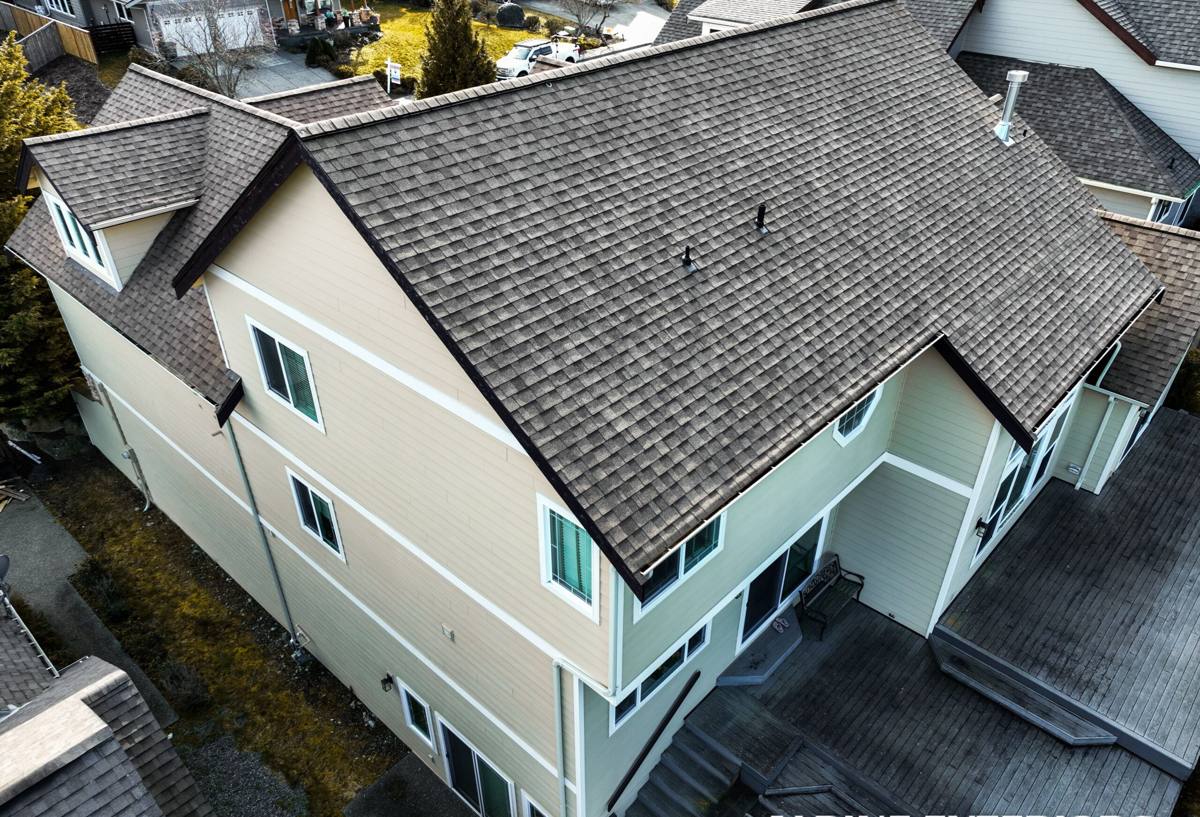
What Salt Air, Driving Rain, and Moss Actually Do to a Deck
It helps to understand the specific mechanisms at work, because they drive nearly every decision in a good deck build here.
Salt air
Airborne salt is corrosive to metal. Fasteners, joist hangers, brackets, and railing hardware that aren't rated for coastal exposure will rust and weaken years before they should, sometimes while the decking boards on top still look brand new. Corrosion at a hidden connection point is one of the more dangerous failure modes in decking because you often can't see it until it's advanced.
Driving rain
Storms off the water in this part of Whatcom County don't just fall straight down — wind-driven rain gets pushed sideways into ledger connections, fascia boards, and any gap where water can collect instead of drain. Standing water at a joist or a poorly flashed ledger is where rot starts, composite decking or not, because the structure underneath most decks is still dimensional lumber.
Moss and algae season
Western Washington's damp, low-light stretch of the year is long, and shaded or north-facing deck areas stay wet for days after a storm passes. That moisture supports moss and algae growth on any surface with texture for it to grip — including some composite boards, especially in the seams and grooves of lower-quality products.
Why Composite Makes Sense Here — and Where It Doesn't Solve Everything
Composite decking is a strong fit for this climate because the boards themselves don't rot, splinter, or need annual sealing. That said, composite decking is only as good as what it's fastened to and how it's detailed. It won't fix a poorly ventilated substructure, and cheaper uncapped composite can still absorb some moisture at cut ends and develop mold or discoloration over time. The table below is a practical comparison for Blaine conditions specifically.
| Material | Salt air resistance | Moss/algae resistance | Maintenance | Typical lifespan |
|---|---|---|---|---|
| Pressure-treated wood | Fair — hardware is the weak point | Poor without regular cleaning/sealing | Annual staining/sealing recommended | 10–15 years |
| Cedar | Good, but needs upkeep | Fair — needs periodic treatment | Regular sealing to prevent graying/cupping | 15–20 years |
| Uncapped composite | Good | Fair — some absorption at cut edges | Periodic washing | 20–25 years |
| Capped composite (fully wrapped boards) | Very good | Good — sealed surface sheds algae growth | Occasional washing | 25–30+ years |
We generally steer Blaine clients toward fully capped composite boards over uncapped composite. The trade-off is a slightly higher material cost, but the sealed surface handles this specific climate — salt, standing moisture, and shaded moss growth — noticeably better over the life of the deck. It's not that uncapped composite is a bad product; it's that the extra protection earns its keep faster here than it does in a drier inland climate.
What a Correctly Built Composite Deck Involves
The decking boards get the attention, but most of what determines whether a deck lasts 10 years or 30 happens underneath and around them.
Framing and fasteners
In a coastal-influenced area like Blaine, we use corrosion-resistant fasteners and connectors rated for the exposure — not just standard hot-dipped galvanized hardware, which can start showing pitting sooner than it should this close to salt air. Joist spacing also needs to match the specific composite board being installed; composite has different span and deflection characteristics than wood, and manufacturers publish spacing requirements that shouldn't be shortcut.
Ledger attachment and flashing
Where the deck attaches to the house is the single most common point of hidden water damage. Proper flashing — installed so water is directed out and away from the ledger board and the home's wall assembly, not trapped behind it — is non-negotiable in a climate with this much wind-driven rain.
Ventilation and drainage underneath
A deck built low to grade or against a slope needs a way for air to move and water to drain underneath it. Without that, the substructure stays damp long after storms pass, which is exactly the condition that shortens the life of joists and hardware, and encourages moss to creep up from below.
Board fastening and gapping
Composite boards expand and contract with temperature more than people expect, and correct gapping at the ends and between boards prevents buckling or excessive gaps opening up later. Hidden fastener systems, when compatible with the board profile, also reduce the surface penetrations where moisture and grime can collect.
Our Process for a Blaine Deck Project
- On-site assessment — we look at sun/shade exposure, drainage, existing structure (if replacing decking on an existing frame), and how exposed the site is to prevailing wind and rain.
- Material selection — we walk through composite board options and hardware grade based on that specific site's exposure, not a one-size-fits-all spec.
- Framing and structural work — repair or build the substructure to current span and fastening standards, with corrosion-resistant hardware throughout.
- Flashing and waterproofing details — ledger flashing, proper drainage paths, and attention to any point where the deck meets the house or ground.
- Decking installation — boards installed to manufacturer spacing and gapping specs, with clean, consistent fastening.
- Final walkthrough — we go over basic care specific to composite decking in this climate before we consider the job done.
Maintaining a Composite Deck in Blaine's Climate
Composite decking is genuinely low-maintenance compared to wood, but "low-maintenance" isn't "no-maintenance" in a place with this much moisture and this long a moss season.
- Sweep or rinse debris off the deck regularly, especially in shaded areas where leaves and organic matter hold moisture against the boards
- Wash the surface a couple of times a year with a mild soap and water or a manufacturer-approved cleaner — this is usually enough to prevent moss and algae from getting a foothold
- Avoid pressure washing at close range or high PSI, which can damage the cap layer on composite boards
- Check railing hardware and any exposed metal connections periodically for early signs of corrosion, especially if the deck faces open water or prevailing wind
- Keep gutters and downspouts near the deck clear so runoff isn't dumping extra water onto or under the deck surface
- Trim back vegetation that's shading the deck and keeping it damp longer than it needs to be
What Affects the Cost of a Composite Deck Project
Every deck is different, but these are the factors that most often move the price up or down for a Blaine project.
| Factor | Why it matters |
|---|---|
| Deck size and shape | Square footage and the number of angles, steps, or level changes affect labor and material |
| Board tier (uncapped vs. fully capped composite) | Capped boards cost more upfront but hold up better against salt air and moisture here |
| Substructure condition | Replacing decking on a sound existing frame costs far less than a full rebuild |
| Height and railing requirements | Taller decks or code-required railings add material and labor |
| Site access and exposure | Waterfront or exposed sites may need upgraded hardware and flashing detail |
Why a Crew That Already Works in Blaine Matters
A lot of decking problems we get called out to fix weren't caused by bad materials — they were caused by a build that didn't account for the specific conditions of a Whatcom County coastal property. Standard hardware specs, standard flashing details, and standard maintenance advice are written for an average climate, and Blaine isn't average. A contractor who already builds and repairs decks in this area knows which corners get hit hardest by wind-driven rain, which shaded spots turn into moss traps by November, and which fastener grade actually holds up a block from the water instead of just meeting a generic code minimum.
That local knowledge shows up in decisions you won't necessarily see on the surface — the hardware spec, the flashing detail, the board tier recommendation — but it's exactly what determines whether the deck still looks and performs well in year fifteen.
If you're weighing composite decking for a home in Blaine, we're happy to take a look at your site, talk through material options honestly, and put together a straightforward estimate — no pressure, no upsell. Use the form below to get started.