 Bellingham Exterior
 Fiber Cement Siding, Installed for Blaine's Coastal Exposure
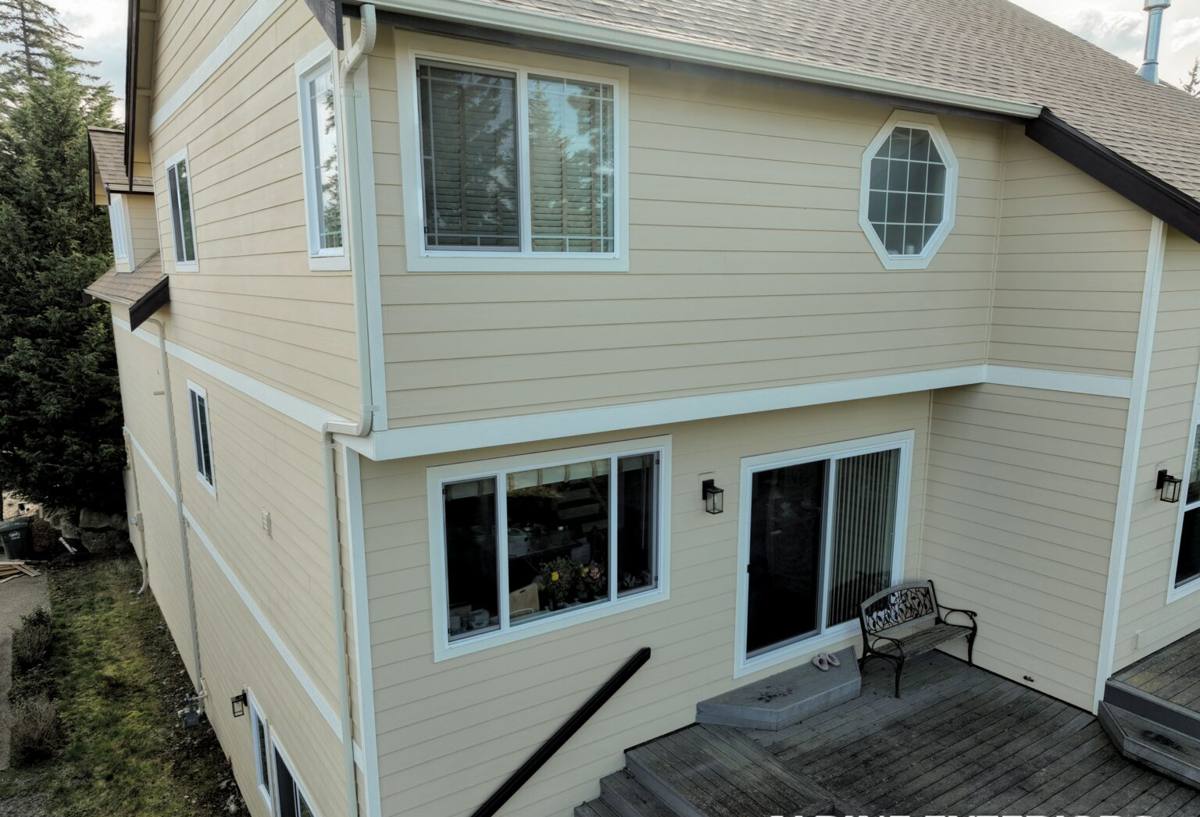
Blaine sits at the northern edge of Whatcom County, close to Semiahmoo Bay and Drayton Harbor, in a spot where salt-laden air off the water is a daily fact of life rather than an occasional nuisance. That location changes what a siding job actually needs to hold up. A product and installation approach that works fine forty miles inland can fall short here, and we've built our siding work around that difference rather than around a one-size-fits-all install. This page is specifically about fiber cement siding for Blaine homes: what the local climate demands from it, what a correct installation actually involves, and how our process works from first look to finished wall.
We install James Hardie fiber cement siding exclusively. We don't offer LP SmartSide, vinyl, Cemplank, Allura, primed spruce, or cedar as alternatives. That's a professional standard built around what we've seen hold up in coastal Whatcom County conditions, not a default we fell into. Later on this page we get into why, but the short version is that a house standing this close to the water doesn't have much margin for a siding system that depends on perfect long-term maintenance to keep water out.
What Blaine's Climate Asks of a Siding System
Salt Air Off the Water
Sustained salt exposure does two things to a house exterior: it accelerates corrosion on fasteners, flashing, and any exposed metal trim, and it breaks down lower-grade paints and coatings faster than drier, inland conditions would. A siding job in Blaine has to account for that from the start, in the hardware spec and the finish, not just the panel itself. Cutting a corner on fastener grade or trim material shows up sooner here than it would in a more sheltered town.
Driving, Wind-Pushed Rain
Storms coming off the water don't arrive as simple straight-down rainfall. Wind drives it sideways into wall assemblies, window flashing, and every seam in the siding system. That sideways load puts more stress on joints, laps, and penetrations than the same total rainfall would in a calm climate, and it's exactly the kind of moisture that exploits any gap a rushed installation leaves behind. A siding system installed for Blaine has to assume water will be pushed at the wall, not just fall on it.
A Moss Season That Runs Most of the Year
Mild temperatures paired with near-constant moisture give moss and mildew a long growing window on shaded and north-facing walls, sometimes most of the calendar year. Any siding surface that stays damp longest becomes the first place growth takes hold, and material choice affects how much that growth actually threatens the wall behind it versus just needing a wash.
Why Fiber Cement Holds Up Where Other Materials Struggle
Fiber cement's core is cement, sand, and cellulose fiber — an inorganic mix that doesn't absorb and swell with water the way wood-based siding products can. That matters directly in a place like Blaine, where the siding is dealing with salt air, wind-driven rain, and prolonged dampness in the same year. A few specifics behind our standardizing on James Hardie:
- Non-combustible core: fiber cement doesn't feed a fire the way wood-based siding can, a real factor for both safety and insurance considerations.
- Factory-applied ColorPlus finish: baked on under controlled conditions rather than brushed on site, so it resists fading and moisture damage longer than field-applied paint.
- Climate-engineered HZ5 formulation: built for regions with sustained moisture and freeze-thaw cycling, which describes coastal Whatcom County closely.
- Dimensional stability: it doesn't cup, swell, or warp under repeated wet-weather exposure the way engineered wood products can.
- Strong transferable warranty: backed by one of the stronger warranty structures in the industry, provided the installation follows Hardie's spec.
None of that means other products are worthless — plenty of homeowners are satisfied with vinyl or engineered wood siding elsewhere. It means that for a town with Blaine's salt exposure and rain pattern, we'd rather install one system we fully stand behind than offer something cheaper that quietly shifts maintenance risk onto the homeowner a few years down the road.
What a Correct Installation Involves
Fiber cement performs the way it's engineered to only when it's installed to spec, and in a coastal town like Blaine the details matter more than they would somewhere drier. The basics we won't shortcut:
Drainage and Moisture Management
A rain screen gap behind the siding gives any moisture that gets past the exterior surface a path to drain and evaporate instead of sitting against the wall sheathing. Properly lapped house wrap and flashing at every seam and penetration direct water down and out, which matters most on walls that take wind-driven rain directly off the water.
Fasteners and Joints
Hardie specifies fastener type and spacing for a reason — corrosion-resistant fasteners placed correctly are one of the more overlooked factors in how long a siding job lasts near salt air. Butt joints and trim transitions need to be sealed properly, since open or poorly sealed joints are typically where salt-laden moisture finds its way behind the siding first.
Trim and Transition Details
Windows, corners, and roof-to-wall transitions are where most siding failures actually start, not in the middle of a flat wall. Getting flashing integrated correctly at these transitions takes more time than a quick caulk-and-cover approach, but it's the difference between a wall that sheds water for decades and one that starts showing staining or soft spots within a few wet seasons.
How Our Process Works
- Walk-through and assessment: we look at the existing siding, substrate condition, trim, and any signs of moisture that's already gotten behind the wall — not just a driveway estimate.
- Scope and product plan: we lay out which Hardie profile and color fit the home, whether it's a tear-off or requires substrate repair first, and what the trim and flashing plan looks like.
- Written estimate: a clear scope and price before any work starts, so there's no ambiguity about what's included.
- Installation: tear-off (or overlay prep where appropriate), house wrap and flashing, rain screen, fiber cement panels, and trim, installed to Hardie's spec rather than a shortcut version of it.
- Final walk-through: we go over the finished job with the homeowner before calling it done, not after.
Cost Factors for Fiber Cement Siding in Blaine
| Factor | What Drives It | Blaine-Specific Consideration |
|---|---|---|
| Home size and complexity | Square footage, number of stories, roofline and trim detail | More trim transitions mean more flashing work near a wet, windy climate |
| Tear-off vs. overlay | Whether old siding and substrate need full removal | Substrate repair is common if moisture has already gotten behind older siding |
| Fastener and hardware grade | Corrosion-resistant fastener and trim hardware selection | Worth prioritizing this close to salt air off the water |
| Access and site conditions | Lot grading, landscaping, staging space | Wind exposure on open, waterside lots can affect scheduling |
These are general drivers, not a quote — every Blaine home sits at a slightly different distance from the water and under different tree cover, so we walk the property before putting a real number on the job. Two houses on the same block can need very different scopes once old siding actually comes off.
Signs Your Blaine Home's Siding Needs Attention
- Moss or dark staining that returns quickly after cleaning, especially on shaded or north-facing walls
- Soft or spongy siding, particularly low on the wall or around window and door trim
- Rust staining or visibly corroded fasteners and trim hardware
- Peeling paint, chalking, or fading finish that's worse than it should be for the siding's age
- Gaps, cracked caulk, or separation at butt joints and trim transitions
- Visible warping, cupping, or bulging panels
Why a Crew That Already Works Blaine Matters
Any siding crew can read a spec sheet. What's harder to fake is knowing, from repeated jobs in the same town, which walls in Blaine stay wet the longest, which trim details tend to fail first on homes exposed directly to the water, and where extra flashing attention actually pays off versus where it's overkill. We're based in Bellingham and work Whatcom County regularly, and Blaine's coastal exposure — the salt air, the wind-driven rain, the long moss season — is territory we already know rather than a climate we're guessing about from a manual. That local pattern recognition shapes real decisions on install day, not just talking points in an estimate.
Get a Free, No-Pressure Estimate
If your Blaine home needs new siding or you're trying to figure out whether what's on the walls now still has years left in it, we're glad to take a look and give you a straightforward assessment. Reach out using the form below to schedule a free, no-pressure estimate.