 Bellingham Exterior
 Decking in Cordata Has to Answer to the Weather First
Cordata sits far enough inland to avoid the worst of the direct salt spray that coastal Bellingham neighborhoods deal with, but it still gets the same wet marine air, the same long stretch of gray drizzle from October through April, and the same moss pressure that shows up on every shaded, north-facing surface in Whatcom County. A deck here doesn't fail because of one bad storm. It fails slowly, from months of standing moisture, shaded boards that never fully dry out, and fasteners or framing that were never rated for this kind of exposure in the first place.
Composite decking exists specifically to take that slow failure mode off the table. But "composite" isn't one product with one behavior — it's a category that ranges from basic capped-composite boards to premium PVC-based systems, and the difference matters a lot more in a climate like ours than it would in a dry inland state. What we install, and how we build the structure underneath it, is shaped by what actually happens to decks in this part of Washington.
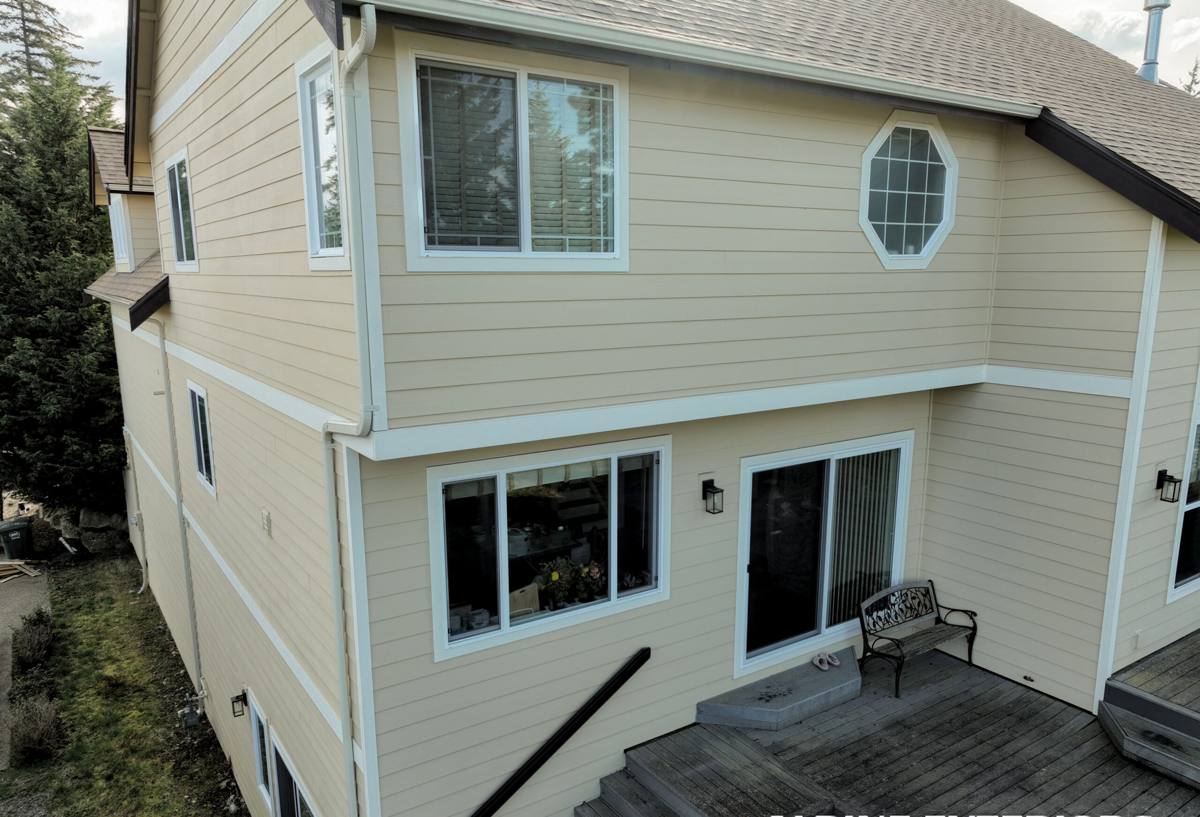
What Cordata's Climate Actually Does to a Deck
Driving rain and standing moisture
Whatcom County doesn't get short, heavy downpours as much as it gets long, low-intensity rain that blows in at an angle. That means water finds its way under railings, into end-grain cuts, and along ledger boards in ways a lot of decking systems weren't designed to handle. Composite boards themselves resist water absorption far better than wood, but the deck is only as good as its drainage — water still has to go somewhere.
Salt air and moisture-laden wind
Even inland from Bellingham Bay, the air carries enough moisture and salt to accelerate corrosion on fasteners, brackets, and any exposed metal hardware. Over a few seasons, that's what causes squeaks, rust streaks, and loosening connections — usually well before the decking surface itself shows any wear.
Moss and algae season
Shaded decks under mature trees, or on the north side of a house, stay damp for weeks at a stretch during our wet season. That's exactly the environment moss and algae need. On wood, this means soft spots and slow rot. On lower-grade composite, it can mean a slick, green film on the board surface if the capping and texture aren't built to shed it.
What a Correctly Built Composite Deck Includes
A composite deck that's actually built for Cordata's conditions is more than swapping wood boards for composite ones on the same old frame. The parts that matter most are usually the parts you don't see once the project is done.
- A framing and substructure rated for sustained moisture exposure, not just treated lumber assumed to be "good enough"
- Proper joist spacing for the specific composite board being used — composite has different span ratings than wood, and manufacturers are specific about this for a reason
- Flashing and ledger board waterproofing where the deck meets the house, since this is the single most common source of hidden rot on any Bellingham-area deck
- Fastener systems (hidden clips, coated screws, or brand-matched hardware) rated for coastal or high-moisture exposure
- Airflow underneath the deck so boards can actually dry between rain events instead of sitting damp for days
- Drainage planning so water sheds away from the house foundation, not toward it
Skip any one of these and you can end up with a deck that looks right for a year or two, then develops problems that trace straight back to the framing or fastening — not the decking material itself.
Composite vs. Wood vs. PVC: How They Actually Hold Up Here
| Factor | Pressure-Treated Wood | Capped Composite | PVC / High-End Composite |
|---|---|---|---|
| Moisture absorption | High — swells, cups, and checks over time | Low — resists water intrusion at the cap layer | Very low — largely non-porous |
| Moss and algae resistance | Poor in shaded, damp spots | Good with textured/capped surfaces | Very good |
| Upkeep in our climate | Annual sealing/staining, regular moss treatment | Periodic washing, minimal sealing needed | Occasional washing only |
| Typical lifespan here | 10–15 years before major repair/replacement | 20–25+ years | 25–30+ years |
| Upfront cost | Lowest | Mid-range | Highest |
Wood isn't a bad material everywhere — it just requires a maintenance commitment that a lot of homeowners underestimate once they're dealing with Bellingham's rain schedule. Composite shifts that burden from "you maintain it every year" to "the material handles it for you," which is the main reason it's become the default choice for decks in wetter parts of Whatcom County.
Our Installation Process for Cordata Homes
1. Site and structure assessment
We start by looking at drainage patterns around the deck footprint, shade exposure, existing framing condition (if this is a replacement), and how the deck ties into the house. This is where we catch problems — like a ledger board that's already been taking on water — before they get built over.
2. Framing and substructure work
Any framing that's compromised gets replaced, not patched around. We build to the span and fastening specs for the actual composite product going down, since undersized joist spacing is one of the more common shortcuts that shows up as bounce or sag a few years later.
3. Waterproofing and flashing
Ledger boards, posts, and any point where the deck meets siding or foundation get proper flashing and membrane protection. This is the step that determines whether water gets managed or just gets hidden.
4. Decking installation
Boards go down with hidden fastener systems where the product supports it, maintaining proper gapping for expansion and drainage — composite moves with temperature more than people expect, and gapping it wrong causes buckling.
5. Railing, stairs, and finishing details
Railing hardware and stair stringers get the same coastal-grade fastener treatment as the deck itself, since these are common weak points that get overlooked.
6. Final walkthrough
We go over drainage, any maintenance the specific product requires, and what to watch for during the first wet season.
Drainage and Airflow: The Details That Prevent Callbacks
Most of the composite deck problems we get called out to look at in Bellingham-area neighborhoods trace back to two things: water that had nowhere to go, and framing that never got a chance to dry out between storms. Composite decking doesn't rot the way wood does, but the framing underneath it usually still involves wood, and that structure needs airflow just as much as an all-wood deck does.
For Cordata specifically, that means paying attention to where the deck sits relative to the house — decks tucked close to grade or under overhangs with limited sun exposure need more deliberate ventilation gaps and drainage slope than a deck that gets full sun and open air most of the day. It's a detail that's easy to skip and expensive to fix later, since it usually means pulling up decking to get at the framing.
Maintenance: What Composite Actually Needs (and Doesn't)
One of the real selling points of composite is how little it asks of you compared to wood — but "low maintenance" isn't "no maintenance," especially in a climate that grows moss on almost anything left damp and shaded.
- Rinse or sweep off debris and standing leaves regularly during fall — trapped organic matter is what feeds moss growth
- Wash the deck surface once or twice a year with a mild cleaner and soft brush, especially in shaded sections
- Check railing and stair hardware annually for corrosion, particularly on decks with more direct wind or moisture exposure
- Keep gutters and downspouts near the deck clear so water isn't dumping directly onto or under it
- Avoid pressure-washing at close range or high pressure, which can damage the cap layer on some composite products
- Trim back vegetation that shades the deck surface for long stretches of the day, if moss has been a recurring issue
Why Hiring a Crew That Already Works Cordata Matters
Decking specs written for a national audience assume average conditions — they don't account for a neighborhood that sits under Bellingham's rain patterns for eight months a year, or for how shade and drainage vary block by block. A crew that's already built and repaired decks in this area knows which framing shortcuts cause problems here specifically, which fastener grades actually hold up against our air and moisture, and how to plan drainage around a lot that doesn't drain as well as it looks like it should on a dry day.
That local pattern-recognition is the difference between a deck that's built to a spec sheet and one that's built for what Cordata actually throws at it year after year.
If you're planning a new composite deck or replacing one that's showing its age, we're happy to come take a look and talk through what your specific site needs — no pressure, no obligation. Request a free estimate below and we'll walk the property with you.