 Bellingham Exterior
 Why Siding Repair in Lynden Takes a Different Approach
Lynden sits inside the same marine-influenced weather system that soaks the rest of Whatcom County — long stretches of driving rain off the Pacific, damp shoulder seasons that stretch into a genuine moss and algae season, and salt-tinged air that drifts in off Bellingham Bay and works its way inland on the prevailing winds. None of that is dramatic on any single day. It's the accumulation that causes problems: siding that stays wet longer than it should, fasteners that corrode a little faster, caulking that dries out and cracks a season or two before you'd expect. A repair that ignores those conditions and just patches the visible damage tends to fail again within a couple of years. A repair that accounts for them holds up.
We've done enough siding work around Lynden and the rest of Whatcom County to know that "siding repair" covers a wide range of actual problems — from a single storm-damaged panel to slow moisture intrusion that's been building behind the wall for years. The right fix depends entirely on which one you're actually dealing with, which is why diagnosis matters as much as the repair itself.
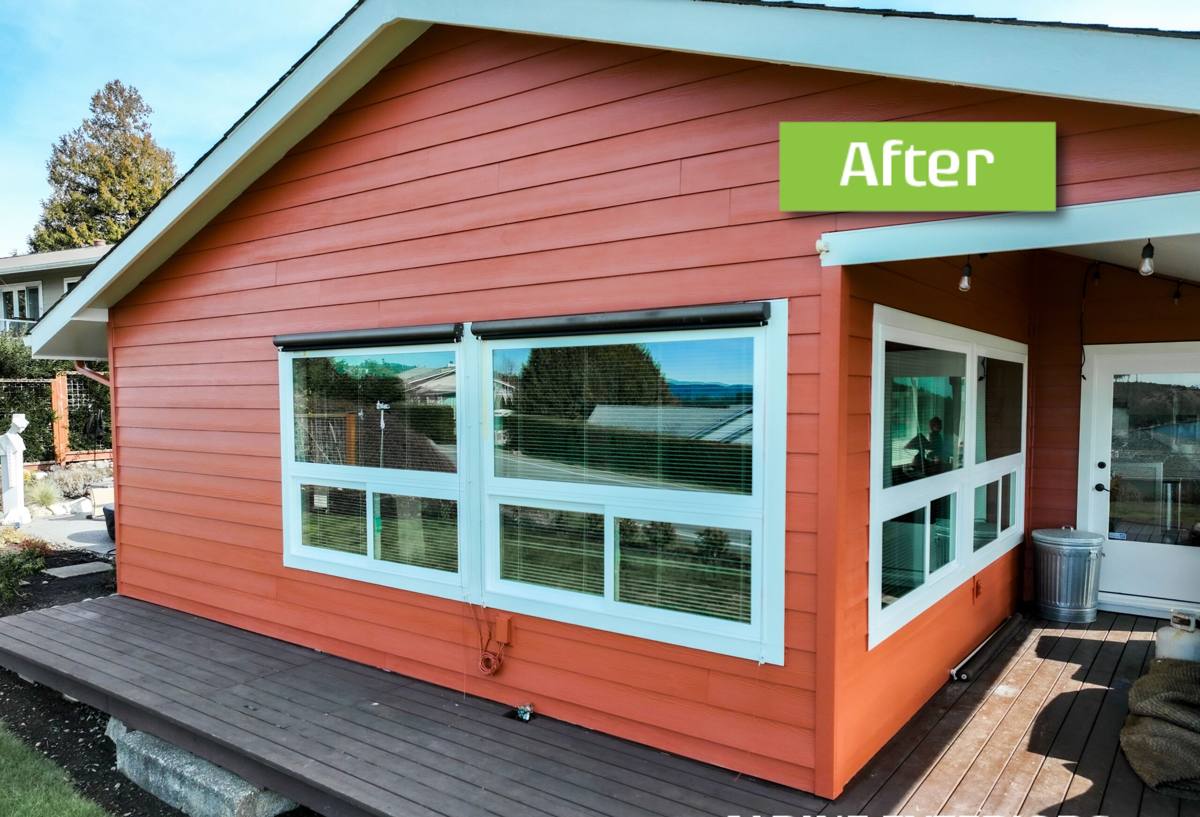
Common Siding Repair Issues We See on Lynden Homes
Moss, Algae, and Chronic Surface Staining
Shaded walls, north-facing exposures, and anywhere airflow is blocked by fences, landscaping, or close-set structures tend to stay damp longest. Over a few wet seasons that turns into green-black staining and, on porous or damaged siding, actual moss growth that holds moisture against the surface. Surface staining is cosmetic. Moss that's been left to grow for a while can be a sign the siding underneath has softened or started to absorb water — that's a repair issue, not just a cleaning issue.
Cracked, Warped, or Separated Panels
Wind-driven rain finds every gap. Panels that have swollen, cupped, or pulled away from the wall are usually reacting to moisture they were never designed to handle — wrong fastener pattern, missing or failed caulk joints, or a water-management detail that wasn't done correctly during the original install. Cracking is more often physical: impact damage, age-related brittleness in some material types, or panels that were never properly gapped for expansion and contraction.
Rot and Soft Spots at Trim, Corners, and Bottom Edges
The lowest courses of siding, window and door trim, and outside corners take the brunt of splash-back and standing moisture. On wood-based products these are the first places rot shows up. Even on more moisture-resistant materials, poor flashing or caulking at these transitions is the single most common cause of hidden water damage.
Caulk and Sealant Failure
Sealant is a wear item, not a permanent fix. In this climate it typically needs attention well before most homeowners expect. Cracked, shrunk, or missing caulk at joints and penetrations is one of the most common reasons water gets behind siding that otherwise looks fine from the ground.
What a Correct Siding Repair Actually Involves
A repair that's done right isn't just about matching color and fastening a new piece over the old one. It involves:
- Pulling back enough surrounding material to see what's actually happening underneath — sheathing condition, house wrap or building paper integrity, and whether water has already traveled beyond the visible damage
- Confirming the water-management details (flashing, kick-out flashing at roof-wall intersections, weep paths) are correct before anything new goes back on, since re-covering a bad detail just delays the next failure
- Matching material type, profile, and reveal so the repair doesn't stand out or create a mismatched expansion joint
- Using fasteners and sealants rated for the specific product and correctly spaced per manufacturer specs, not just "close enough"
- Repainting or color-matching so the finished patch blends rather than becoming a visible patchwork years later
Skipping the first two steps is the most common shortcut in this trade, and it's the reason so many "repairs" need to be redone. If the sheathing behind a damaged panel is already compromised, replacing the panel without addressing what's underneath just buys a year or two before the same spot fails again.
Repair or Replace? How We Actually Make That Call
Not every damaged area needs a full re-side, and not every homeowner needs to hear that a full re-side is the answer. The honest answer depends on a few concrete factors:
| Factor | Leans Toward Repair | Leans Toward Replacement |
|---|---|---|
| Extent of damage | Isolated panels or a single wall section | Damage spread across multiple elevations |
| Underlying sheathing/wrap | Dry, intact once opened up | Soft, stained, or showing rot |
| Siding age and condition | Mid-life, otherwise sound | Near or past expected service life |
| Material availability | Matching product/profile still made | Discontinued line, no clean match |
| Root cause | Isolated event (impact, one bad flashing detail) | Systemic issue affecting most of the house |
When a wall has been failing for years — not from one bad flashing detail but from the material itself struggling with sustained moisture exposure — patching it is a short-term answer to a long-term problem. In those cases we'll tell you that directly, along with what a targeted replacement of just that section or elevation would look like, rather than pushing a full re-side you don't need.
Why We Repair and Recommend James Hardie Fiber Cement
We install James Hardie fiber cement exclusively — we don't install vinyl, LP SmartSide, Cemplank, Allura, or bare cedar or primed spruce. When it comes to repair work, that has practical implications worth being upfront about.
We can and do repair whatever siding is already on your Lynden home, matching material and technique to what's there. But if a wall is failing repeatedly — moisture intrusion, recurring rot at trim, panels that keep cupping or separating — and the underlying product is a wood-based or engineered-wood system, we'll tell you honestly that repeated spot repairs are treating a symptom. Those materials can perform well for years, but once moisture gets a foothold, they're working against their nature in a climate like this one. Vinyl has the opposite problem: it rarely rots, but it cracks and fades with age and UV exposure and can't really be color-matched or patched invisibly once it's a few years old.
Hardie fiber cement is non-combustible, dimensionally stable, and doesn't absorb and swell the way wood-based products can. Its ColorPlus factory finish resists fading in the UV and moisture cycle this region gets, which matters for patch work specifically — a factory-finished replacement panel matches far more reliably over time than field-painted repairs on other materials. When a repair on non-Hardie siding turns into "this needs to happen again in three years," replacing that section or elevation with Hardie is usually the more honest long-term answer, and it's what we'll recommend rather than selling you another short-term patch.
Our Repair Process
- On-site assessment. We look at the visible damage and open up enough surrounding material to see what's happening behind it — no assumptions.
- Straightforward estimate. You get a clear breakdown of what's actually needed, including whether we think repair or a targeted replacement makes more sense, and why.
- Scheduling around the weather. Given how much of the year is wet here, we plan repair work for dry windows and use appropriate weather protection when a job has to proceed around less predictable conditions.
- Correct execution. Water-management details get fixed first, then matched material goes back on with proper fastening and sealant.
- Finish and cleanup. Color-matched finish work and a clean site when we're done — no debris left behind.
Why Hiring a Crew That Already Works in Lynden Matters
Siding repair is deceptively local. A crew that mostly works in drier climates or unfamiliar with Whatcom County's building patterns can miss the moisture-driven failure points that show up here specifically — the shaded, slow-drying walls, the trim details that take the brunt of driving rain, the moss and algae growth that signals a bigger problem underneath. Working regularly in Lynden and the surrounding area also means knowing which siding products and profiles are common on homes here, so a repair can be matched correctly instead of guessed at.
It also means realistic scheduling. We know what the wet season does to a repair timeline here, and we plan around it instead of promising a start date that weather is likely to blow up.
Signs Your Lynden Home May Need Siding Repair
- Green or black staining that keeps returning after cleaning
- Panels that look warped, cupped, or are visibly pulling away from the wall
- Cracked, missing, or brittle caulk at joints, corners, and trim
- Soft spots you can press with a thumb near the bottom edges or around windows and doors
- Peeling or bubbling paint concentrated in one area rather than across the whole house
- Musty smell or visible staining on an interior wall that backs up to an exterior wall
- Fasteners that are rusting, backing out, or leaving streaks below them
After the Repair: Keeping It From Happening Again
A good repair holds up longer with basic upkeep. In this climate that mostly means staying ahead of moisture and growth rather than reacting to damage after the fact — rinsing off moss and algae buildup before it takes hold, keeping gutters and downspouts clear so water isn't dumping against a wall, keeping landscaping trimmed back enough for the siding to actually dry between rain events, and doing a quick visual check each fall before the wet season sets in. None of it is complicated, but skipping it is how a small, cheap fix turns into a bigger one.
If you're seeing any of the warning signs above, or you just want an honest read on whether your siding needs a patch, a section replaced, or nothing at all, we're glad to take a look. Reach out for a free, no-pressure estimate — the form below gets you started.